Most puff stitch tutorials teach the hook moves and skip the one measurement that decides everything. A puff that collapses was pulled up too short. Fix the loop height and the stitch mostly fixes itself.
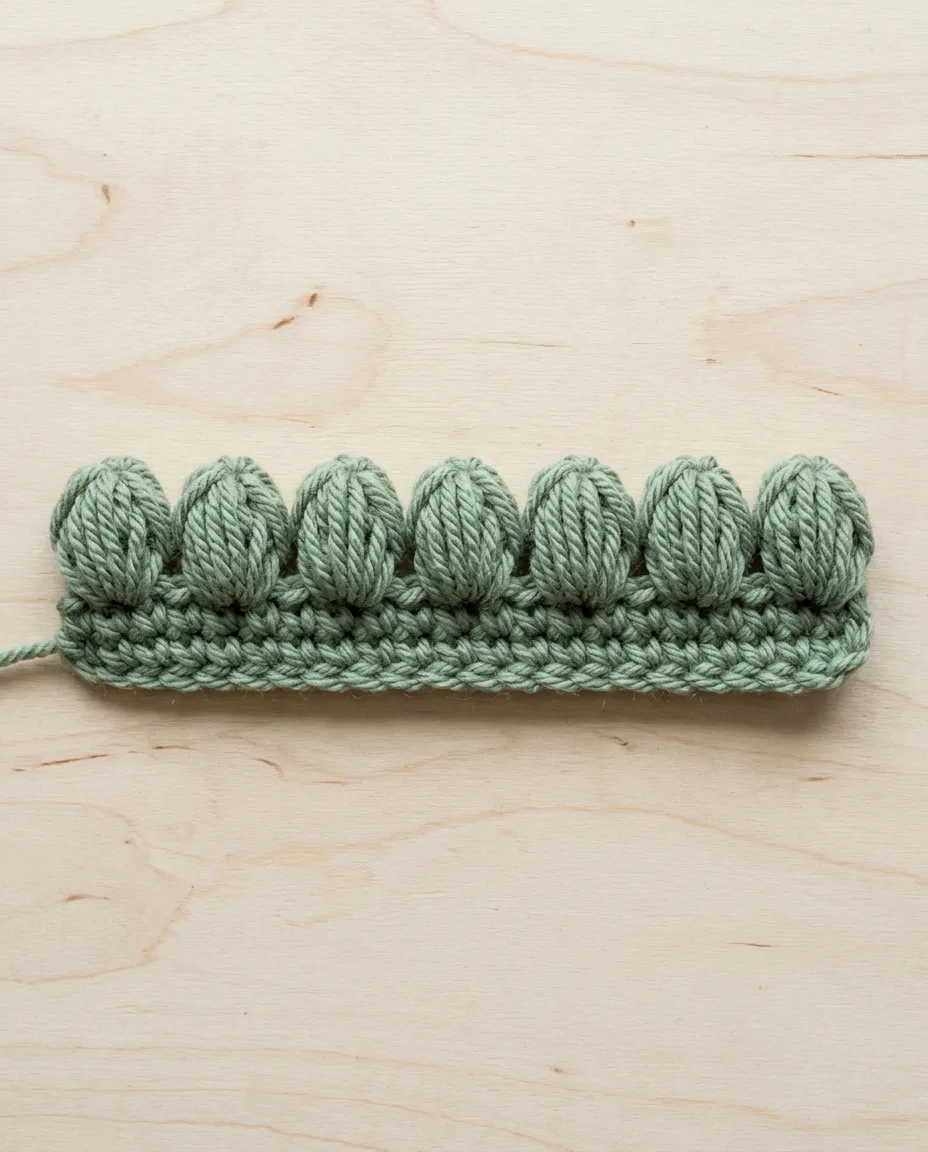
The puff stitch (puff st) is a bundle of tall loops drawn up through one stitch and closed together at the top. Worked right, each puff sits on the fabric like a small pillow, about as wide as it is tall. Worked wrong, it flattens into a loose knot with a gap on either side. Three habits separate the two, and all of them can be learned on a swatch, a small square of fabric made only to test a stitch.
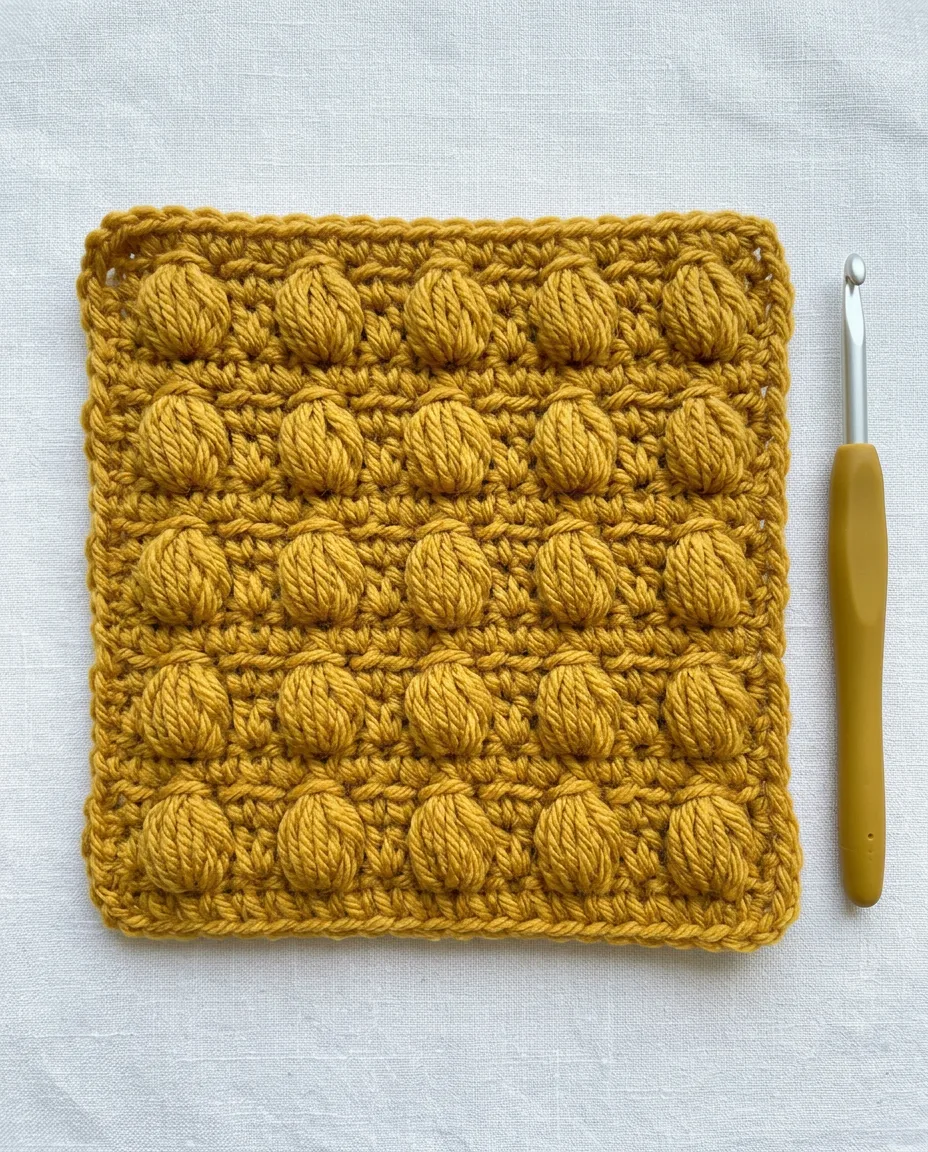
This page uses US crochet terms. The swatch below takes about 30 minutes and uses the kit here.
The puff stitch, one hook move at a time
Run the yarn over your index finger before it reaches the hook so it feeds with a little drag. That drag is your tension, meaning how firmly the yarn is held as it goes onto the hook, and it matters more in this stitch than in any plain one. Read all seven moves before you start the first puff. The fourth one is where the count lives.
- Yarn over. Wrap the yarn over the hook from back to front so a new strand sits on the hook next to the loop already there.
- Insert the hook into the stitch where the puff will sit. Go under both top loops of that stitch, the two strands that form a V when you look down at the row.
- Pull up a loop and keep pulling until it stands about 1 cm tall, a little under half an inch. Three loops now sit on the hook.
- Repeat the first three moves three more times into the same stitch. Yarn over, insert the hook, pull up to 1 cm. Each repeat adds two loops. After the fourth pull-up there are nine loops on the hook.
- Yarn over once more. This strand is the one that will close the bundle.
- Pull that strand through all nine loops in one motion. Tip the head of the hook downward so it does not snag the first loop on the way through. One loop remains.
- Chain 1 to close. Yarn over and pull through the single loop. This chain locks the top of the puff and is never counted as a stitch.
Nine loops is the number for worsted yarn on a 5 mm hook. Count them before you close. Seven loops gives a slimmer puff that suits sock yarn. Eleven makes a fat one that needs a 6 mm (J) hook to pull closed without a fight.
Skip the closing chain and nothing holds the nine loops together, so the next stitch drags them sideways. Make it and the puff stays upright for the life of the piece. Beginners lose the shape here more than anywhere else.
 Save
SaveWhy puffs collapse
Short loops flatten a puff faster than anything else. Pull each loop to 1 cm and check it against the one before it. The first loop sets the height and the other three copy it. A loop pulled to only 6 mm gives a puff half as tall and twice as wide, and it will sink into the row below.
Uneven loops are the second cause. If the first loop is 1 cm and the fourth is 5 mm, the closing yarn over cinches the short loop first and the tall loops bunch to one side. The puff leans. Pull every loop against the same spot on the shank, the straight part of the hook behind the head, and all four come out level. Some crocheters rest a thumbnail on that spot as a stop.
Tension is the third. A tight closing chain is the usual mistake. Pull the chain 1 snug enough to gather the nine loops, then stop. Yank it and the top of the puff pinches into a point while the loops below bulge sideways. Loose tension in the pull-ups causes the opposite problem, loops that slide back down the hook before you can close them. The fix for that is to hold the four loops against the hook with your thumb while you yarn over. Both faults show up in the first row. Neither survives the second if you watch for them.
And yarn matters, which most tutorials never mention. A springy wool or acrylic with four plies, meaning four single strands twisted together, holds a puff upright for years. Drapey cotton or bamboo relaxes within a week and the puffs go soft. Chenille hides every flaw and makes a puff look enormous, though it frays if you have to pull a row out.
 Save
SaveA practice swatch on 17 chains
Chain 17. A chain is one yarn over pulled through the loop on the hook, repeated. Sixteen of these chains become stitches and the extra one is the turning chain, the chain that lifts the yarn to the height of the next row. Any even number plus one works for this stitch pattern. Seventeen is a comfortable width.
Work the first few rows in daylight. Loop height is far easier to judge when the shadow under each loop is visible.
Row 1 is a plain row of single crochet (sc). Insert the hook into the second chain from the hook, yarn over, pull up a loop so two loops are on the hook. Yarn over again and pull through both loops. One single crochet made. Work one into every chain across for 16 stitches.
- Sc in the second chain from the hook and in each chain across 16 sts
- Ch 1, turn. Sc in the first st. [Puff st in the next st, ch 1, skip 1 st] 7 times. Sc in the last st (8 sc, 7 puff st, 7 ch-1 spaces)
- Ch 1, turn. Sc in each sc, each puff and each ch-1 space across 16 sts
- Repeat rows 2 and 3 until the swatch has 8 puff rows, then finish with a row 3 16 sts
Work every puff row from the wrong side if you want all the puffs to bulge toward you on the front. Puffs push toward the side facing away from the crocheter while being made, so the back of a puff row is the side that looks plump. A row of single crochet between puff rows gives each puff a flat shelf to sit on and keeps the fabric from ruffling.
Count stitches at the end of every row 3. Sixteen is right. Seventeen means a closing chain got counted as a stitch. Fifteen means a chain-1 space was missed.
Finished, the swatch comes out close to 5 inches (13 cm) wide and 6 inches tall, and it will be thick. Puff fabric runs about twice the thickness of plain single crochet at the same hook size. Expect it to use twice the yarn as well.
Where the puff stitch shines
Warmth is the honest answer. All those trapped loops hold air, so a puff stitch hat on a 5 mm hook is warmer than a double crochet hat on the same hook and the same yarn. Cowls work for the same reason. A blanket border two puff rows deep adds weight to the edge and stops the blanket curling.
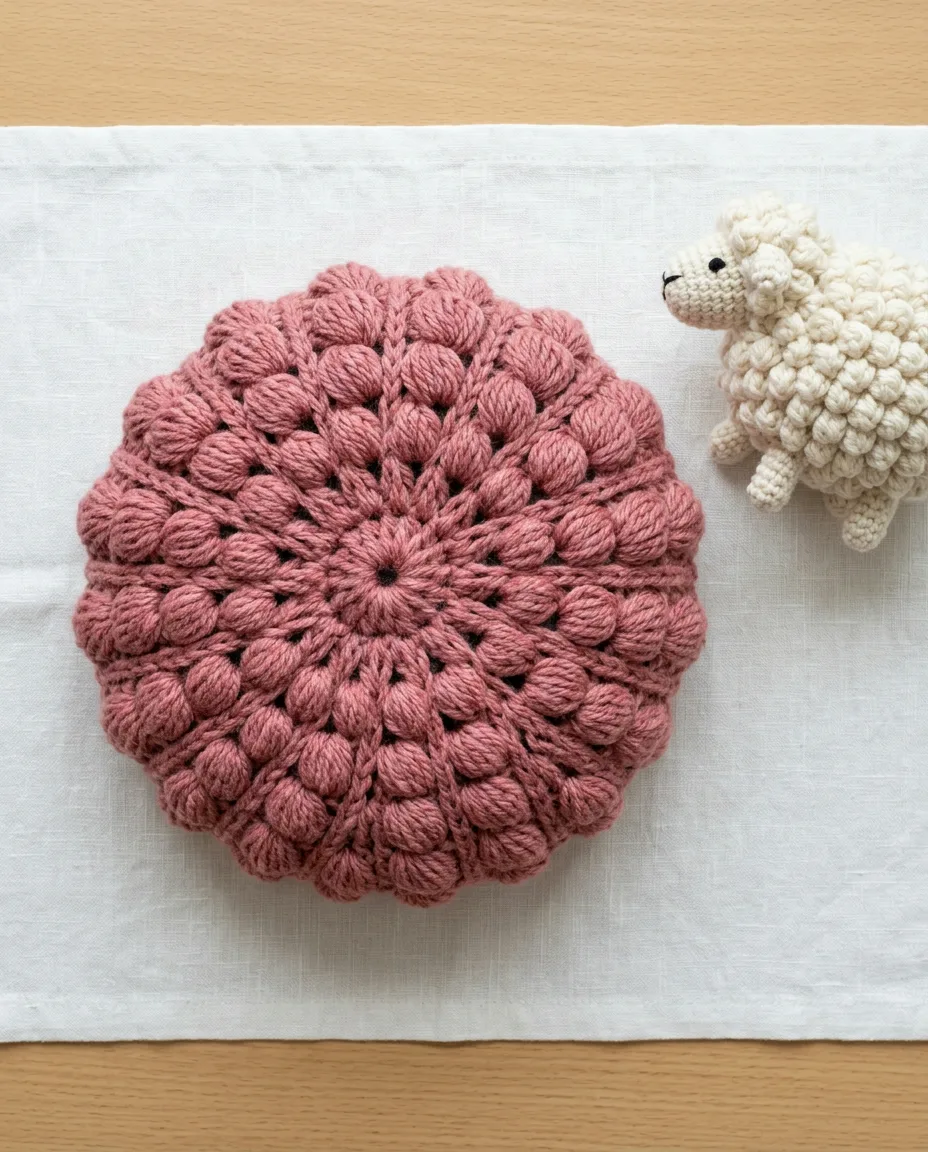
Toys get something from it too. Six puffs worked around the body of a ball give a sheep its fleece. Puffs down the back of a tube make a hedgehog. And one puff in the middle of a flat circle is a passable flower center, with no extra parts to sew on. Fewer seams means fewer places for a toy to come apart.
Uneven tension hides well in this stitch too. A single crochet row shows every tight stitch as a dip. A puff row hides it inside the texture. Beginners who struggle to keep a flat fabric even often find that a puff stitch swatch looks tidy on the first try.
 Save
SaveWhere it goes wrong
Crowding is the first trap. A puff in every stitch with no chain between them has nowhere to spread, so the fabric buckles and the puffs squash each other flat. Leave the chain 1 and skip a stitch between puffs, as in row 2 above. Puffs in every stitch only work on a hook two sizes larger than normal.
Miscounting loops is the second. Nine loops looks like a lot on the hook and it is tempting to stop at seven. Count them every time for the first row and the hand learns the feel of nine within a dozen puffs. A stray fifth pull-up gives eleven, and the closing yarn over will not pass through cleanly.
Hook size trips up almost everyone once. The yarn band for worsted yarn says 5 to 5.5 mm, and that is for plain stitches. A 4 mm hook makes pulling the closing strand through nine loops a struggle, and the struggle makes you yank, which makes a tight pinched puff. Go up a size from the band. Go up two if the yarn is a dense cotton.
Lastly, the closing chain is not a stitch. Counting it as one adds a stitch to every puff row and the swatch grows a slanted edge. The next row works into the top of the puff, which is the loop just before that closing chain.
A staggered variation
Offsetting the puffs by one stitch on every other puff row turns the straight columns into a honeycomb. Nothing changes in the hook moves. Only the placement moves, by one stitch, and the fabric stops showing vertical lines of puffs and starts showing diagonal ones.
- Ch 1, turn. Sc in the first 2 sts. [Puff st in the next st, ch 1, skip 1 st] 6 times. Puff st in the next st, sc in the last st (3 sc, 7 puff st, 6 ch-1 spaces)
- Ch 1, turn. Sc in each sc, each puff and each ch-1 space across 16 sts
Use this pair in place of rows 2 and 3 on every second puff row. The stitch count stays at 16 on every plain row, which makes it simple to check. Blankets look best with the stagger. Hats look best without it, because straight puff columns line up with the decreases at the crown and the stagger fights them.