Start with the pumpkin. It is one rectangle sewn into a tube and gathered at both ends. It takes about two hours, and it teaches the ribbed stitch that two more projects on this list use. Everything after it gets quicker. The eight projects below are ranked by how much you get for the time, so the first three are the ones to make if you only have one weekend.
None of them needs shaping beyond a flat circle or a ball. None needs a stitch harder than half double crochet. The terms are US crochet terms. Hook sizes are given in millimeters with the US letter. Every finished size is a real measurement at the stated gauge, which is the number of stitches and rows that fit in 4 inches. Your result will be close if your yarn matches the weight named.
Yarn and hook notes for the whole list
Six of the eight use worsted weight yarn, the medium weight marked 4 on the ball band, with a 5 mm (H) hook. Acrylic is fine for anything decorative. Cotton is better for the mug cozy and the coasters because it does not melt against a hot mug and it washes without pilling. The ear warmer and the cowl use thicker yarn. The acorn drops down to a 3.5 mm (E) hook so the stuffing does not show through.
Three of the projects are stuffed. Use polyester fiberfill, the loose white stuffing sold in bags at any craft store, and pack it until the piece holds its shape when squeezed. Stuffed pumpkins and acorns are decor and not toys. If a child under 3 will reach them, sew every piece on firmly and leave off the loose stem.
A pumpkin from one stuffed rectangle
Start with a chain of 24 in worsted weight yarn on the 5 mm hook, then make a row of 23 half double crochets (hdc). To make one: yarn over, which means wrapping the yarn over the hook from back to front. Insert the hook into the next stitch, yarn over again and pull up a loop. Then yarn over and pull through all three loops at once. From row 2 on, put every half double crochet into the back loop only, the loop on the far side of the V on top of each stitch. That leaves the front loop lying free on the surface, and after a few rows those free loops line up into ridges. Chain 1 to turn, keep the count at 23, and work 54 rows.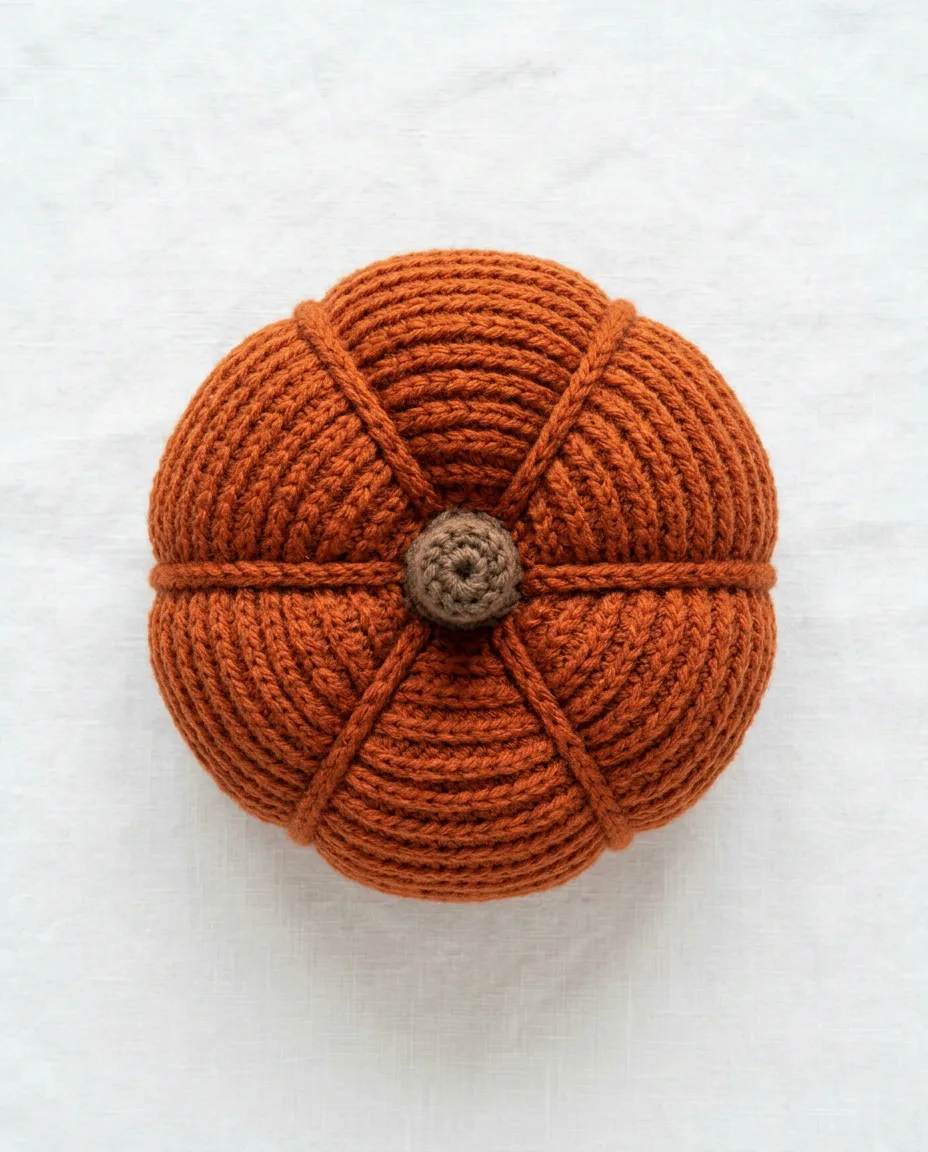 Save
Save
At a gauge of 13 stitches and 12 rows to 4 inches (10 cm), the rectangle measures about 7 by 18 inches (18 by 46 cm). Fold it so the two short ends meet and sew them together with a yarn needle, a blunt needle with a big eye. Thread a long strand through every row end around one open end of the tube. Pull it tight to close the hole and knot it. Stuff the tube hard. Close the second end the same way.
Now the shaping, which is all done with yarn. Thread 2 yards of the same color on the needle and push it through the center from bottom to top. Wrap it down the outside and come back up through the center. Six wraps spaced evenly around divide the pumpkin into segments, and each wrap should be pulled hard enough to sink into the stuffing. The finished pumpkin sits about 6 inches (15 cm) wide and 4 inches (10 cm) high. The stem is a short tube of single crochet, the shortest stitch: insert the hook, yarn over, draw a loop up, yarn over once more and bring the hook through both loops. Begin with chain 2, put 6 single crochets in the second chain from the hook, and work 5 rounds of 6 without joining. Stitch it over the top hole. Budget about 120 yards (110 m) of yarn and 2 hours.
Chunky ear warmer in super bulky yarn
Super bulky yarn, marked 6 on the band, with a 10 mm (N) hook makes this a one-hour project. Chain 9 and make 8 half double crochets across. Turn with a chain 1 and repeat until the strip measures 19 inches (48 cm), about 28 rows at 6 rows to 4 inches. The strip is 4 inches (10 cm) wide. Nineteen inches sounds short for a head, and it is; the fabric stretches to 22 inches and the stretch is what holds it in place.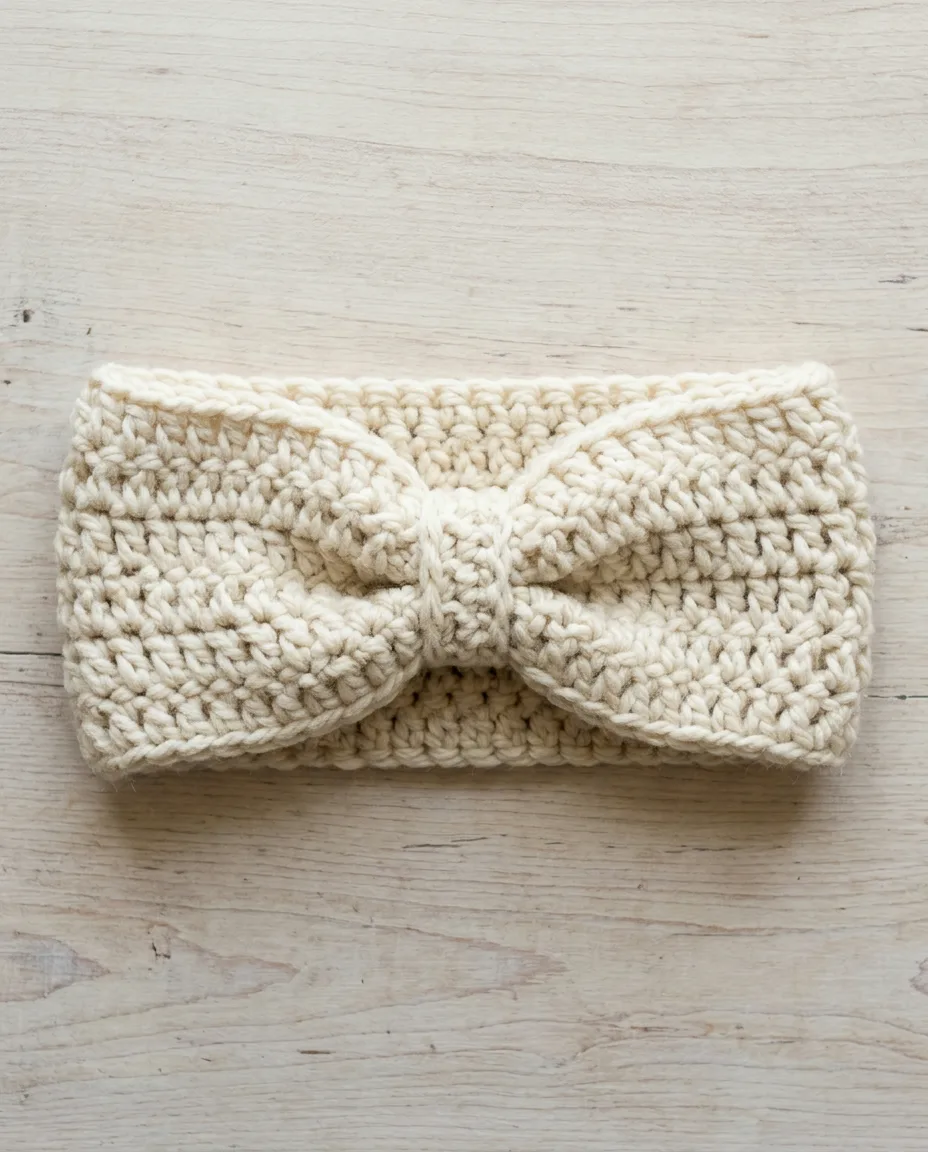 Save
Save
Sew the two short ends together. Then make a small band to hide the seam and give the twisted look: chain 6, work 5 single crochets, and repeat for 10 rows. Pinch the seam of the headband to gather it, wrap the small band around the pinch, and join the band’s ends at the back. About 70 yards (64 m) of super bulky yarn covers the whole thing, and most 100 g balls hold 80 to 90 yards.
Ribbed beanie worked sideways
This hat is the pumpkin rectangle again with different numbers. Make a chain of 36 in worsted weight yarn and work 35 half double crochets through the back loops for 60 rows. The rectangle comes out close to 10.5 by 20 inches (27 by 51 cm). Once it is sewn, the ridges run up and down the hat, which is what gives it the ribbed look. Twenty inches unstretched fits a 22 inch adult head with the ribs opened out a little.
Sew the short ends together to make a tube. Run a strand of yarn through every row end around the top edge, pull it tight to close the crown, and knot it on the inside. Fold up 2 inches (5 cm) of the bottom edge for the brim. Expect 3 hours and about 200 yards (183 m). A hat for a child with a 20 inch head needs a chain of 32 and 54 rows.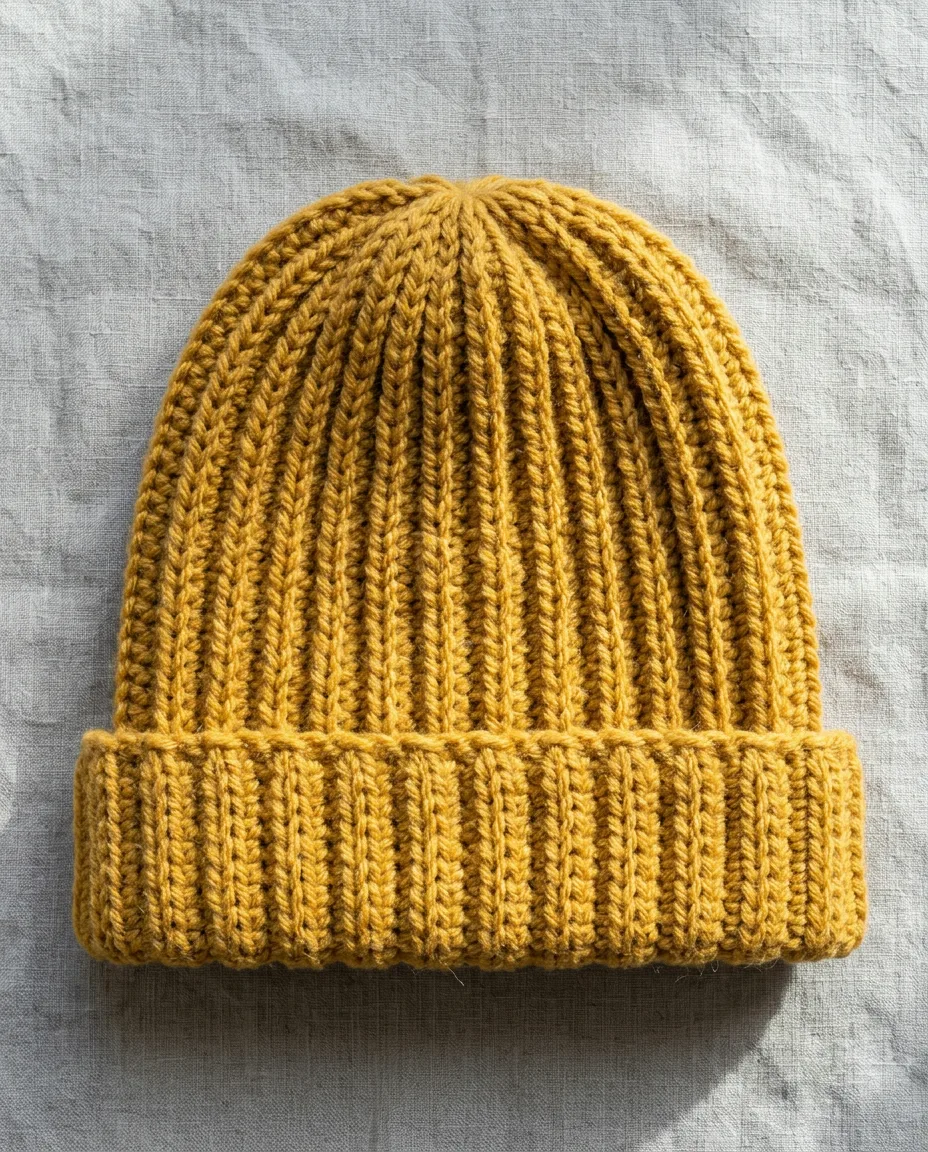 Save
Save
Two mistakes show up often. The first is losing a stitch at the start of each row, because the back loop of the first stitch hides under the turning chain, the chain 1 you made to turn. Count every tenth row. The second is a crown that bunches into a knot because the rows were pulled too tight. Pull the gathering strand firmly, then stop. A dime-sized hole at the center is normal and the bunching covers it.
Leaf garland for a doorway or mantel
Each leaf is worked around a starting chain in one go. Use a 4 mm (G) hook with worsted or DK yarn, and chain 9. Skip the first chain and work one stitch into each of the next seven: 1 single crochet, 1 half double crochet, 3 double crochets, 1 half double crochet, 1 single crochet. A double crochet starts with a yarn over before the hook goes in. Pull up a loop so there are three loops on the hook, then yarn over and pull through two loops twice. Put 3 single crochets into the very last chain to turn the point, then mirror the same seven stitches up the other side of the chain. Finish with a slip stitch, which means inserting the hook and pulling the yarn through both the stitch and the loop on your hook in one motion, into the first stitch. One leaf measures about 2.75 inches (7 cm) long and 1.25 inches (3 cm) wide.
Make 15 leaves. Rust and mustard carry the garland, and a few in deep olive stop it reading as one flat color. One leaf takes about 8 yards (7 m) and 10 minutes. To make the cord, chain until it measures 60 inches (150 cm), roughly 240 chains at this hook size. Attach a leaf to the cord every 4 inches, leaving 2 inches bare at each end for hanging loops. The leaves curl slightly as you work them; press each one under a damp towel for 10 seconds to flatten the points.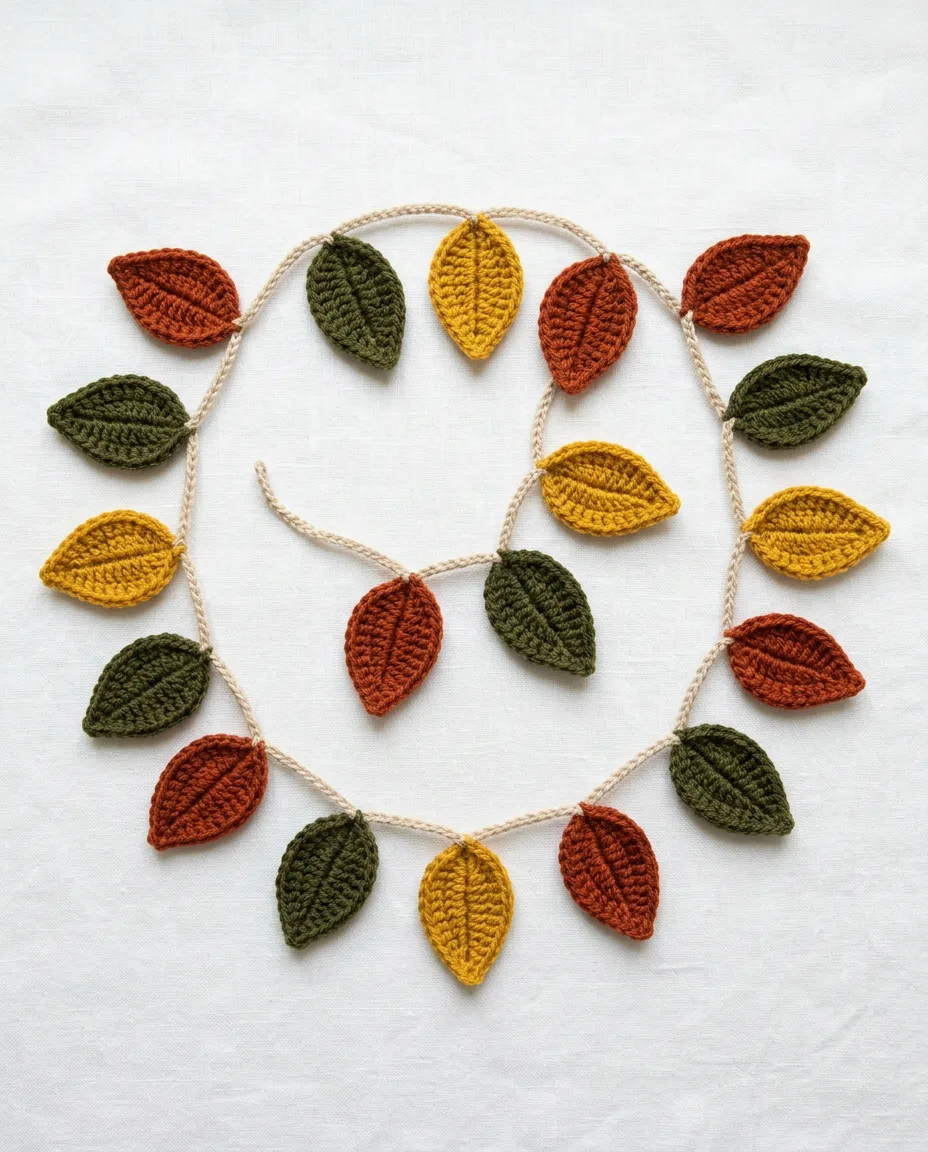 Save
Save
The cowl that takes two balls of bulky yarn
Bulky yarn, marked 5, and an 8 mm (L) hook. Chain 60 and close the chain into a ring with one slip stitch into the first chain, checking first that the chain is not twisted. Work 15 rounds of half double crochet, one stitch into each stitch of the round below. Slip stitch into the first stitch to close each round and chain 1 before starting the next. At 9 stitches and 6 rounds to 4 inches, the cowl comes to 27 inches (69 cm) around and 10 inches (25 cm) high. That sits once around the neck with room to pull it up over the chin.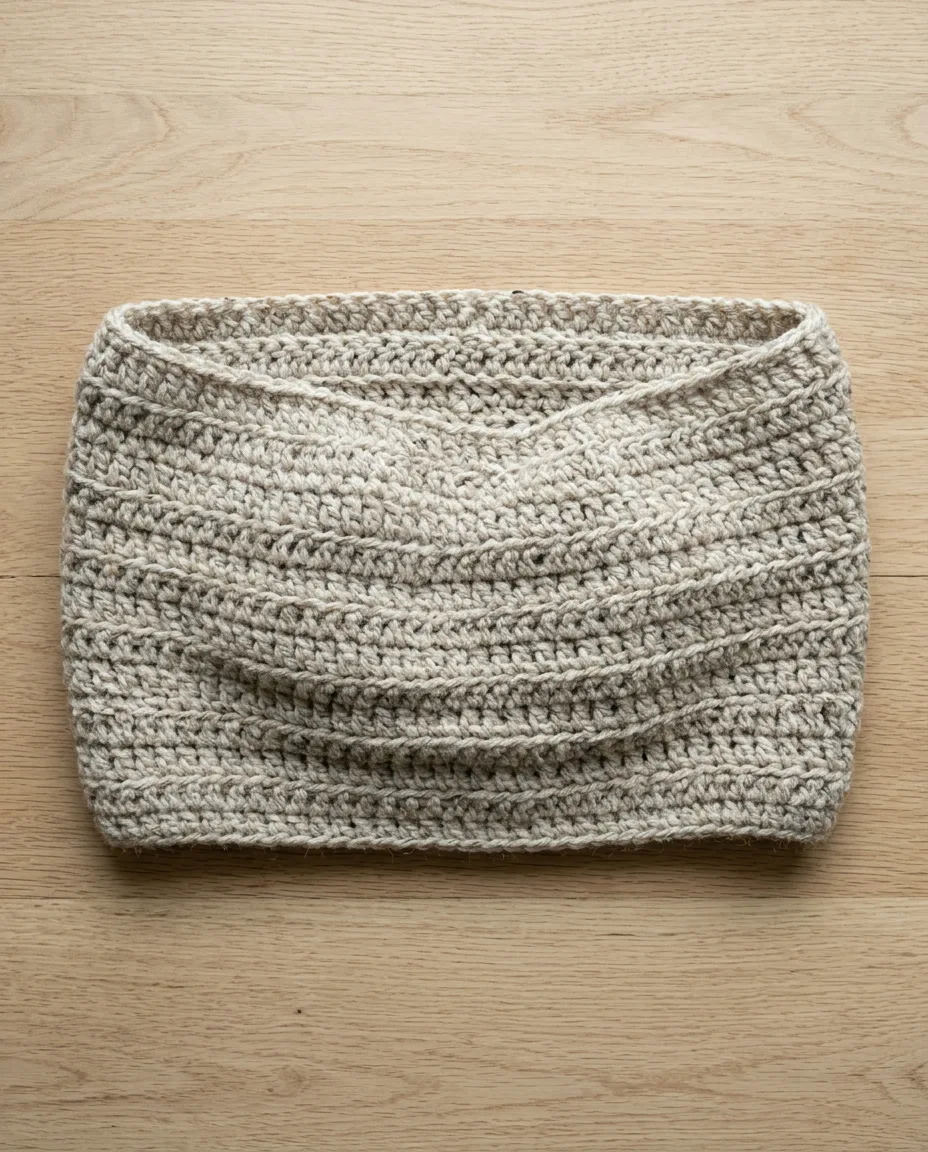 Save
Save
The join line spirals a little, and in half double crochet it shows as a faint diagonal seam. Wear it at the back. Two 100 g balls of bulky yarn, about 240 yards (220 m) total, cover a cowl this size in around 3 hours. A cowl that loops twice needs a chain of 120 and 10 rounds instead; it uses the same amount of yarn and hangs lower.
Stuffed acorns, worked in two colors
Acorns are worked in the round in single crochet with a 3.5 mm (E) hook, which packs worsted yarn tight enough that stuffing never shows. Begin the body in tan with 6 single crochets worked into a chain-2 ring, the same start as the pumpkin stem. In round 2, put two stitches into every stitch (12). In round 3, work one stitch, then two in the next, and repeat that around (18). Round 4 is two stitches, then two in the next, around (24). Work rounds 5 through 8 plain at 24. Round 9 is two stitches then a decrease, around (18). A decrease here means pulling up a loop in each of the next two stitches and then yarning over and pulling through all three loops. Stuff, then work one stitch and a decrease around (12), then six decreases (6), and sew the hole shut.
Make the cap in brown with the same first four rounds, 6 up to 24. Then work 2 rounds of 24 in the back loops so the cap turns down at a sharp edge and sits like a lid. The stem is a chain of 4 with 3 single crochets worked back along it. Stitch the stem to the top of the cap and the cap over the top of the body. Each acorn is about 2.5 inches (6 cm) tall. Count on 45 minutes and 25 yards (23 m) of yarn across both colors. Five in a wooden bowl is enough. Twelve with a loop of thread on each make a garland.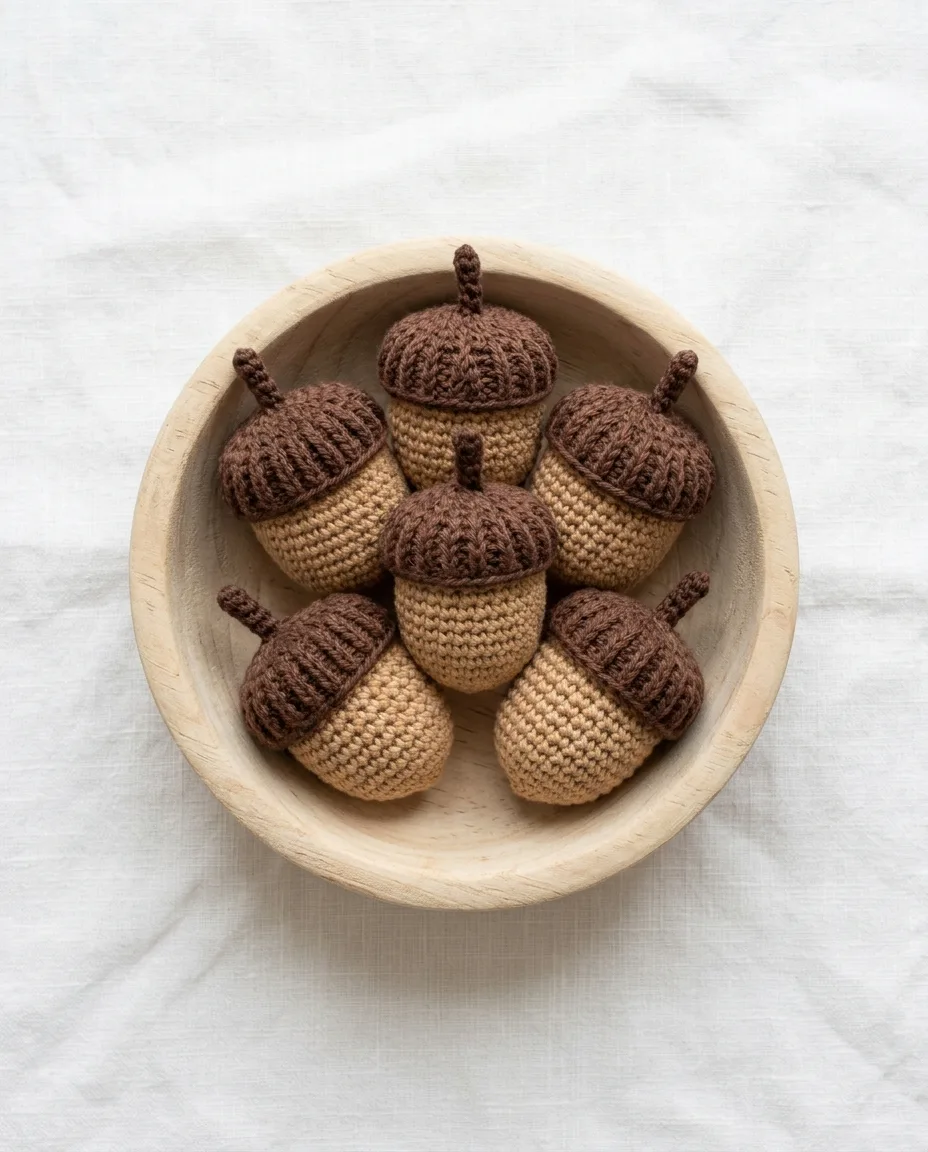 Save
Save
Mug cozy with a button
Worsted cotton and a 5 mm hook. Chain 12, make a row of 11 half double crochets, and continue for 23 rows. At the gauge used for the pumpkin that gives a strip 3 inches (7.5 cm) high and 9 inches (23 cm) long. Nine inches wraps a standard 12 ounce mug, which is about 10 inches around, and leaves a 1 inch gap for the handle. On the last row, chain 8 at one corner and slip stitch back into the same corner to make a button loop. Sew a 1 inch (25 mm) button to the opposite end.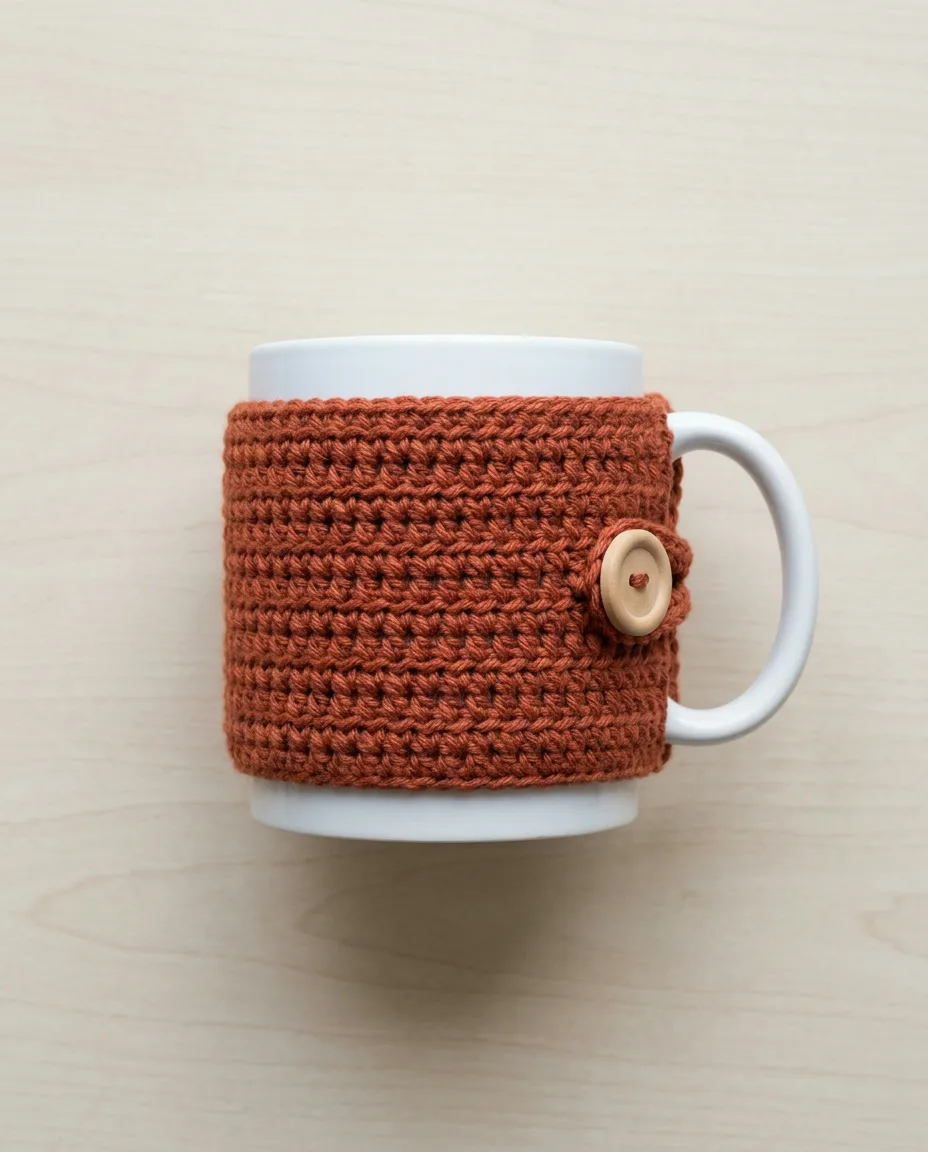 Save
Save
Cotton matters here more than anywhere else on the list. Acrylic yarn softens against a mug fresh from a microwave and goes shiny where it touches. Cotton takes the heat and goes in the wash. A single cozy uses about 40 yards (37 m) and 45 minutes, so a set of four with four different buttons is an evening. Skip the button loop and sew the ends together for a cozy that slides on from the bottom, but measure the mug first, because many mugs flare at the top.
Coaster set from flat circles
A flat circle is the same arithmetic as the acorn body without the decreases. Use worsted cotton and a 4.5 mm (7) hook. Start as for the acorn with 6 single crochets in a chain-2 ring, and add 6 stitches every round, so round 2 has 12 and round 7 ends at 42. Spread the increases so they do not stack on top of each other, or the circle turns into a hexagon with visible corners. Round 7 at 42 stitches measures about 4 inches (10 cm) across. Close with a slip stitch, cut the yarn and weave the tail in.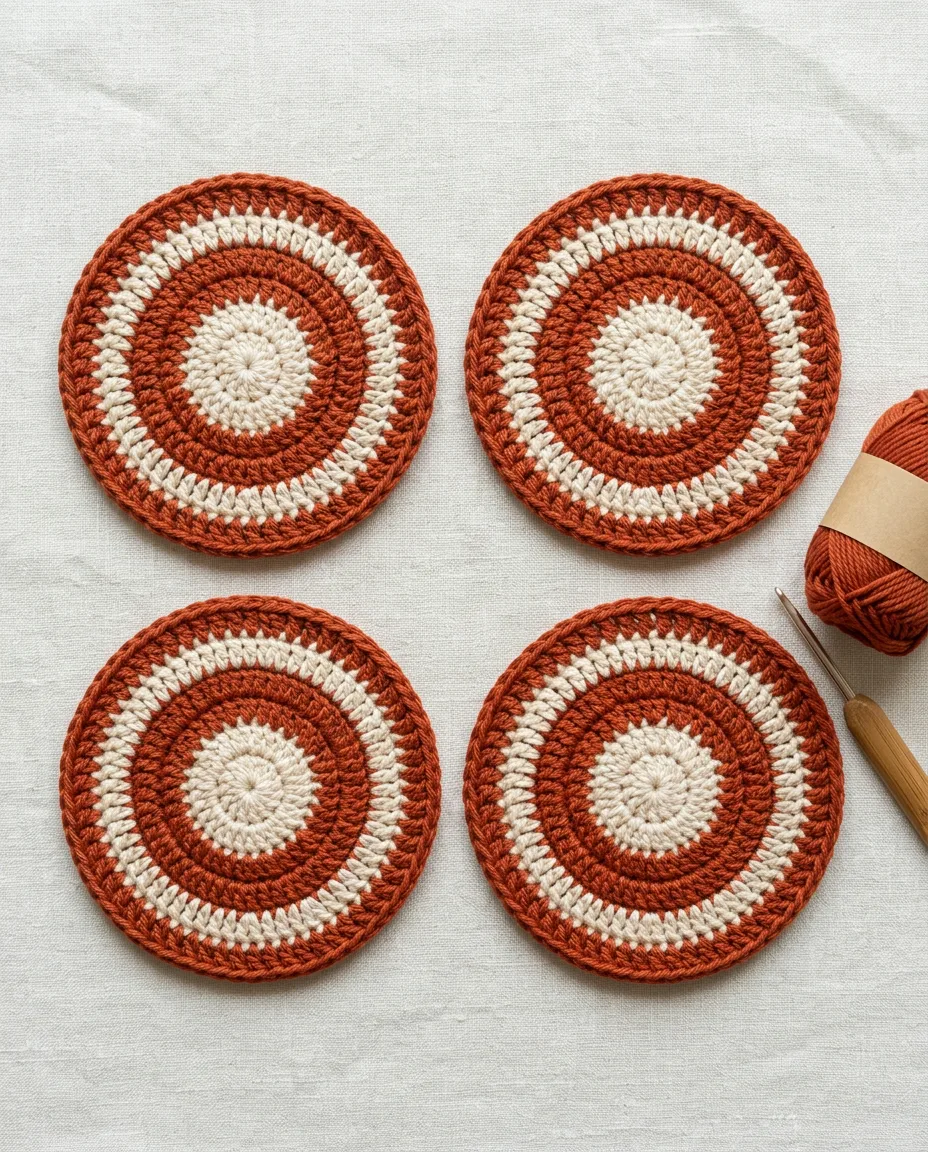 Save
Save
But a flat circle is only flat if your stitches are the right tightness. If the circle cups like a bowl, your stitches are tight and the hook should go up to 5 mm. If the edge ruffles, go down to 4 mm. Fifteen minutes and 20 yards (18 m) per coaster means a set of four in rust and cream uses one 100 g ball with yarn to spare. Wash them in the machine on cool and lay them flat; cotton coasters that go in the dryer come out a size smaller and stay that way.