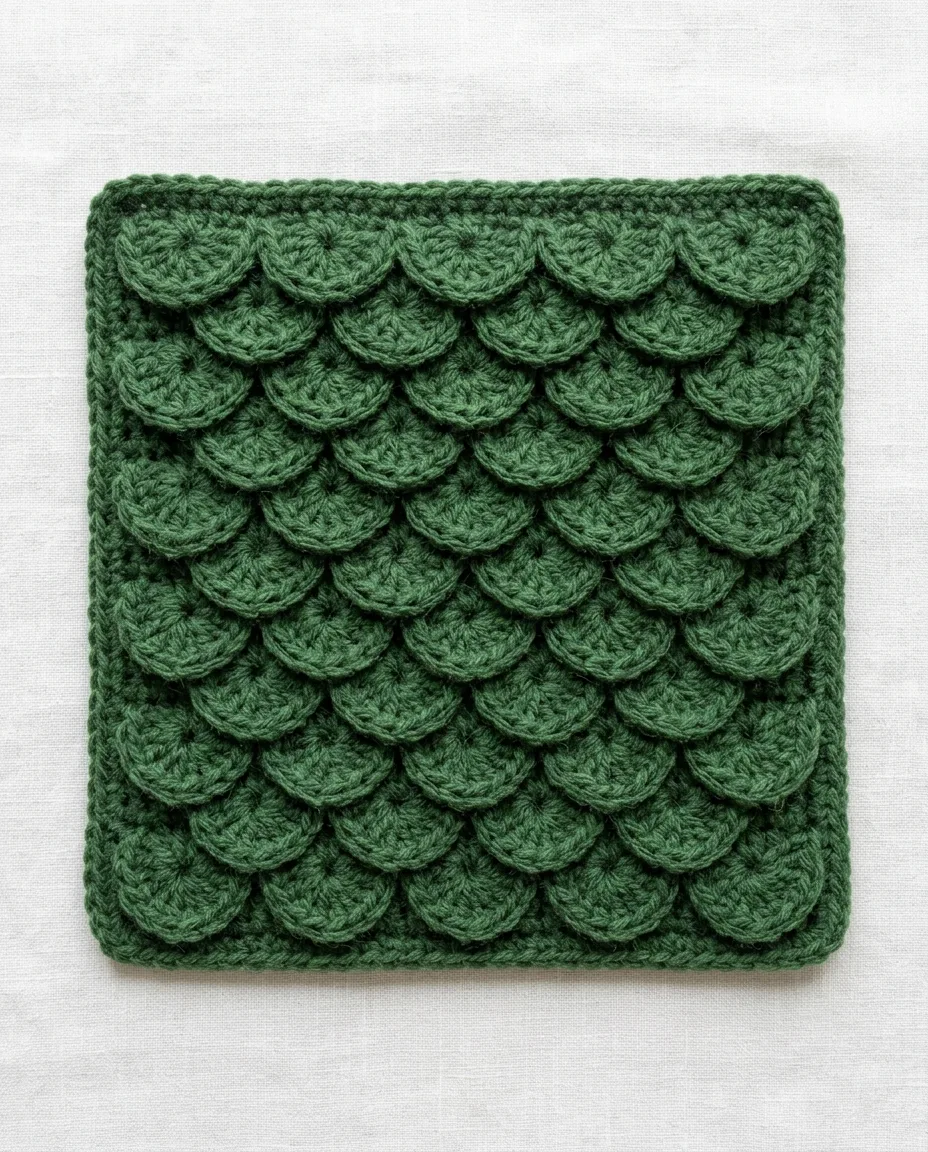
Plenty of crocheters park crocodile stitch on the someday list. They figure the scales need some secret trick. They don’t. Each scale is just ten double crochets wrapped around two posts, and the posts come out of a perfectly ordinary base row. The fiddly bit is turning the work as you go (the first scale feels clumsy, the fourth feels normal). Everything here uses US crochet terms. And before you plan a bag or a cuff around this stitch, make a swatch, a small test piece about the size of your palm.
Double crochet (dc) carries the whole stitch, so get comfortable with it first. Wrap the yarn over the hook from back to front. That wrap is called a yarn over. Now push the hook into the stitch, wrap again and draw up a loop. You’ll have three loops on the hook. Wrap and pull through two of them. Wrap once more and pull through the last two. Done. The finished stitch has a tall stem called the post, and every scale gets built on posts.
Worsted weight is the medium-thick yarn sold for sweaters and blankets, marked 4 on the band. Size your hook one step up from what the band suggests. Sounds backwards? It isn’t. Each scale piles ten stitches onto a base row, and on a snug hook they cup inward and curl at the edges.
Work one scale around a pair of posts
Every scale sits on two double crochets that share a stitch at the bottom. Down one post, back up the other. That’s the whole route, and the stitches fan out into a rounded flap along the way.
- Give the swatch a quarter turn. The next pair of posts should now lie sideways, tops pointing at you.
- Yarn over once, then push the hook under the first post from front to back so it pokes out the far side.
- Catch the yarn and draw a loop up around the post. You’ll have three loops on the hook now.
- Wrap and pull through two loops, then wrap again and pull through the last two. That’s one double crochet.
- Four more go around that same post, working from its top down toward the base. Five in all.
- Now chain 1 at the base of the pair. That’s how you turn the corner.
- Rotate the swatch again. This time it’s five double crochets around the second post, base to top.
- Let the finished scale flop down over the row below. Then slip stitch or single crochet into the next pair, whichever the pattern calls for.
Gaps are what you’re watching for. Shove each new stitch up against the last one as you travel down the post, and five should fill it completely. Bare post peeking through? Then either the hook’s too big or your stitches are loose. Check the hook first, since it’s the easier fix.
The swatch, row by row
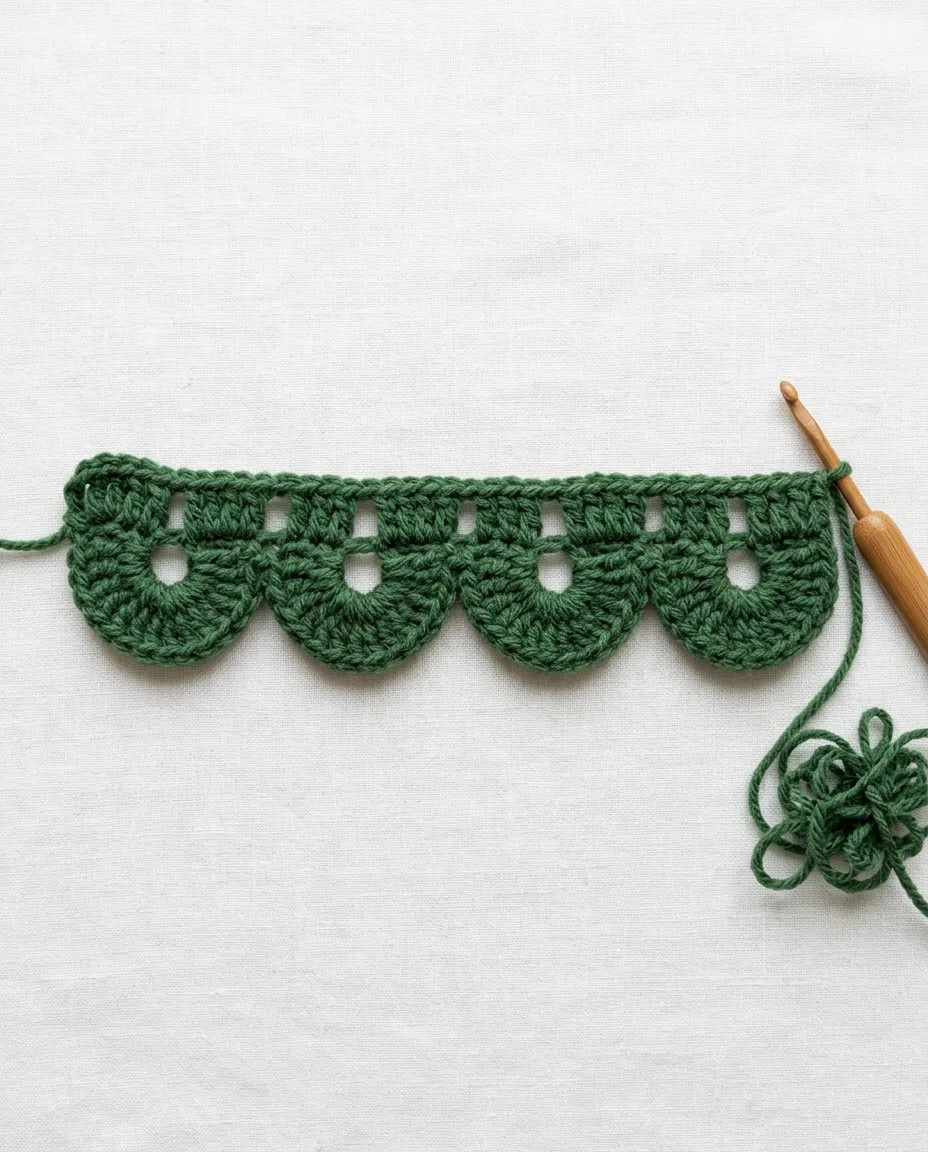
Two rows take turns here. The base row lays down pairs of double crochets. Then the scale row turns every other pair into a scale and pins the pairs in between with a single crochet.
Single crochet (sc) is the short stitch. Put the hook in, wrap, and draw up a loop. Then wrap and go through both loops at once. A slip stitch (sl st) is even shorter: hook in, wrap, and pull that loop straight through everything on the hook. You’ll only need it once per base row, so don’t sweat it. There is a fuller walkthrough in the guide to the crochet waistcoat stitch.
25 chains is a multiple of 6 plus 1. That works out to 8 pairs on every base row and 4 scales on every scale row. Want it wider? Add chains in steps of 6. Each step buys you two more pairs and one more scale.
- Dc in 4th ch from hook (skipped ch count as a dc), (sk 2 ch, 2 dc in next ch) x7 8 pairs
- Ch 1, turn, sc between dc of first pair, (scale on next pair, sc between dc of next pair) x3, scale on last pair 4 scales
- Turn, sl st into ch-1 sp at center of first scale, ch 3 (counts as dc), dc in same sp, (2 dc in next sc, 2 dc in ch-1 sp at center of next scale) x3, 2 dc in last sc 8 pairs
- Ch 1, turn, (scale on next pair, sc between dc of next pair) x4 4 scales
- Ch 3 (counts as dc), turn, dc in first sc, (2 dc in ch-1 sp at center of next scale, 2 dc in next sc) x3, 2 dc in ch-1 sp at center of last scale 8 pairs
- Ch 1, turn, sc between dc of first pair, (scale on next pair, sc between dc of next pair) x3, scale on last pair 4 scales
 Save
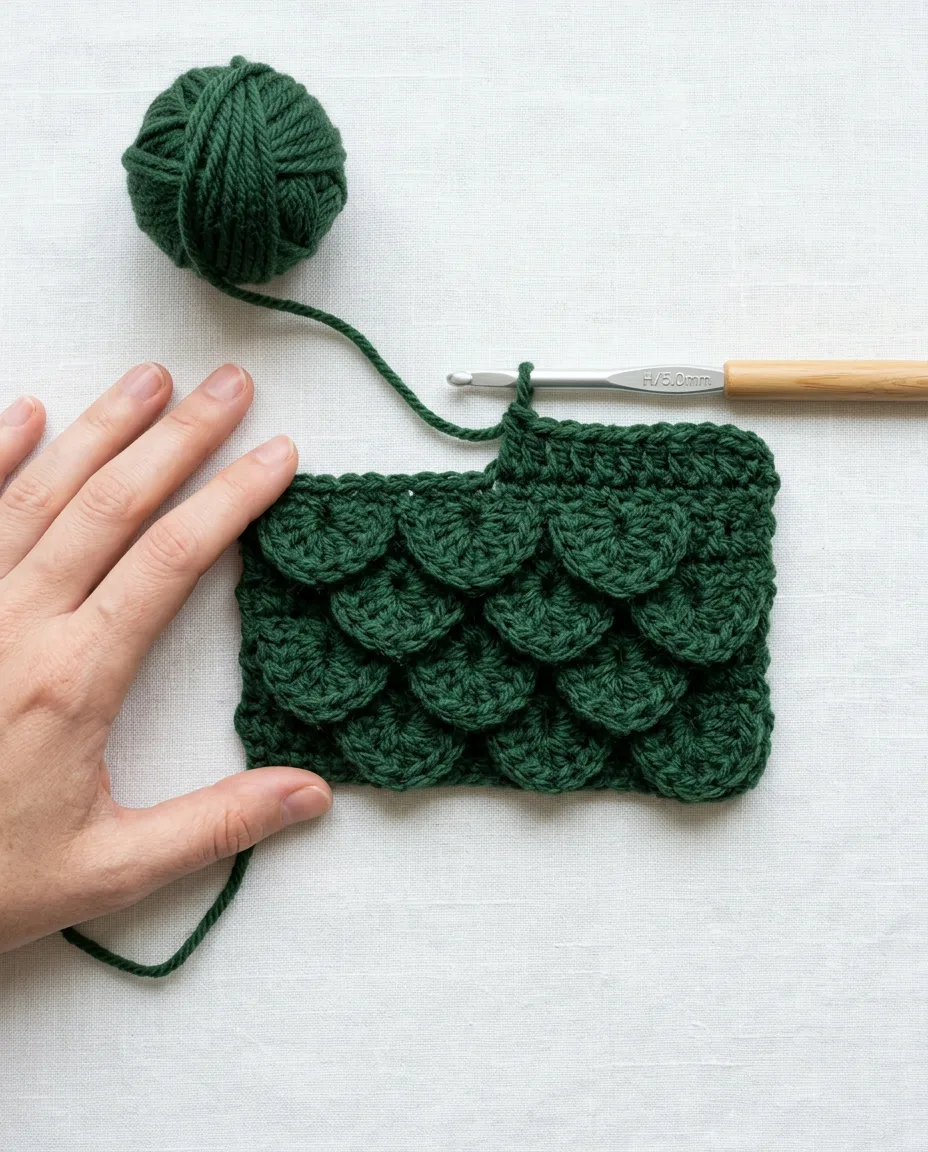
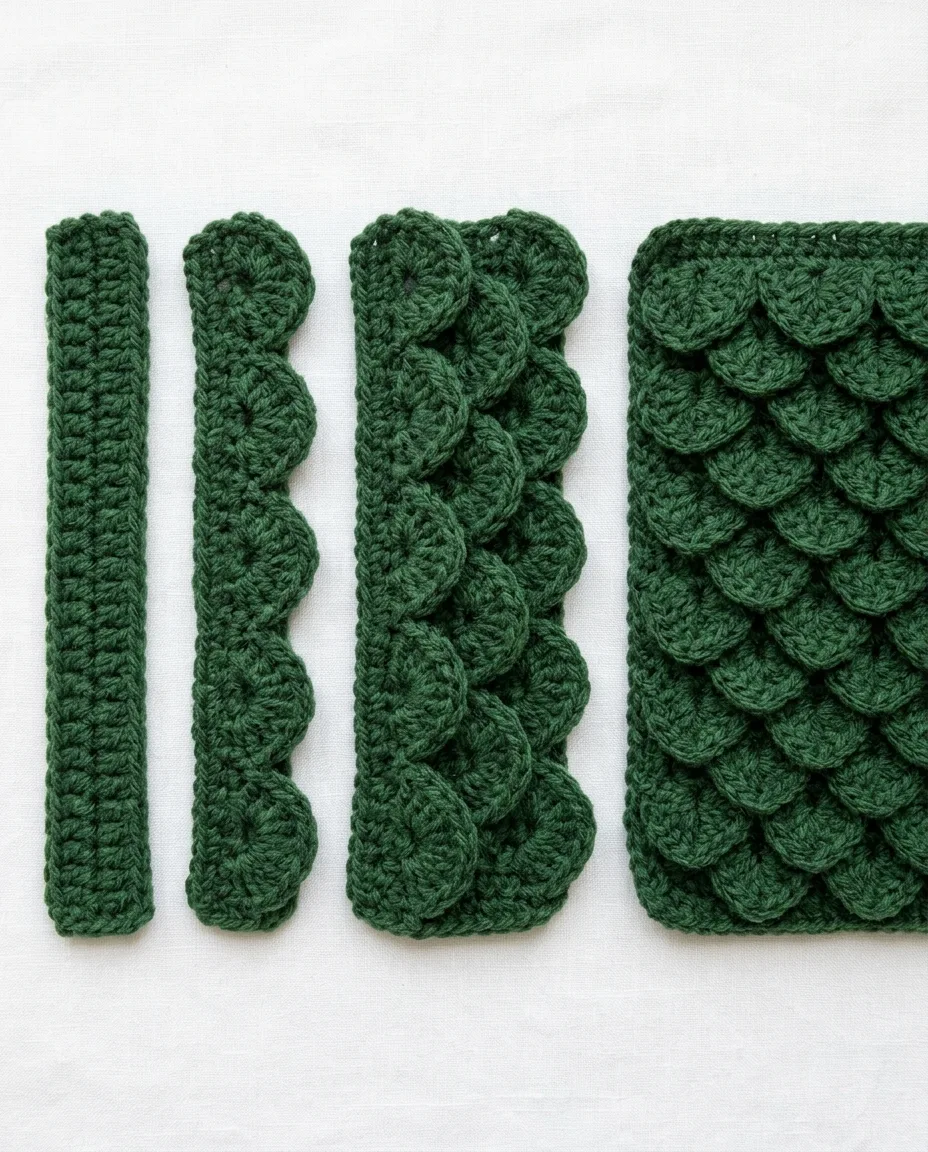
Keep repeating Rows 3 to 6 for as long as you want fabric. So why do the scales stagger? Each base row drops a pair into the middle of every old scale, plus a pair onto each single crochet between them. The new scales land in the gaps, offset by half a scale (exactly how roof shingles cover the seams in the row underneath). Scale rows are always the even rows. That keeps every scale on the same face.
 Save
Don’t judge the strip after Row 2. It looks thin and a little odd at that point, just posts with four flaps dangling off them. The overlap only shows up from Row 4 on, once the second set of scales covers the gaps in the first. Give it four scale rows. That’s where the texture really starts to read.
 Save
Where the shingled texture earns its yarn
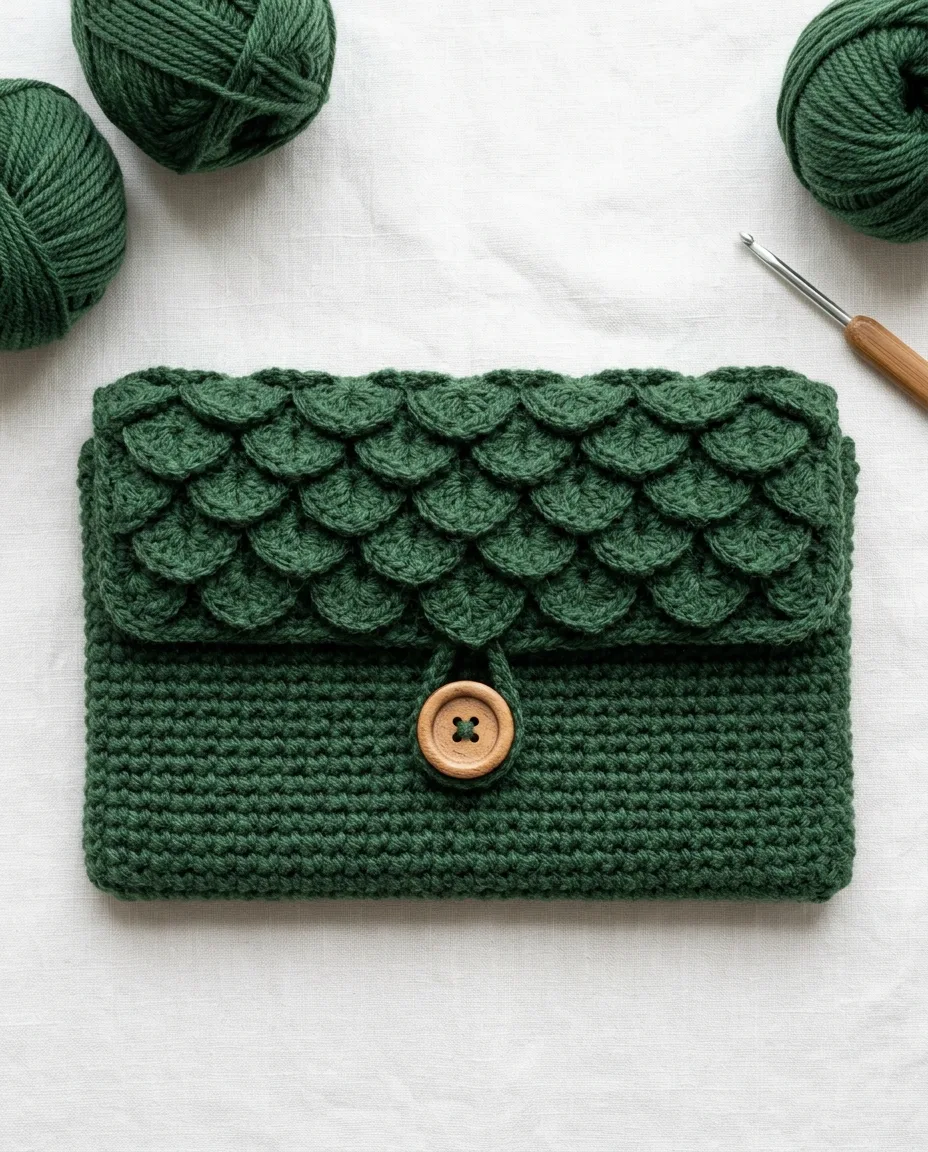
Fair warning: this stitch eats yarn. Every scale is ten double crochets parked on a base row that’s already a full fabric. So a piece swallows far more yarn than plain double crochet at the same size. In a bag flap or a purse, that weight is a plus. The thick layers hold their shape and guard whatever’s inside. Put it in a summer top or a light scarf, though, and it’s a nuisance, because the fabric hangs and stretches out. The guide to stretchy crochet ribbing covers the whole method.
Keep it to small, sturdy things. A clutch flap. The cuff of a fingerless mitt. Pinecone ornaments work well, and so does the back of a toy dinosaur. A dragon’s wing is fine too if you make it flat and fold it. Whole crocodile stitch blankets do exist. They’re very warm and very heavy, and the yarn bill climbs fast.
 Save
Flat scales, cupped scales and other common slips
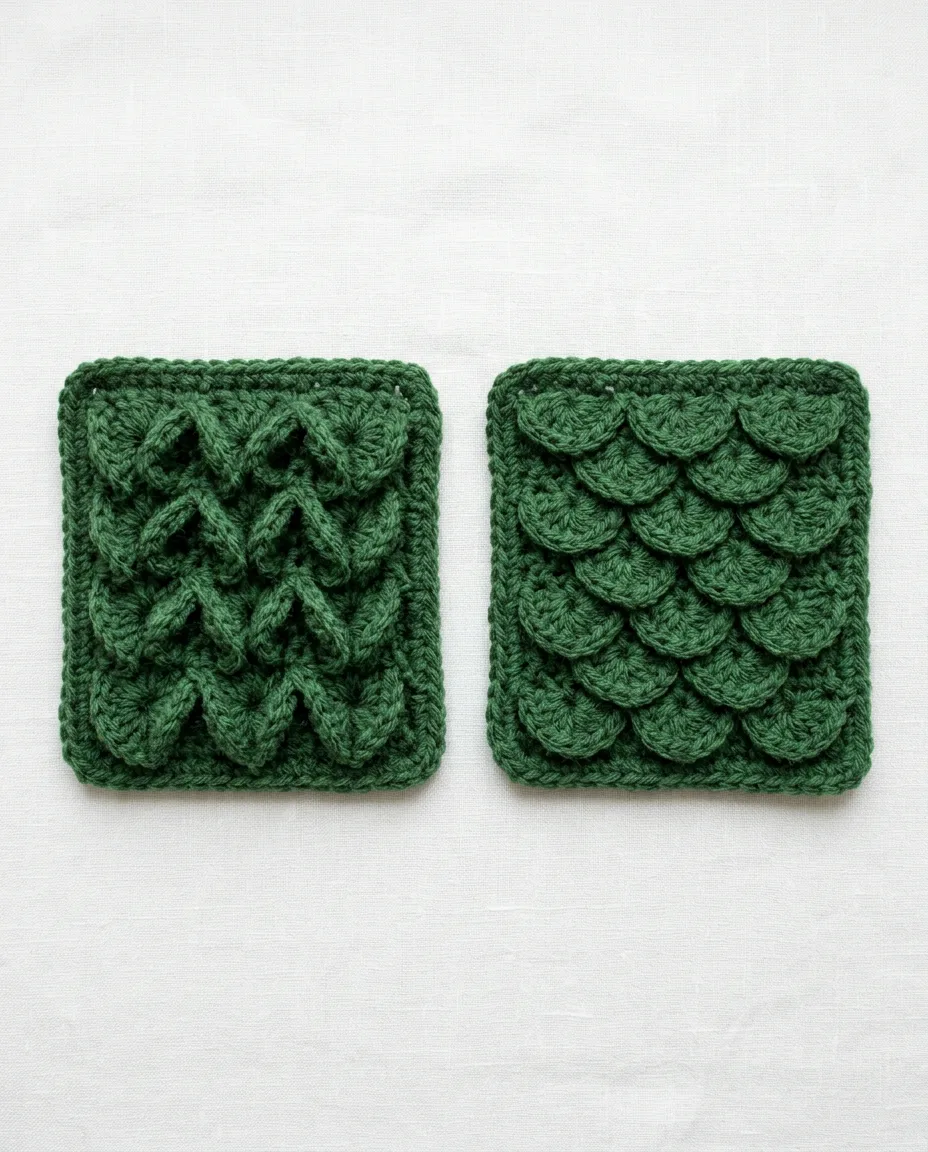
Cupped scales are the first problem most people hit. If yours curl inward like spoons, the stitches around each post are too tight. Go up one hook size for the scale rows only. Leave the base rows on the smaller hook. That single swap sorts out most swatches.
But flat, floppy scales point the other way. Usually the five double crochets got spread along the post with gaps between them. Or the yarn’s too slippery to hold a curve at all. Pack the stitches in. Cotton and bamboo blends drape more than wool does, so in those yarns the scales lie flatter whatever you try. Worth knowing before you buy.
Not every slip comes down to tension, which just means how tightly you hold the yarn as it feeds onto the hook. Put a scale on the wrong pair and the offset breaks. The next scale row then stacks its scales straight on top of the old ones, and you’ll spot it right away. So count pairs after every base row. This swatch should have 8. Watch the edges too. A half-scale sticks out on one side of the base rows, and that’s normal (it bugs people anyway). A border of single crochet tidies it once the piece is done.
 Save
Change colors every scale row for a two-tone version
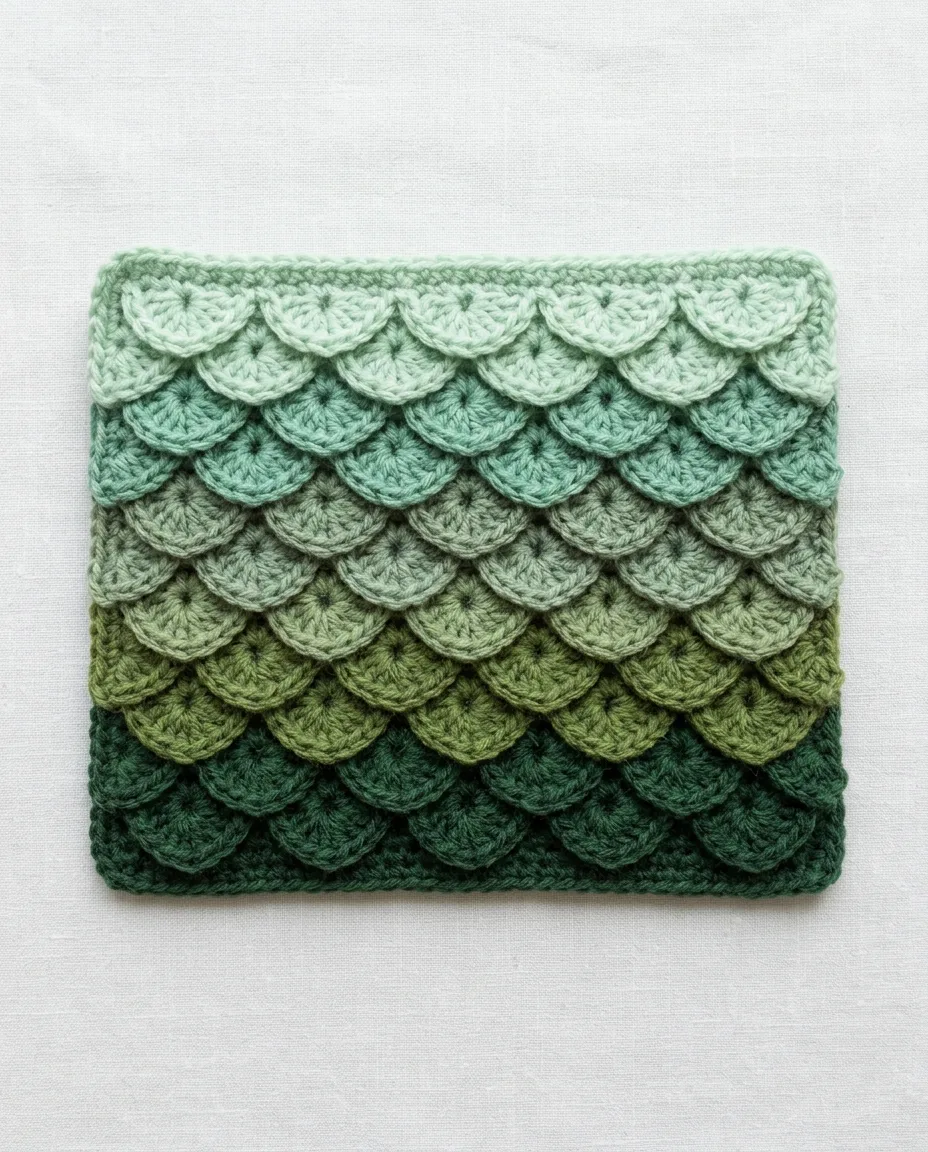
Swap yarn at the start of each scale row and the scales come out striped. The base rows hide underneath, so one color covers all of them. Join the new color with a slip stitch in the first stitch. Stripes only two rows tall? Carry the old yarn up the side instead of cutting it. Graded shades look best, with dark green at the bottom fading to pale green at the top, the way a real reptile’s belly lightens. The basket weave guide breaks the whole project into steps.
Blocking is what makes any finished piece lie flat. Soak it. Roll it in a towel to press the water out, then pin it flat to dry. Wool scales hold the blocked shape. Acrylic springs right back unless you steam it lightly, with the iron held above the fabric. Never press down. Do that and the scales flatten for good.
 Save