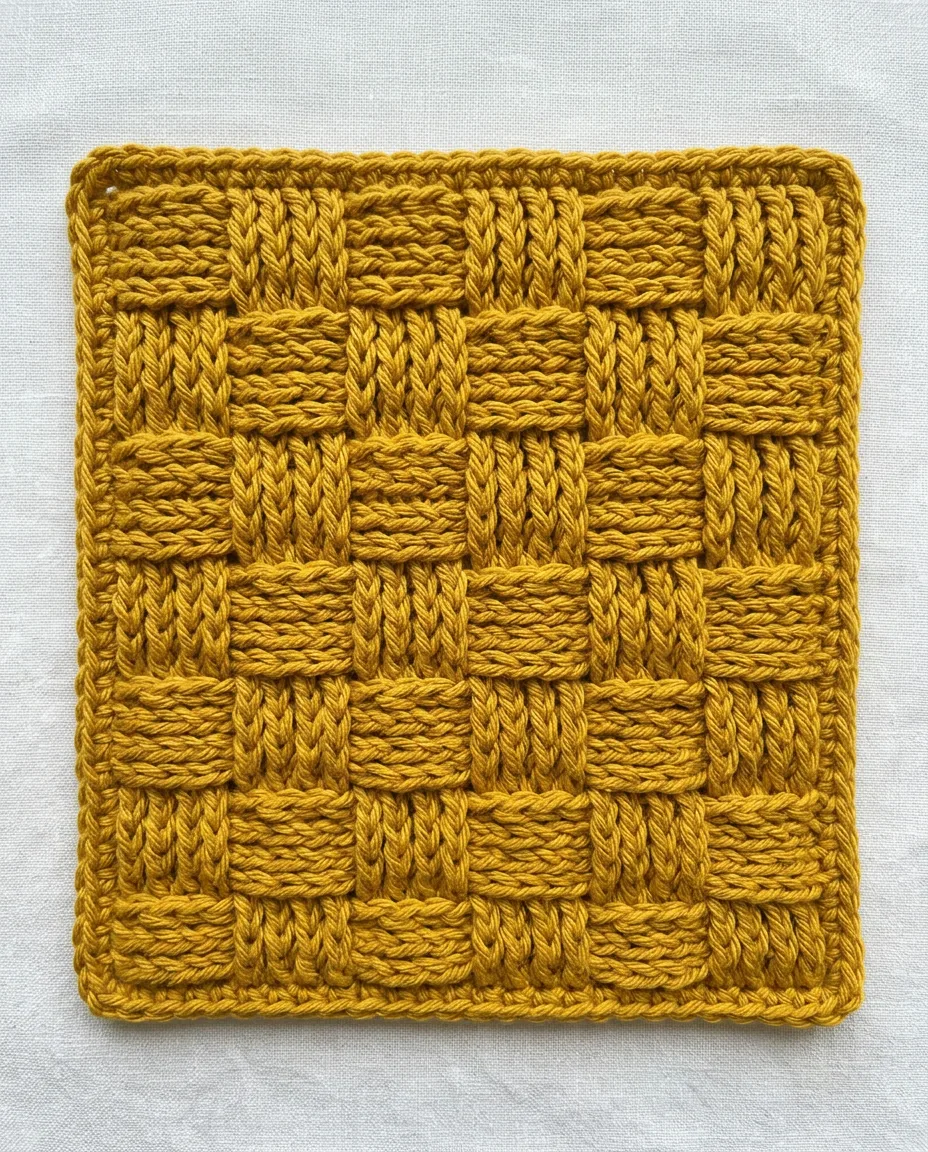
Work four stitches around their posts from the front. Then four from the back. Keep swapping like that and you’ve got basket weave, which honestly is the entire stitch. Give it a few rows and the blocks start bulging out and sinking in, until the fabric looks like flat strips of cane laced over and under each other.
People assume it’s an advanced stitch. Mostly because of how it looks. You only need two stitches for it, the front post double crochet and the back post double crochet, and both begin exactly like an ordinary double crochet does. A post stitch is just one you work around the upright stem of a stitch below instead of into its top. That’s it. Same yarn overs, same pull-throughs, different spot for the hook. (The terms here are US crochet terms, in case your pattern books are British.)
Worsted is a medium yarn, marked size 4 on the band. Go with cotton if you can. Fluffy acrylic softens the edges of each block, and cotton keeps them sharp. Color makes a bigger difference than you’d expect on a first swatch, the small test square you practice on before a real project: light and solid is best. Speckled yarn hides the posts. So does navy.
Work the stitch one group at a time
Twenty-six stitches across. Six blocks of 4, then one plain edge stitch on each side so the sides don’t wobble.
- Chain 28. Wrap the yarn over the hook from back to front (that’s a yarn over), then put the hook into the 4th chain from the hook.
- Pull up a loop. You’ll have 3 loops on the hook now. Yarn over, pull through 2 of them. Yarn over again and pull through the last 2, and that’s one double crochet.
- Double crochet in each chain across. Those 3 skipped chains at the start count as the first stitch, so Row 1 ends up with 26 stitches.
- Chain 2 and turn. The chain is your first edge stitch, so skip the first stitch of the row below.
- Yarn over. Push the hook from front to back just before the next stitch, then bring it back out to the front just after it. The hook should be lying behind that stitch’s post, its upright stem.
- Yarn over and pull up a loop, then finish it the way you’d finish any double crochet. One front post double crochet done. Do 3 more in the next 3 stitches.
- Now the back post double crochet. Yarn over, push the hook from back to front before the next stitch and out to the back again after it, so this time the hook sits in front of the post.
- Yarn over, pull up a loop, finish like a double crochet. Then 3 more back post double crochets.
- Alternate groups of 4 front post and 4 back post until there’s 1 stitch left. Put a half double crochet into the top of the turning chain, the 2 chains you made at the start of the row. For that one you yarn over and insert the hook, pull up a loop, then yarn over once more and go through all 3 loops at once. Row 2 has 26 stitches.
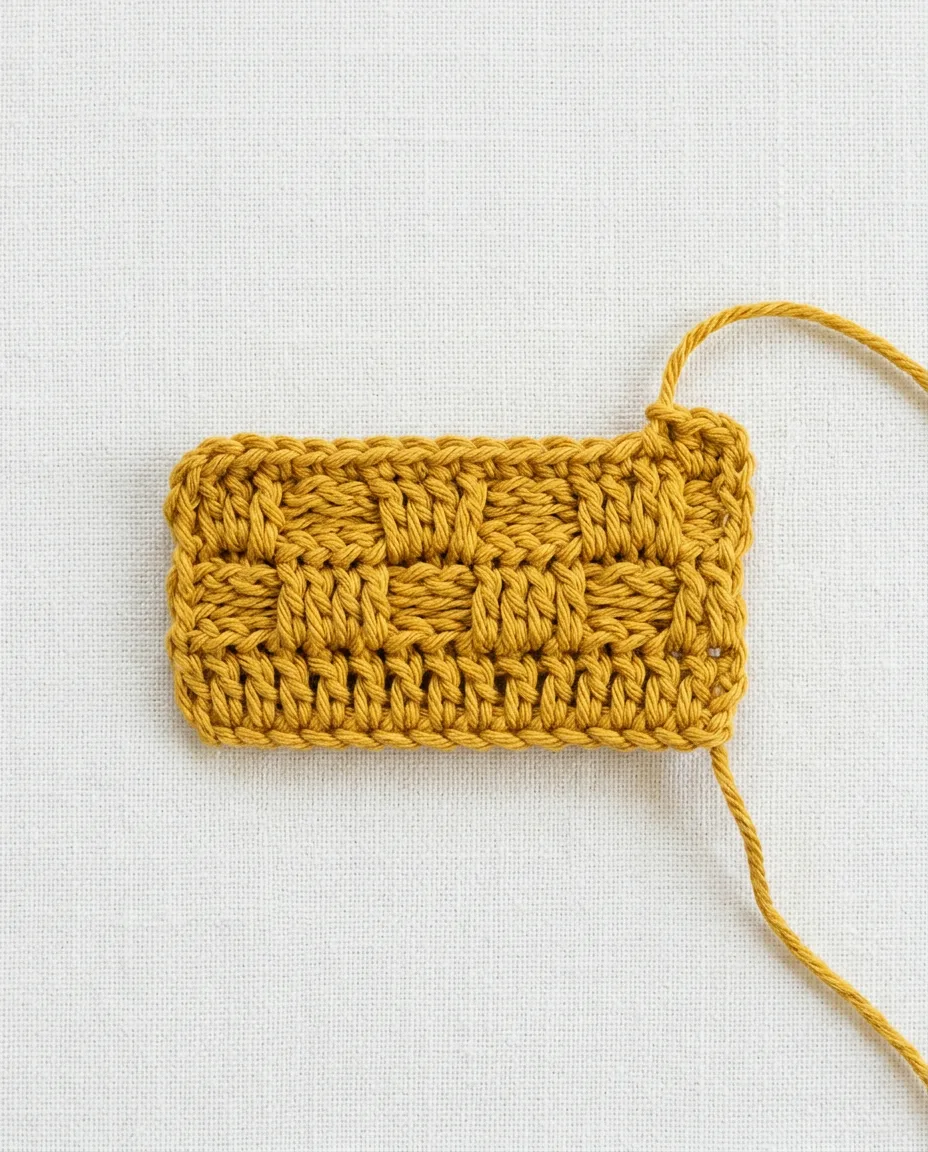
- Row 3 is worked exactly like Row 2, starting with 4 front post double crochets. It feels backwards because you’re on the back of the work, but this is what keeps each block raised on the same side.
- Rows 4 and 5 flip it. Start each of them with 4 back post double crochets, then 4 front post.
- Repeat Rows 2 to 5 twice more and stop after Row 13. You should have six blocks across and six up.
 Save
Don’t panic at Row 3. The swatch is still short, with one lonely band of raised and sunken blocks along the bottom and nothing resembling a checkerboard. That only shows up when Row 4 reverses things.
Post stitches push the blocks forward and back
An ordinary double crochet goes into the top of the stitch below it, under those two top loops. A post stitch skips the top entirely and hugs the stem. Hook it from the front and the new stitch tilts toward you; hook it from the back and it tilts away.
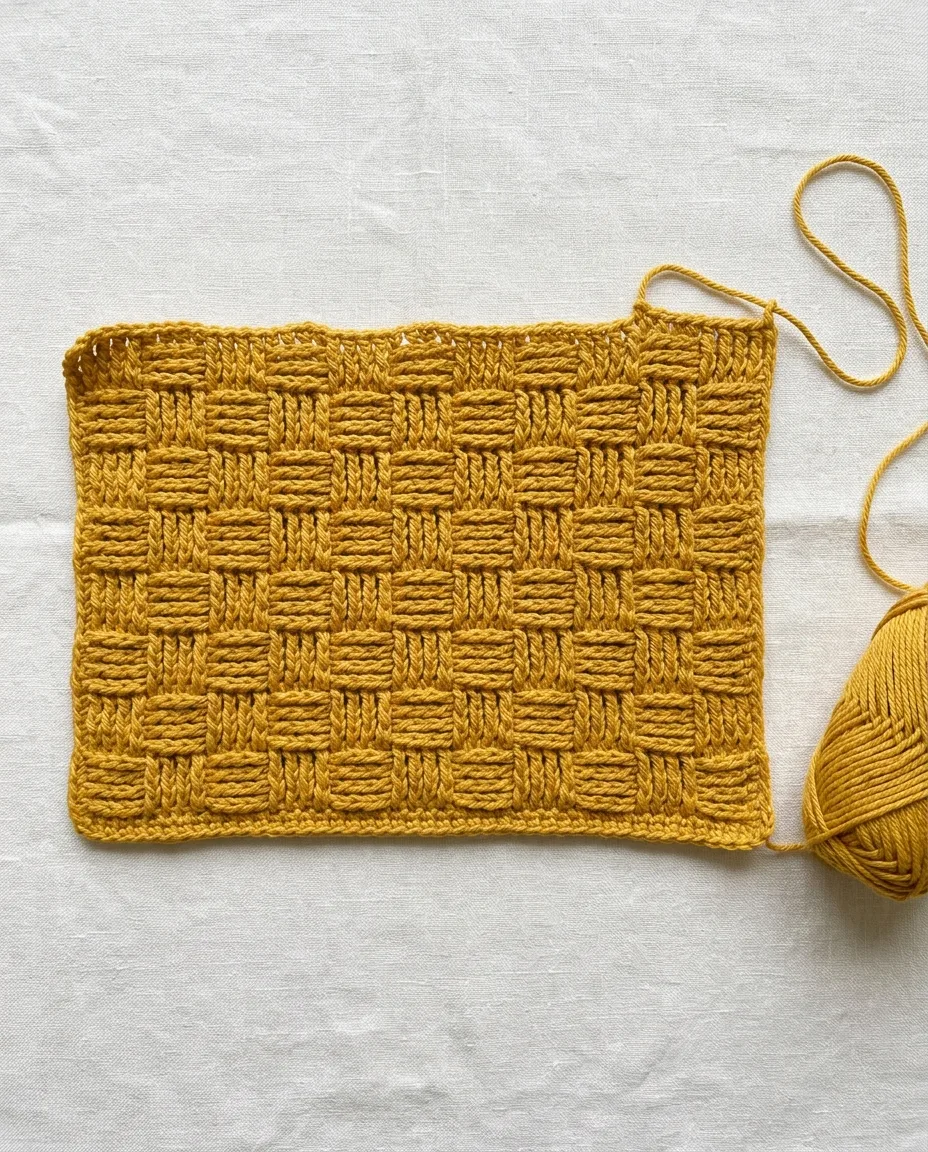
So four front post stitches in a row make a ridge that stands up. The four back post stitches beside them drop down. Stack two rows of that and you get a block that’s close to square, since a double crochet is roughly twice as tall as it is wide. And then the order flips. A raised block lands right on top of a sunken one, and your brain, which badly wants to see weaving, fills in the rest. Nothing is actually going over or under anything. Every row is worked flat, start to finish. The guide to the crochet popcorn stitch covers the whole method.
 Save
By Row 9 there’s no mistaking it. Tip the swatch on its side, though. Every post stitch wraps yarn around more yarn, so the fabric ends up much thicker and stiffer than plain double crochet. Good for some things. Bad for others.
Thick and warm, but slow to grow
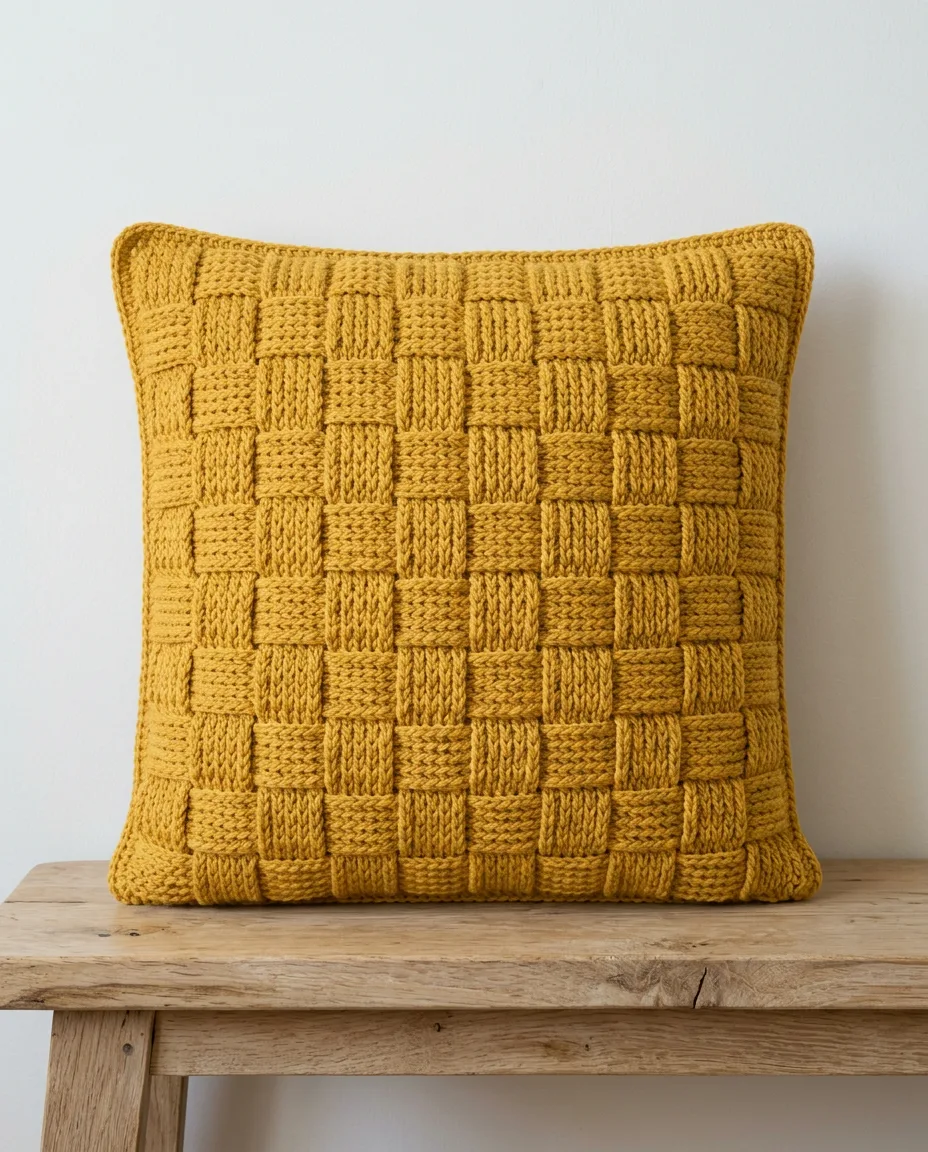
Dishcloths first. That’s where most people meet this stitch, and it earns its spot there, since the ridges scrub and cotton shrugs off hot water. Cushion covers are another good fit (the texture shows up from the other side of the room). Worked in a soft yarn, it turns into a dense baby blanket without the little holes that small fingers like to poke through.
Baskets and bins, too. Use a bulky yarn and a hook one size smaller than the band asks for. The fabric will stand up by itself.
 Save
Where it costs you is yarn. Time as well. Post stitches swallow noticeably more yarn than plain stitches do. The rows creep upward slowly, too. So buy more than you’d buy for a plain double crochet blanket of the same size, a good deal more if you hate running short. There’s not much stretch here either. Not much drape. Make a sweater body in basket weave and it hangs like a stiff, heavy panel, which is why it belongs on flat, sturdy things. There is a fuller walkthrough in the guide to shell stitch crochet.
Mistakes that break the checkerboard, and how to spot them
Row 3 causes most of the trouble. You’re on the wrong side, and the instinct is to copy what you see facing you. Ignore that instinct. Work it exactly as Row 2 is written. When a band of blocks comes out half as tall as the ones around it, a wrong-side row went the wrong way, and that’s nearly always the reason.
Then there’s counting. The edge stitches sit right there, begging to get a post stitch worked around them, and once that happens every block slides over by one. Count to 26 at the end of each row. Boring? Sure. Put a stitch marker in the turning chain, too, because that chain is very easy to skip without noticing.
Watch the hook. Sometimes it slips under the top loops when it was meant to go around the stem, and you get a flat stitch sitting inside a raised block. It shows up as a little dip.
Tight hands make this worse than they would with plain stitches. Yank the post stitches snug and the swatch pulls narrow, then the edges start to roll. Let the loop on the hook stay as tall as it would for a normal double crochet. Still curling? Go up half a hook size to 5.5 mm. That usually sorts it. The herringbone half double guide covers it round by round.
 Save
A smaller weave and a two-color version
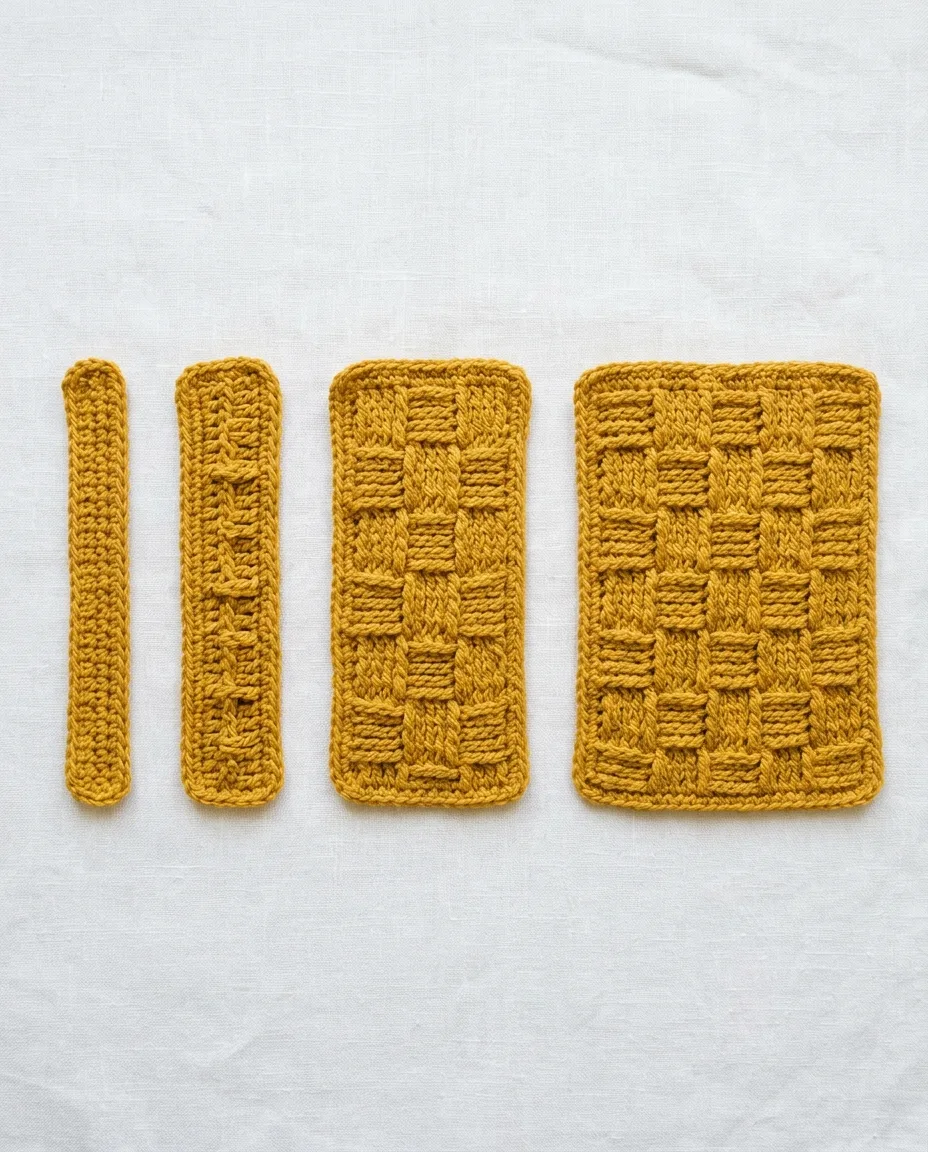
Want something finer? Blocks of 3 stitches. The same 28-chain start works, because the 24 stitches between the edges split evenly into 3s. Work 3 front post and 3 back post across Rows 2 and 3, then swap for Rows 4 and 5. These blocks end up a touch taller than they are wide, so the whole thing reads more like a woven placemat than a basket. Some people like that better.
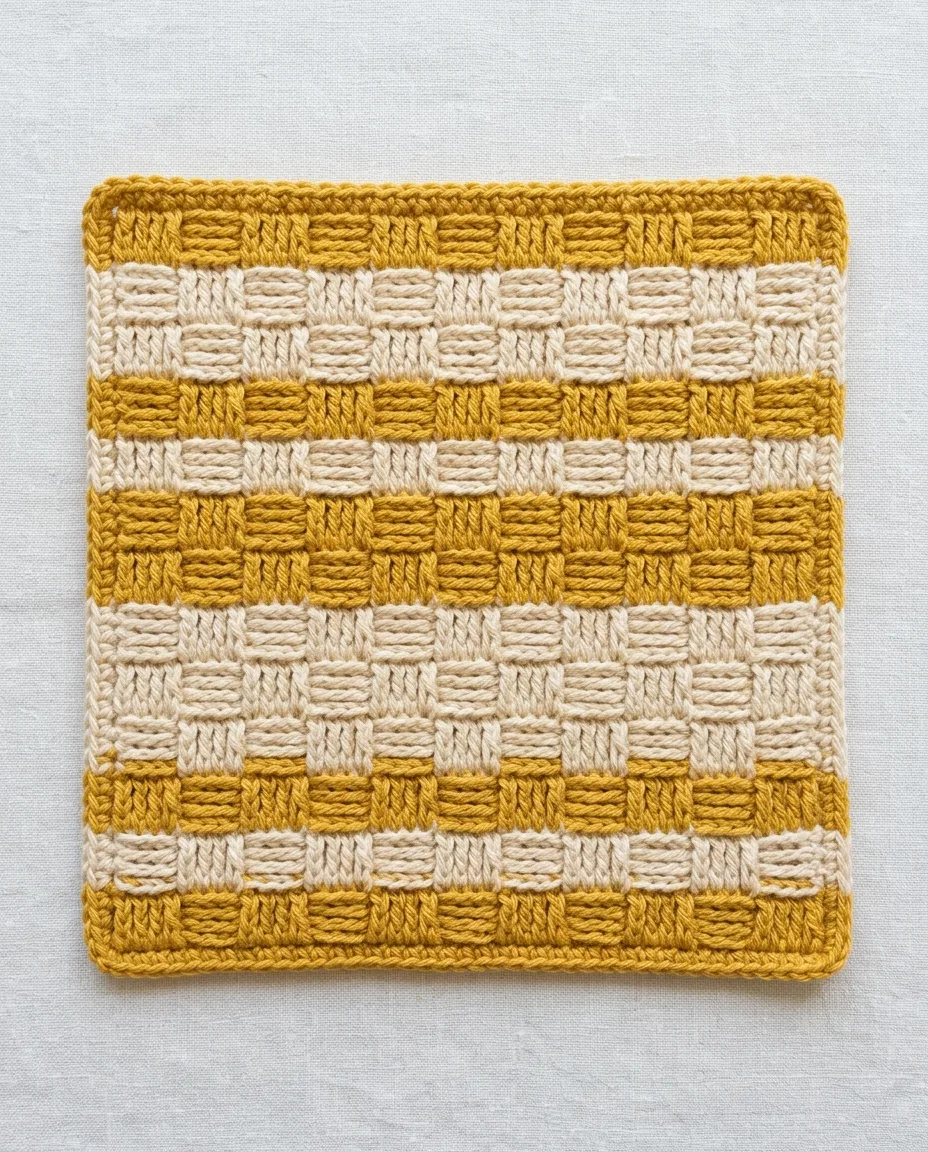
Two colors push the woven look further. Switch color at the start of Row 2 and then every second row, so each band of blocks is one color. Bring the new color in on the last yarn over of the row before it, and the switch tucks itself into the edge stitch where nobody looks.
 Save
Once the swatch makes sense, try a dishcloth. Chain 36, work Row 1 for 34 stitches and stop after Row 17. Eight blocks by eight fits a kitchen sink nicely.