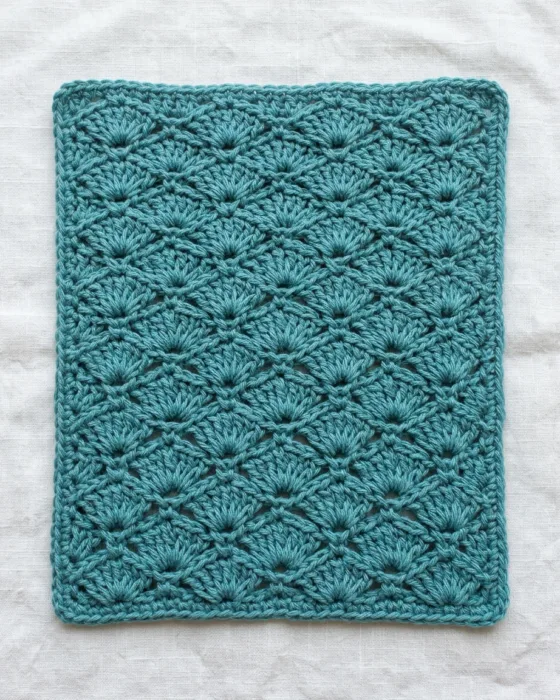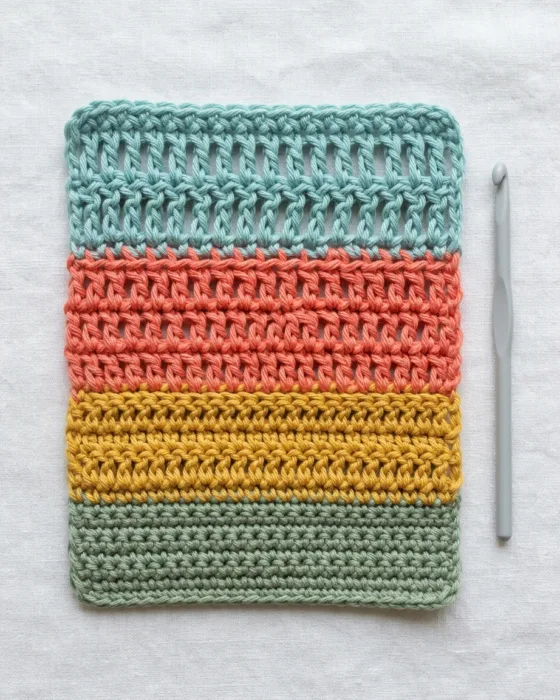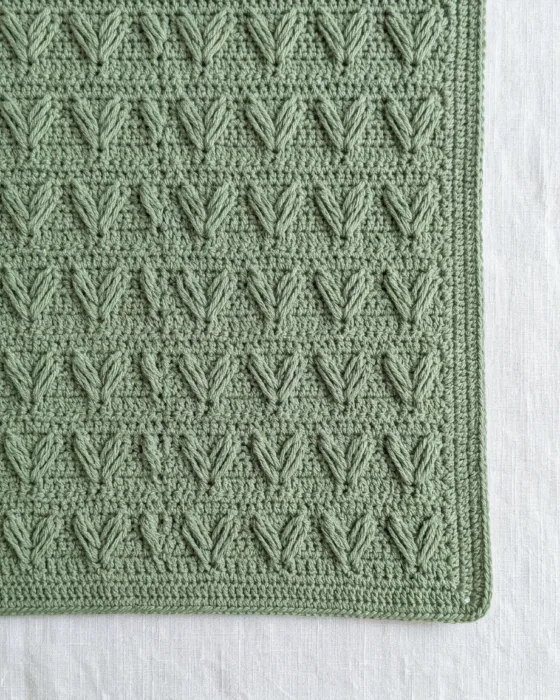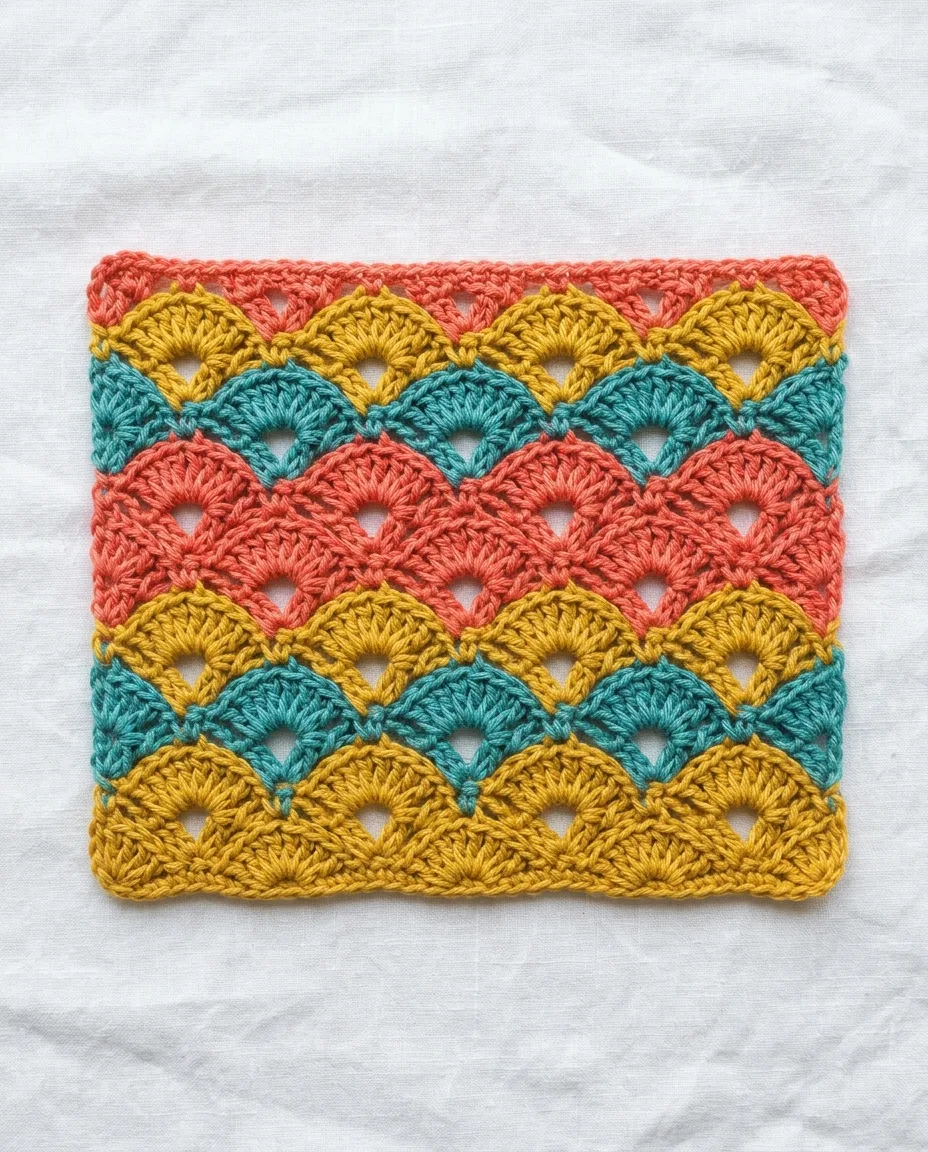
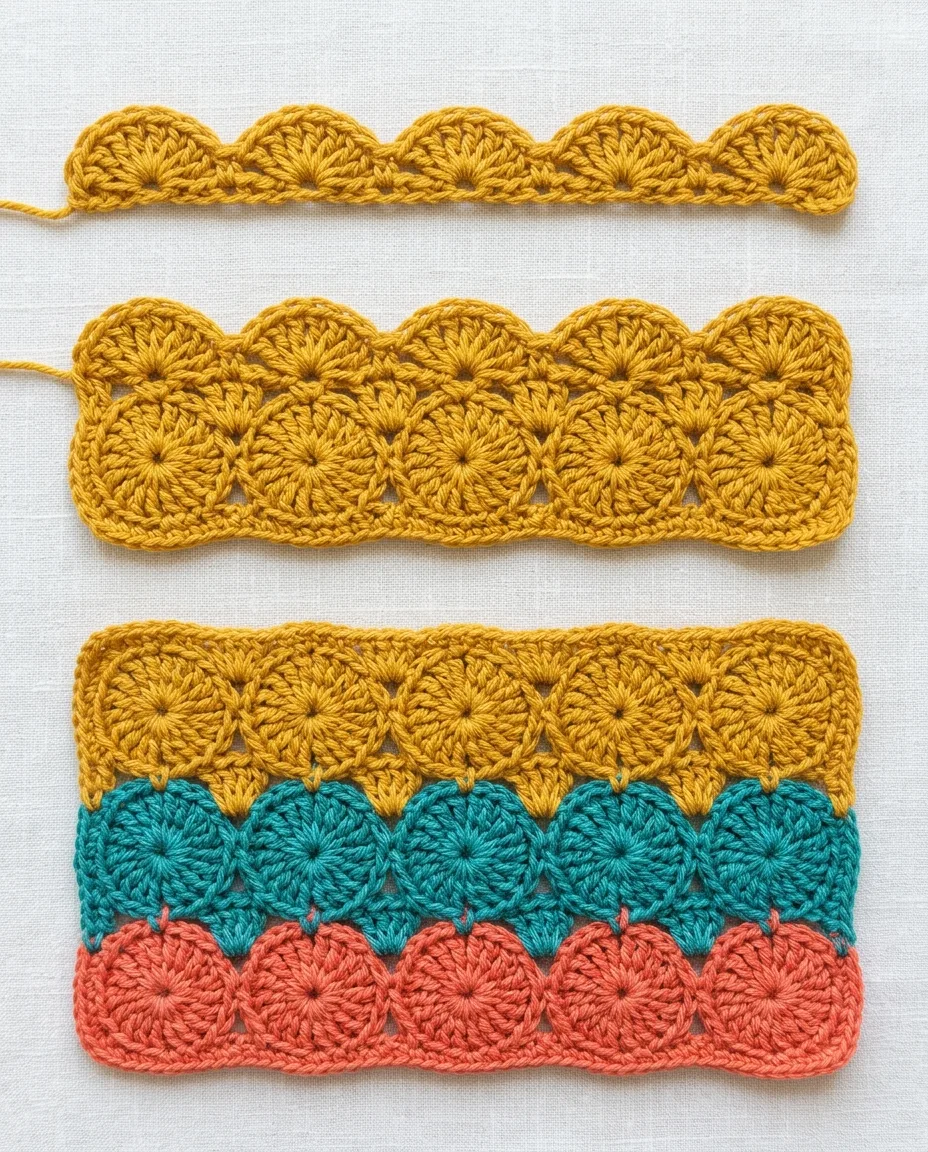
Three balls of cotton sit on the table: mustard, teal and a bit of coral left over from a dishcloth. Someone picks the mustard first, chains a short strip, and four rows later there’s a row of round wheels with teal ones tucked in the dips above them. That’s the Catherine wheel stitch. It makes offset circles across the fabric, and every color change shows up as a whole new row of them.
It isn’t a first-week stitch. You’ll need double crochet and you’ll need to count to seven, a lot. But the moves repeat, and once Row 2 clicks, the rest is the same four rows over and over. Plan on one evening for a swatch, the small test square you work before a real project. All terms here are US crochet terms.
How the fans and clusters are made
Two shapes do all the work. A fan is seven double crochets crammed into one stitch, so they spread out like a half circle. A cluster is the reverse. You start seven double crochets across seven stitches, stop each one partway, and join all their tops into a single point. Fan below, cluster above, and you’ve got a wheel.
- Chain 27. Count them twice, honestly.
- Single crochet in the second chain from the hook.
- One more single crochet in the next chain. That’s the edge.
- Skip 3 chains. Just leave them bare.
- Wrap the yarn over the hook from back to front. That wrap is called a yarn over. Push the hook into the next chain.
- Yarn over again and pull a loop back through. Three loops now.
- Yarn over, pull through two. Yarn over, pull through the last two. That’s one double crochet.
- Six more double crochets into that same chain. Seven in one hole, and the fan opens.
- Skip 3 chains. Single crochet in each of the next 3.
- Now the cluster, on Row 2. Start a double crochet but stop after the first pull-through. Two loops stay on.
- Same half-finished stitch in the next stitch over. Three loops.
- Keep going until seven stitches are started. Eight loops on the hook.
- Yarn over and pull through all eight at once. One cluster, done.
Step 13 is the one people fumble. Eight loops is a crowd, so pull through slowly and keep the hook tilted down a little. If a loop slips off, put it back on before you go any further. Losing one means the cluster only has six legs and the wheel gets a flat side.
The full pattern, row by row
Abbreviations live in the rows below: sc is single crochet, dc is double crochet, sk is skip, sp is space. Dc7tog is the cluster from the steps above. Dc4tog is a shorter version that gathers four stitches at the edge.
- Sc in 2nd ch from hook, sc in next ch, *sk 3 ch, 7 dc in next ch, sk 3 ch, sc in next 3 ch; rep from * to last 4 ch, sk 3 ch, 4 dc in last ch, turn 26 sts
- Ch 2 (does not count), dc4tog over first 4 sts, *ch 3, sc in next 3 sts, ch 3, dc7tog over next 7 sts; rep from * to last 2 sts, ch 3, sc in last 2 sts, turn 26 sts
- Ch 3 (counts as dc), 3 dc in first st, sk next sc, *sc in next ch-3 sp, sc in top of next cluster, sc in next ch-3 sp, sk next sc, 7 dc in next sc, sk next sc; rep from * to last ch-3 sp, sc in ch-3 sp, sc in top of dc4tog, turn 26 sts
- Ch 1, sc in first 2 sts, *ch 3, dc7tog over next 7 sts, ch 3, sc in next 3 sts; rep from * to last 4 sts, ch 3, dc4tog over last 4 sts, turn 26 sts
- Ch 1, sc in top of dc4tog, sc in next ch-3 sp, *sk next sc, 7 dc in next sc, sk next sc, sc in next ch-3 sp, sc in top of next cluster, sc in next ch-3 sp; rep from * to last 2 sts, sk next sc, 4 dc in last sc, turn 26 sts
- Rep Rows 2 to 5 until the piece is as tall as you want, ending after a Row 4 26 sts
- Ch 1, sc in top of dc4tog, *3 sc in next ch-3 sp, sc in next 3 sts, 3 sc in next ch-3 sp, sc in top of next cluster; rep from * to last ch-3 sp, 3 sc in ch-3 sp, sc in last 2 sts 26 sts
 Save
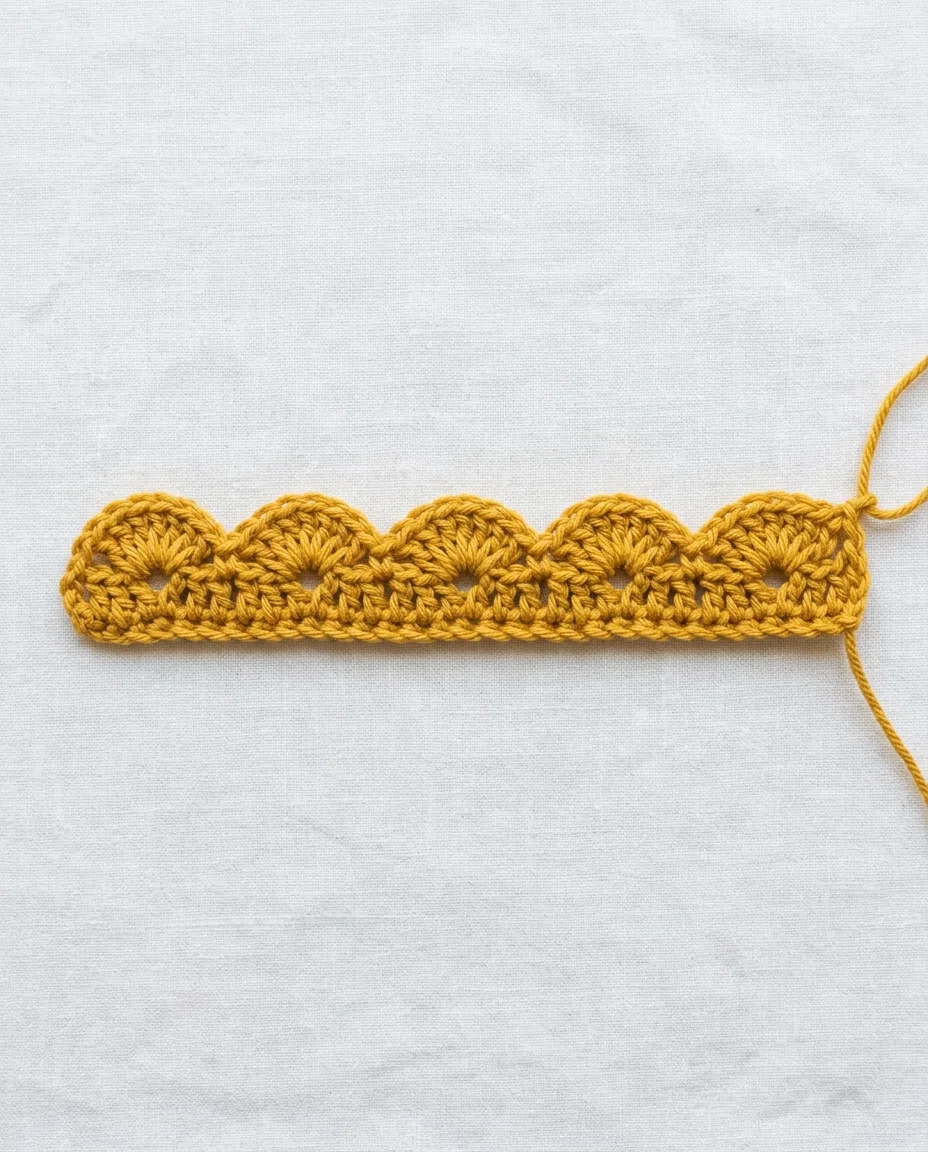
Row 1 looks like a shell stitch. Nothing round yet. That’s fine.
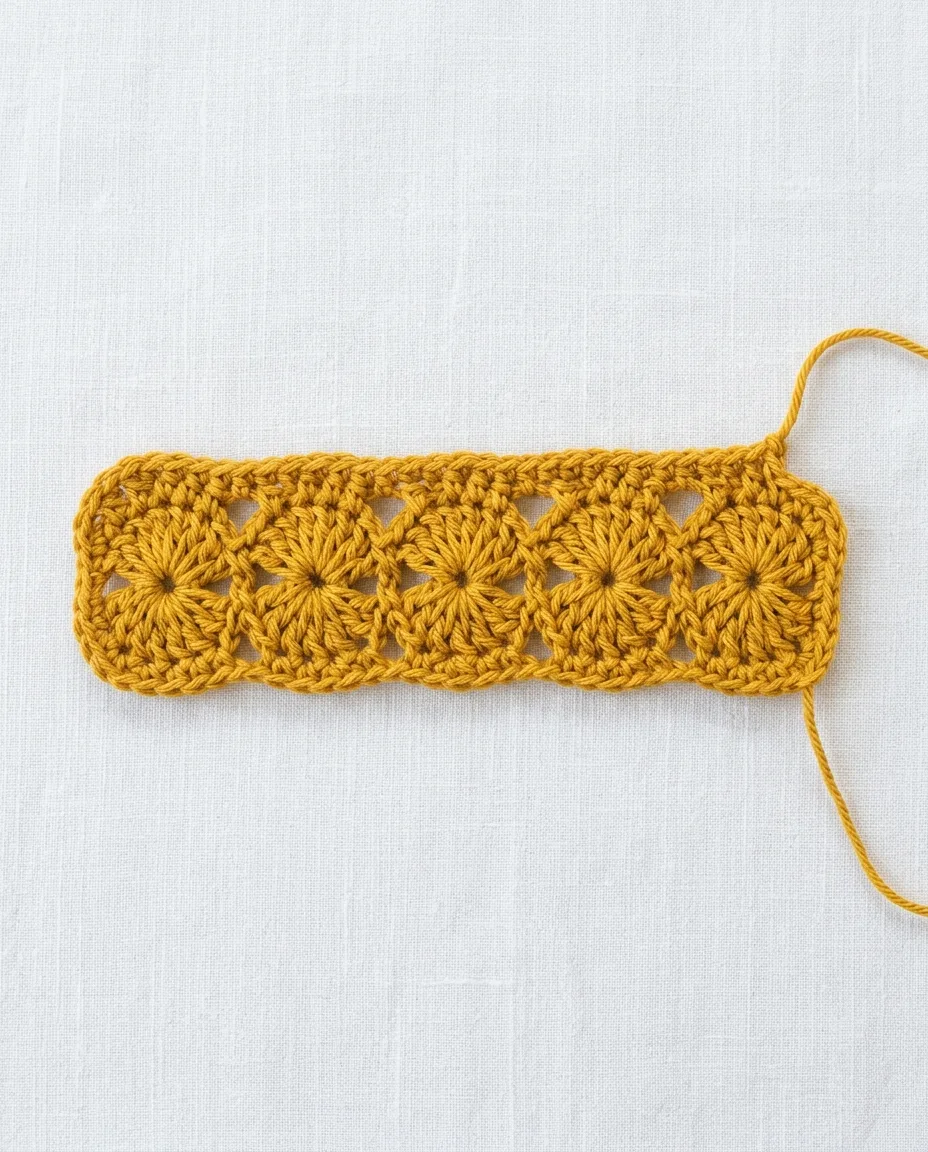
Counts in the rows include the chain-3 loops, three per loop. So Row 2 still adds up to 26 even though it has only 9 real stitches. If you’re short at the end of any row, check the last fan first. Four double crochets at the edge get forgotten more than anything else in this pattern, and a missing one shifts every wheel above it.
 Save
And the turning chain on Row 3, the few chains you make at the start of a row to reach stitch height, counts as a stitch. Ch 3 there stands in for the first double crochet of the half fan. Skip it on Row 4 and the dc4tog only has three real stitches to grab. That corner pulls in.
Changing colors so each wheel stands alone
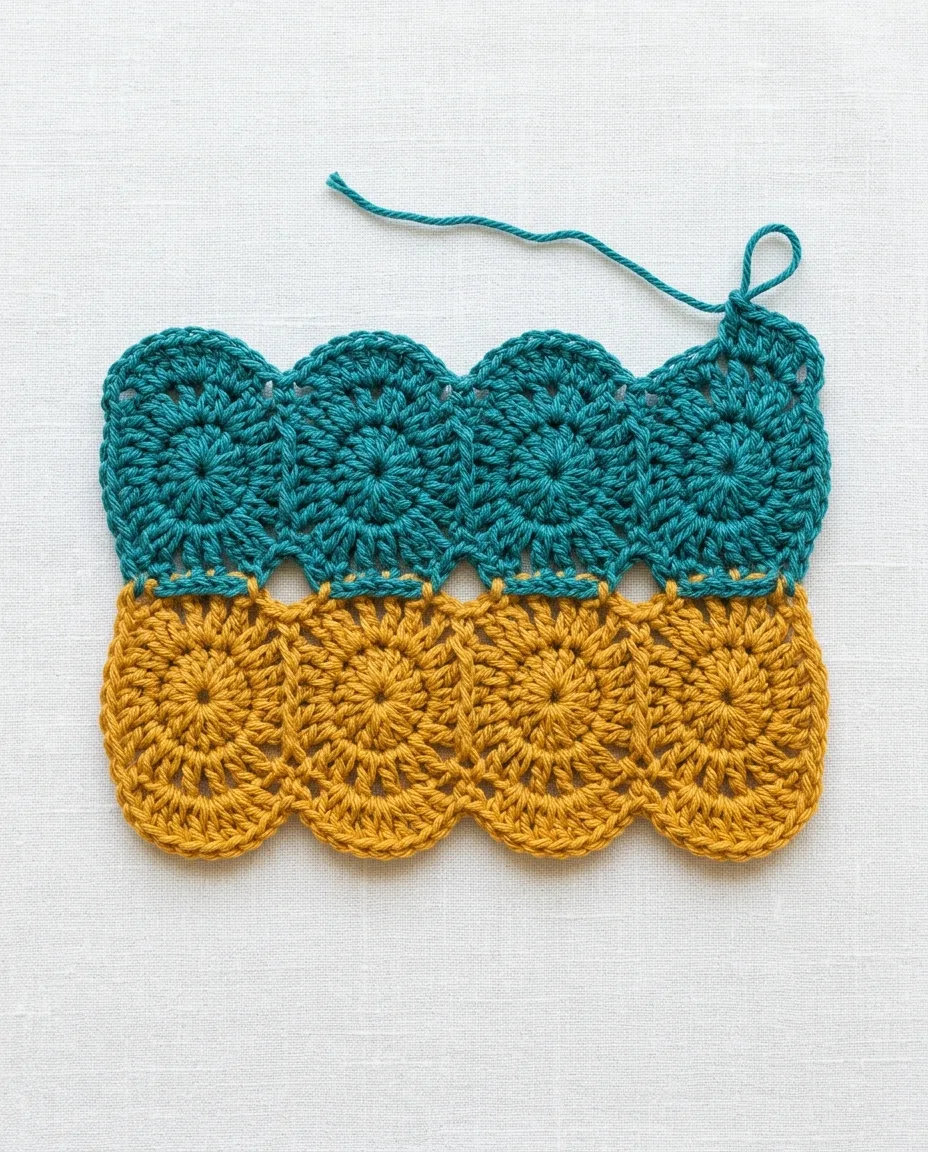
A wheel is two rows: the fan row and the cluster row on top of it. So swap colors every two rows, at the end of Row 2 and Row 4. Do the swap on the very last yarn over of the row. The old color finishes the stitch, the new color is what you pull through, and the next row starts clean.
Two colors give a checkerboard of circles. Three is where it starts to swirl, since no band ever touches its own color. Want more contrast? Put a pale color between two dark ones. Mustard next to teal reads well from across a room; navy next to dark green mostly disappears. Coral works as the third color in almost any mix. It’s bright enough to separate the other two. Cream does the same job more quietly.
 Save
Ends pile up fast. Two per color change, on both edges. Weave them into the single crochets along the side, where they hide well. Leave each tail at least 4 inches (10 cm) long. The needle needs something to hold. Carrying the unused color up the side works too if it’s only two rows, but it’ll show as a short float on the edge.
Where the wheels look best
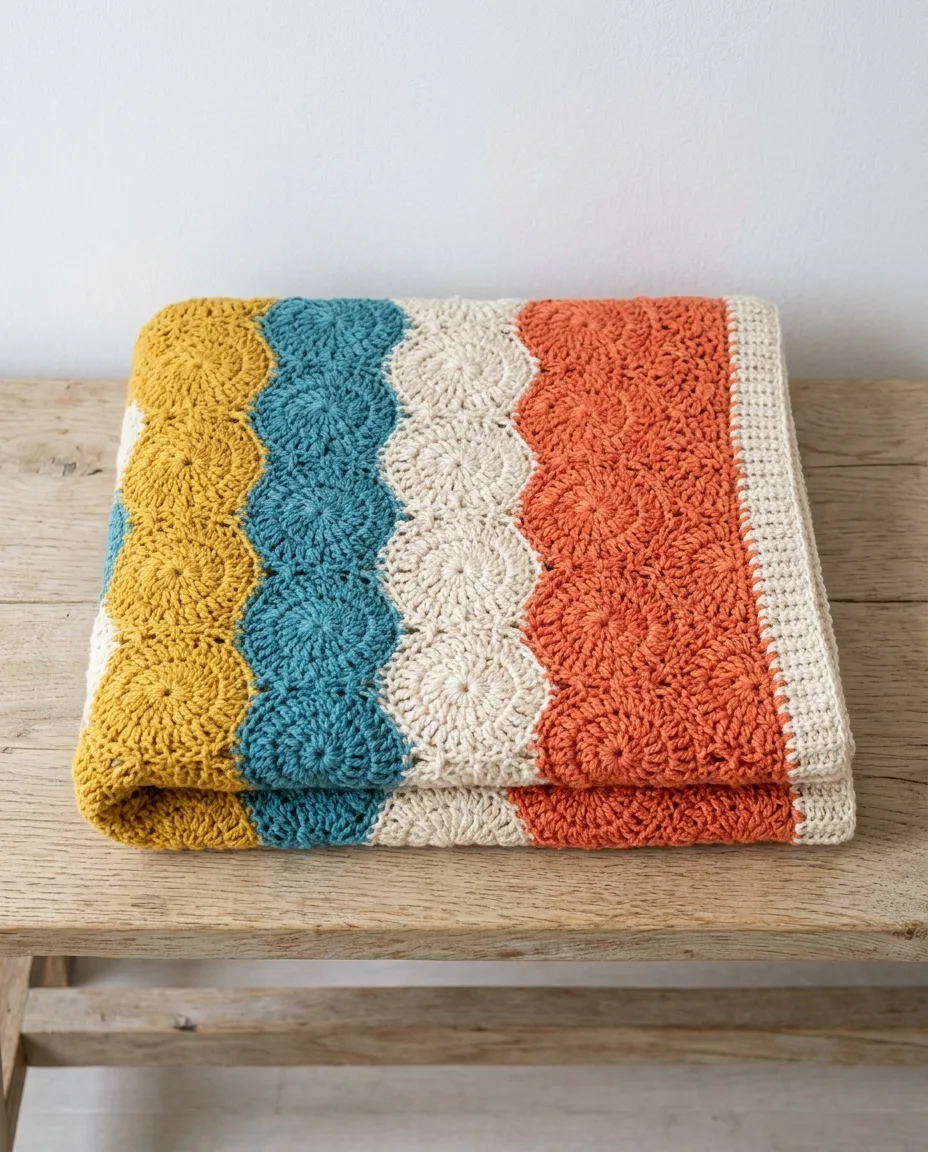
Big, flat things. Blankets and cushion covers show off the circles, and a throw in four colors makes a good first big project. Scarves work as well, though the back looks rougher than the front. No pattern this busy suits a small, shaped piece like a hat crown, since the wheels get cut off at every decrease.
 Save
Fabric weight matters here. It’s thick. Each wheel packs a lot of yarn into one spot, and a throw in this stitch swallows more yarn than plain double crochet would. Cotton gives the sharpest circles. Acrylic is softer and lighter, but the wheels blur a bit at the edges.
If the edges ripple or the wheels lean
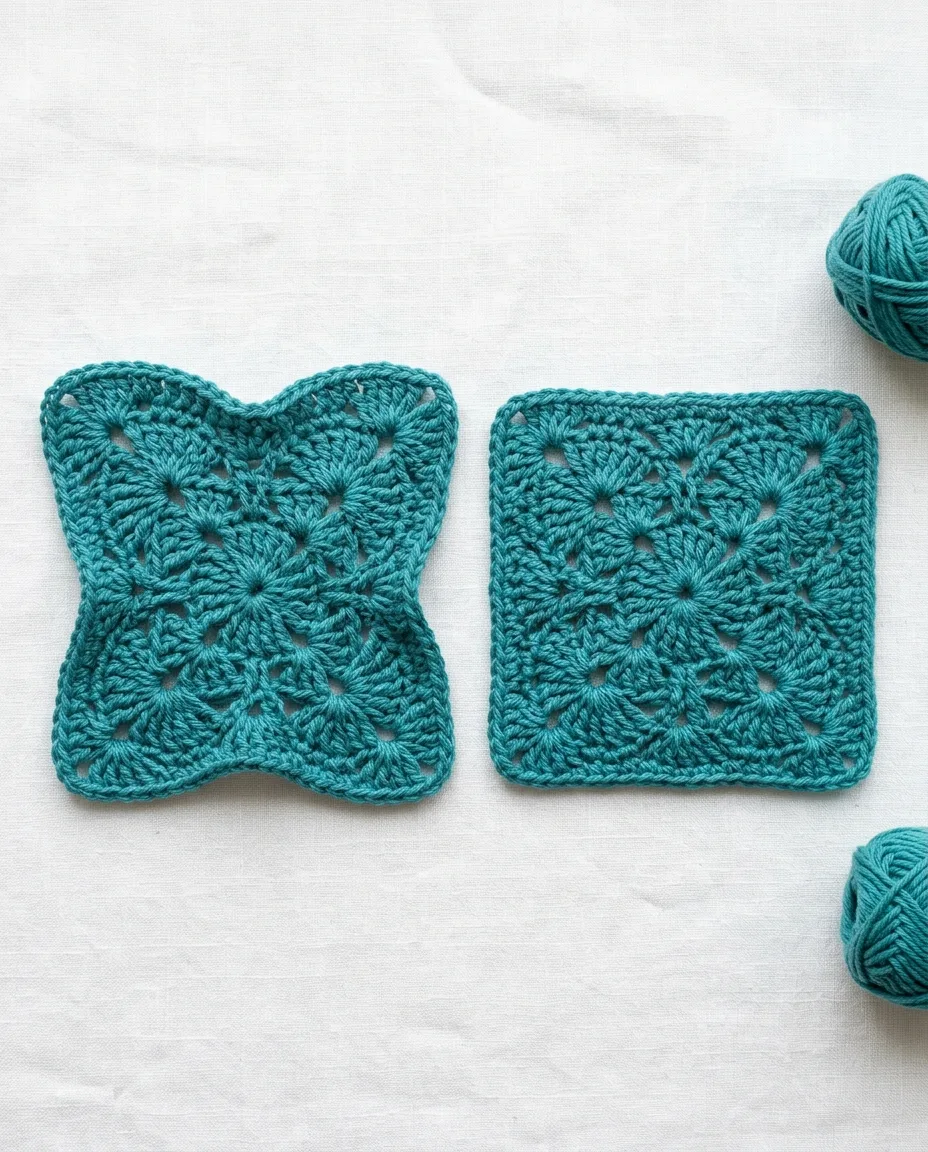
Rippled sides almost always mean the fans are too loose. Seven double crochets in one stitch can flare like a skirt. Drop to a 4.5 mm (7) hook and try four rows again. Usually that’s enough. Still waving? Check that every fan sits in a single stitch. Two fans sharing a stitch, or one fan split across two, adds width the rows can’t take back.
 Save
Leaning wheels are a counting problem. Somewhere a fan went into the wrong stitch, so the one above it lands off center. Count the three single crochets between fans on every fan row. The fan goes in the middle one of the three, every time. If a wheel leans to the right, the fan below it probably went one stitch too far along.
Gaps beside the clusters come from chain-3 loops pulled too tight. Loosen up on those and the space fills. A small hole there is normal, though. It’s part of how the circle looks.
A smaller wheel for finer yarn
Five-stitch wheels suit sport weight yarn and baby blankets. Chain a multiple of 8 plus 6. Skip 2 chains on each side of a fan instead of 3, work 5 double crochets per fan, and close each cluster as dc5tog. Edge half fans become 3 double crochets. The circles come out tighter and closer together, which reads more like texture than like a bold graphic.
Not every yarn takes it well. Fluffy mohair and chenille hide the cluster points, and the wheels turn into bumps. Smooth yarn with a firm twist keeps the spokes clear. If you can see each stitch in a plain swatch, it’ll work here.
 Save