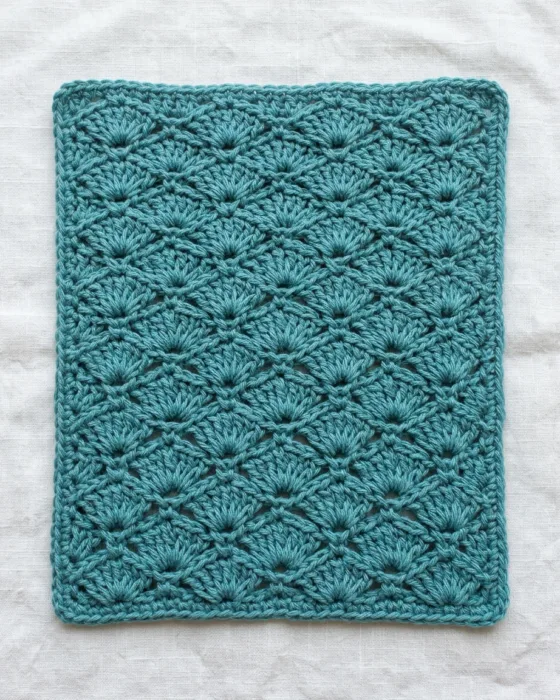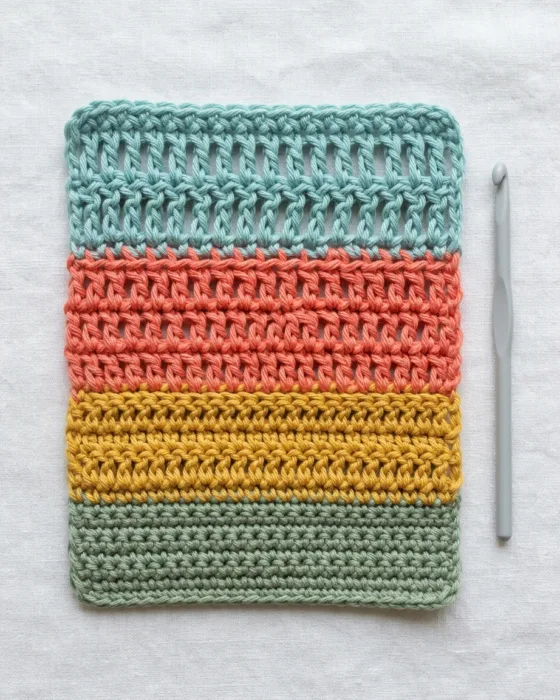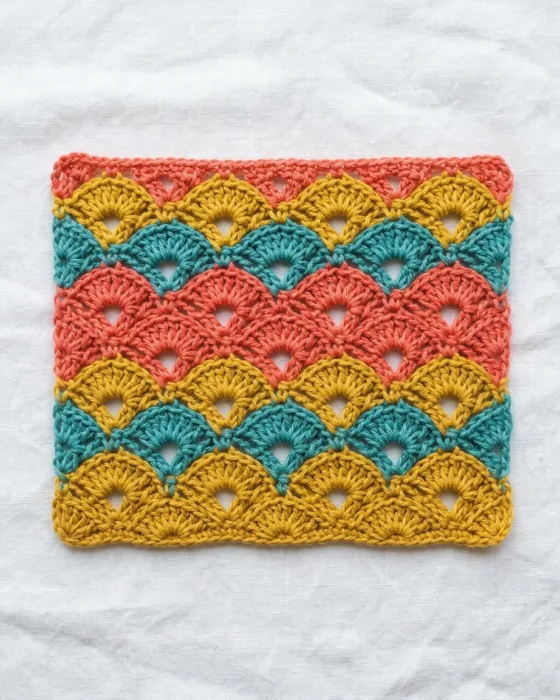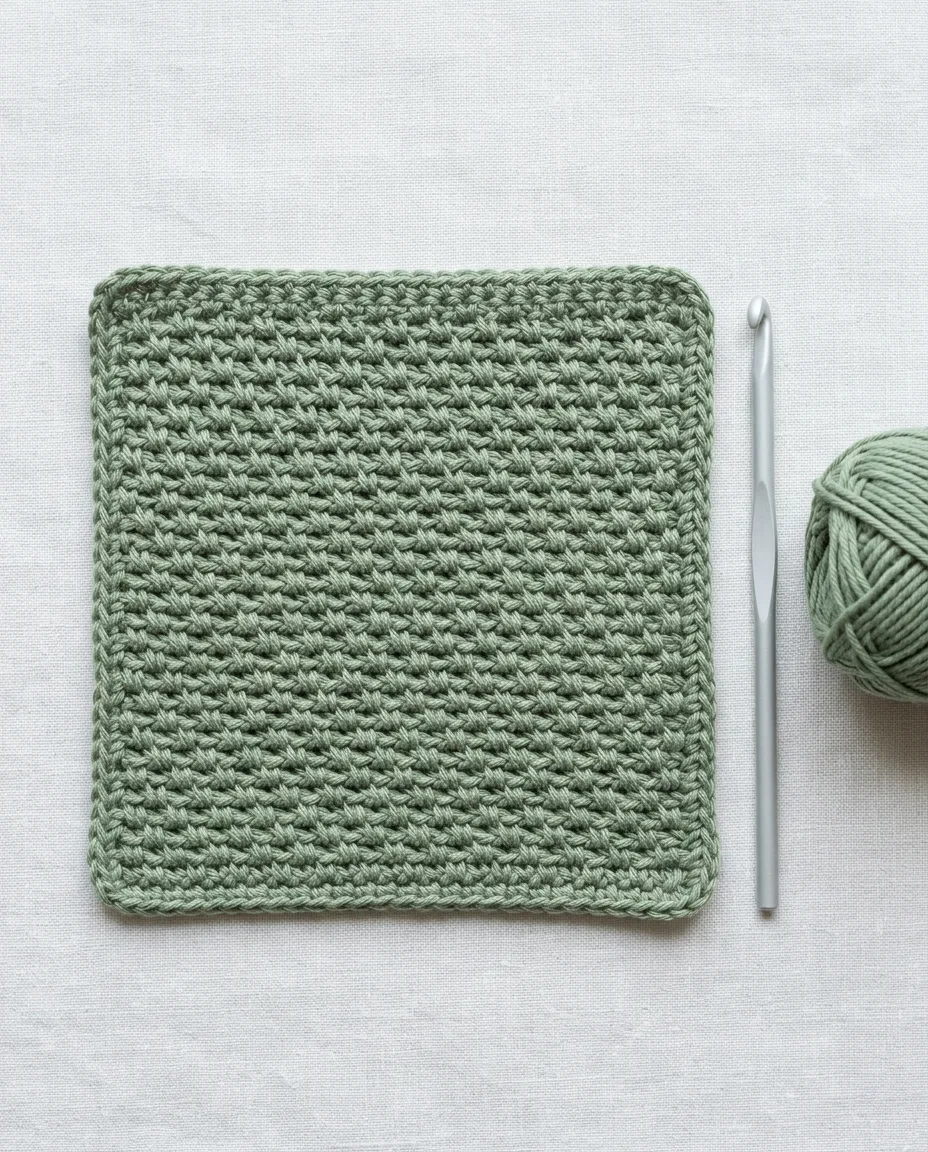
Half stitches, half gaps. That’s moss stitch. Every row alternates one single crochet with one chain, edge to edge. The next row drops its stitches into those gaps and lays its chains over the stitches. The offset locks everything into a brick pattern. You end up with a flat, firm fabric that looks surprisingly like cloth off a loom.
You’ll also see it called linen stitch, and older patterns say granite stitch. In crochet, all three names mean the same thing. To work it, the hook goes into a gap. You yarn over, which means wrapping the yarn over the hook from back to front, and pull up a loop. Wrap again and pull through both loops on the hook. That’s a single crochet. The only other move is the chain. So if you can chain, an afternoon is enough to learn this.
US crochet terms throughout. British patterns call a US single crochet (sc) a double crochet, which confuses a lot of people at first. In worsted weight yarn, the practice swatch below comes out about 4 inches (10 cm) square. Worsted is the medium-thick yarn with a 4 on the band.
Work moss stitch, row by row
The steps lean on three terms. A yarn over means wrapping the yarn over the hook from back to front. A chain-1 space is the little gap under a single chain. And the turning chain is the short chain at the start of each row. It lifts your hook up to the height of the new stitches.
- Chain 18. Keep it loose. The first row will tighten it for you.
- Put the hook into the 4th chain from the hook. Yarn over and pull up a loop. Yarn over once more and pull through both loops on the hook. One single crochet done.
- Chain 1 and skip the next chain. Single crochet into the chain after that.
- Keep repeating that step to the end. You should have 8 single crochets, with a chain-1 space between each pair.
- Turn and chain 2. Those two chains form the edge of the new row.
- Skip the first single crochet. Push the hook through the open gap under the first chain-1 space, and single crochet there.
- Chain 1 and skip the next single crochet. Then single crochet into the next chain-1 space.
- Repeat across. The final single crochet goes into the space under the turning chain from the row below.
- Turn and repeat that row until the swatch is square, about 20 rows.
18 chains give 8 single crochets per row. Count at the end of every row. Get seven and a space was skipped. Get nine and one was worked twice. Either way, the swatch starts leaning within a few rows. The guide to herringbone half double crochet covers the whole method.
 Save
The offset is what makes it look woven
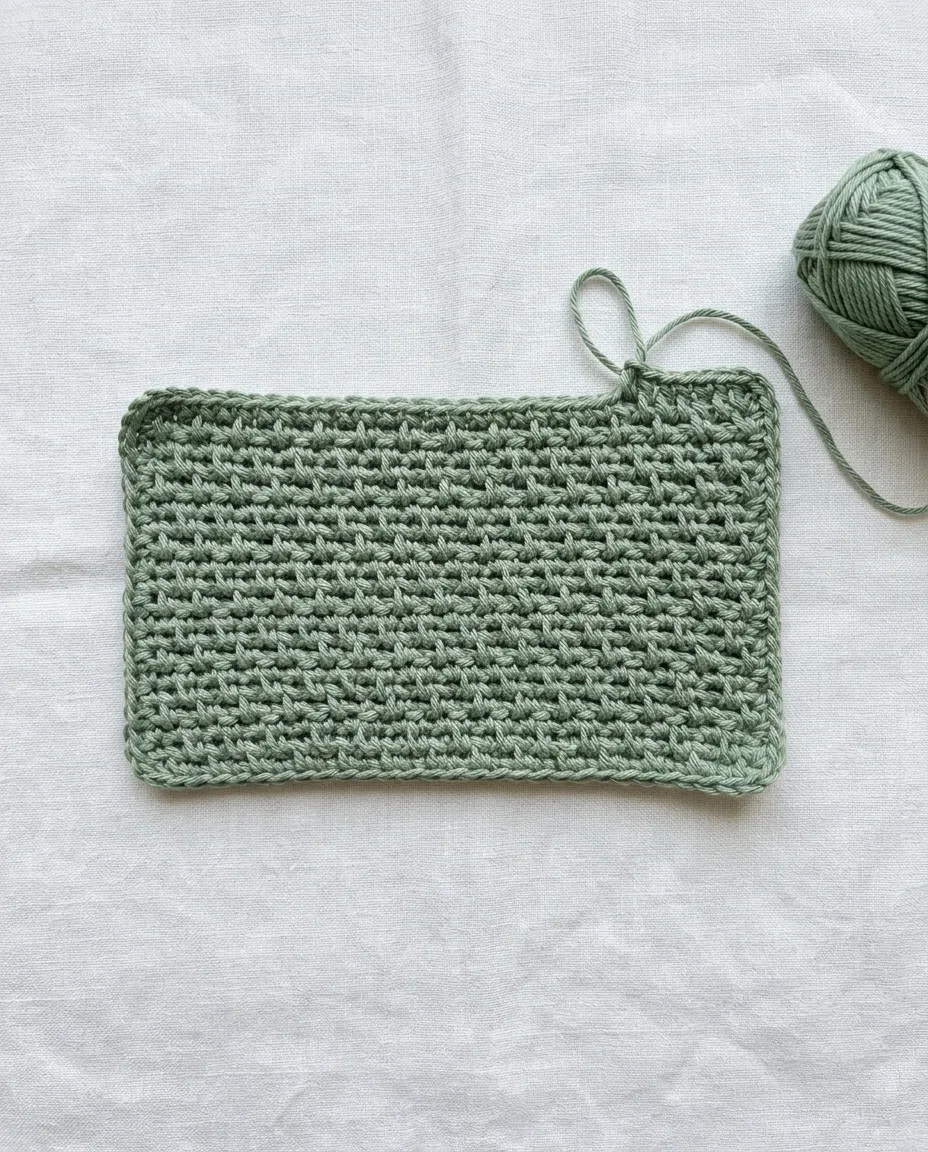
Ten rows in, take a look. Every single crochet sits above a gap, and every gap sits above a single crochet. They line up into small diagonal ribs running both ways across the fabric. Step back a bit and those ribs read as over-and-under threads, like a coarse linen tablecloth. Flip it over. The back is almost identical to the front, so a scarf or a dishcloth has no wrong side to hide.
And the chains are doing more than filling space. Each one lies across the top of the stitch below and covers its top loops. Plain single crochet shows a ridge of loops on every row. Moss stitch tucks them away, and that’s why the surface looks smooth. The herringbone half double guide covers it round by round.
 Save
Dense, yes. Stiff, no. Plain single crochet in the same yarn actually feels stiffer, since it has no chains to give a little. Moss stitch also tends to lie flat on its own. The corners rarely curl, so a finished dishcloth seldom needs blocking (wetting a piece and pinning it to shape while it dries). That alone makes it a good first stitch for kitchen cloths.
Big hook, softer fabric
Go one hook size up from the yarn band. Sometimes two. Moss stitch runs tight by nature, because every chain gets squeezed between two stitches. Use the hook the band suggests and worsted cotton comes out closer to a trivet than a cloth. With a 5 mm (H) hook, it still folds in your hand.
Gauge is how many stitches and rows fit in a set width, usually 4 inches. For anything that has to fit a body, it matters. With this stitch, count the single crochets and the chains together. With the 5 mm hook you can expect roughly 17 of them across 4 inches, and about 20 rows in the same height. Your hands might run tighter or looser. If the number’s off, change the hook and leave everything else alone.
Not every yarn shows the weave. Fuzzy mohair blurs the chains into a haze. Smooth cotton or plain wool gives you the clearest pattern. Variegated yarn is the fun one here. The color shifts along the strand, and the short stitches chop each color into small flecks instead of long stripes.
Dishcloths and market bags suit it best
In cotton, moss stitch makes a very good dishcloth. Firm enough to scrub a pan. It dries faster than solid single crochet too, since air gets through the gaps under the chains.
 Save
Market bags work for much the same reason. A key can’t slip through gaps that small, yet the fabric still shifts around whatever you put inside. Go with a firm cotton or a cotton blend. Make the handles in plain single crochet, though. They stretch less that way.
Scarves are a natural fit as well. Front and back match, so the scarf looks right however it falls around the neck. Blankets? Possible, but slow. Each row adds just one short stitch of height, about a fifth of an inch (5 mm). A 50 inch throw needs around 250 rows. That’s a whole winter.
Three mistakes that tilt the swatch
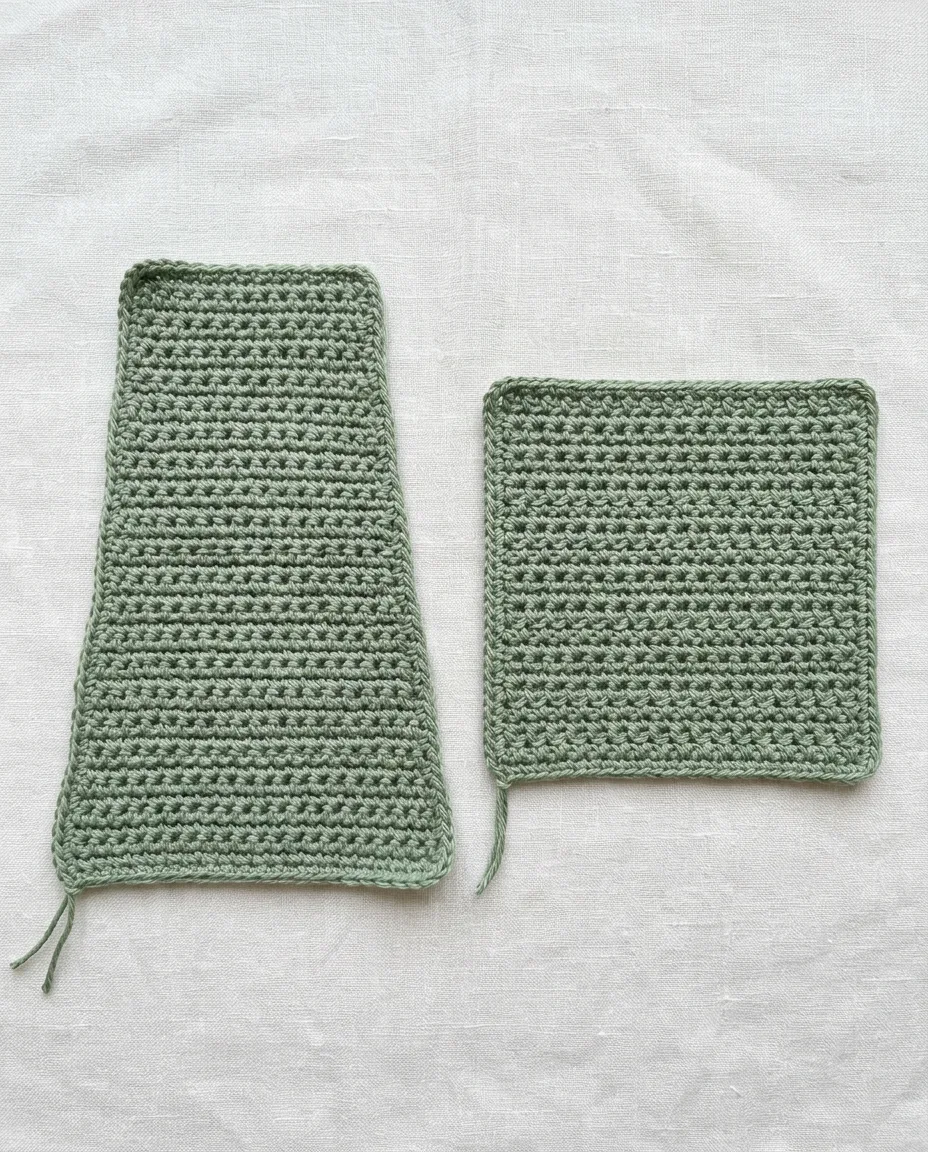
Narrowing toward the top is the first problem you’ll likely hit. The culprit is almost always the last stitch of the row. It belongs in the space under the turning chain, and that space hides well. Skip it once and the row drops a stitch. Skip it every few rows and both sides slope inward. For the first few rows, tie a scrap of contrast yarn around each turning chain so you can spot it.
 Save
Problem two is a tight foundation chain, the starting chain the first row is built on. The first row pulls it in, and the bottom edge gathers up like a drawstring bag. The fix is quick. Chain with a hook one size bigger, then switch back for the rows.
But the third mistake is harder to see. Some beginners stab the hook into the chain itself, right through its loops. That perches the new stitch on top of the chain, and the brick pattern goes lumpy. Every time, the hook goes through the open gap under the chain. After a few rows it gets easy. There’s one gap directly above every single crochet in the row below.
Two colors make a tweed
Switch colors every two rows and moss stitch becomes tweed. The colors break into short, staggered dashes. From across a room, the two blend into one. Choose two colors with a clear difference in lightness, like cream and rust. Two shades of similar depth just smear together.
Work two rows in the first color. At the last single crochet of row two, insert the hook, yarn over and pull up a loop. Now drop the old color. Yarn over with the new one and pull through both loops. Let the old strand hang at the side. Two rows later you’re back at that same edge, so you can pick it up again without cutting. Carry it loosely up the side. The border covers it later.
 Save
You can change color every single row instead. The flecks get finer. The catch is that each row ends at the opposite edge, so you cut the yarn and weave in two ends per row. Across a blanket, that’s hundreds of ends. For a big piece, stick to two-row stripes.
Finish with a border
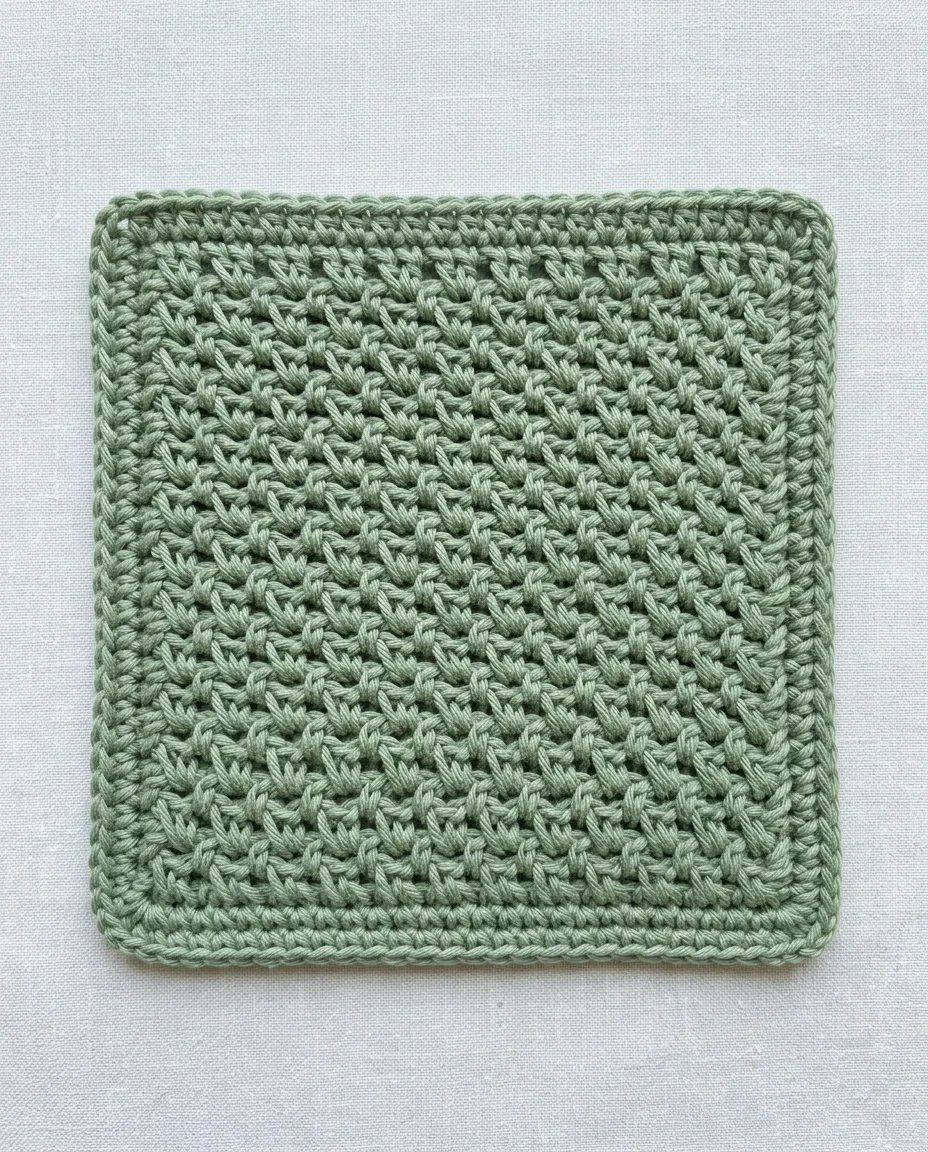
No moss stitch edge comes out perfectly straight. Turning chains sit a little looser than the stitches next to them, so the sides wave slightly. A single round of single crochet around the outside fixes it.
Along the top and bottom, work one single crochet into each stitch and each space. On the sides, put one into the end of each row. Corners get 3 single crochets in the same spot, which lets them turn flat. Join to the first stitch with a slip stitch. For that, insert the hook and yarn over. Then pull the loop straight through both loops on the hook. Weave in the ends with the yarn needle and you’re done.
 Save
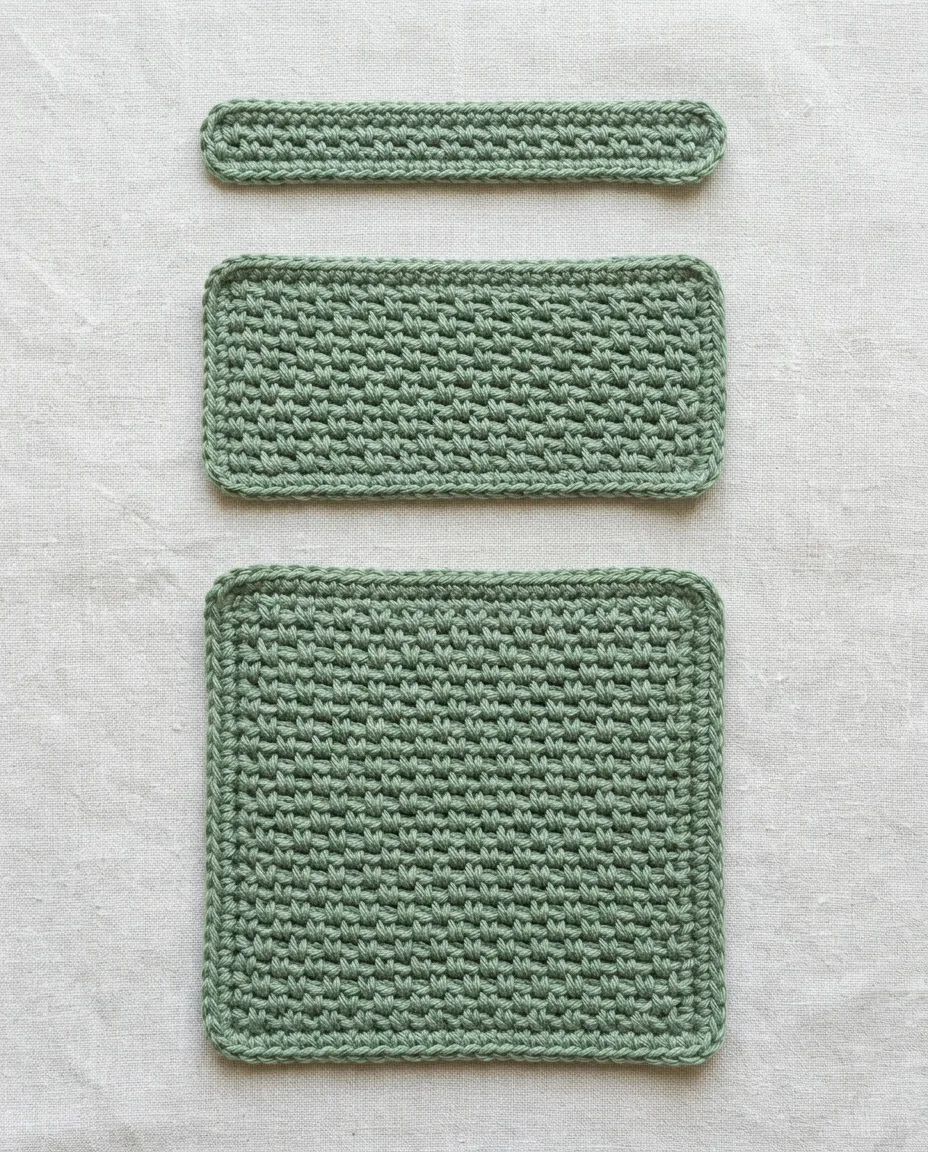
With the border on, lay the stages side by side. Row 2 and Row 20 show the exact same brick pattern. Only the size changes. So a mistake shows up early, as long as you look for it.
 Save
20 rows on 18 chains make the swatch. Scaling up is simple arithmetic. Want a dishcloth about 9 inches (23 cm) square with this hook and yarn? Chain 38 and work about 45 rows. Any even number of chains will do. Add the border last, and check the single crochet count on every row before you turn.