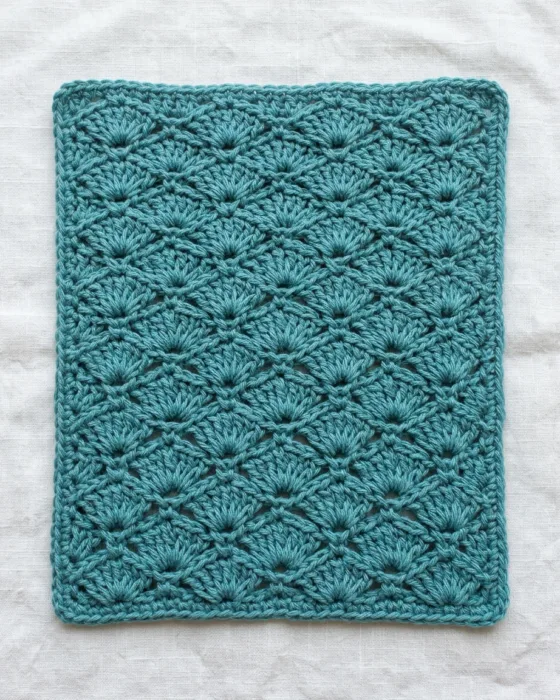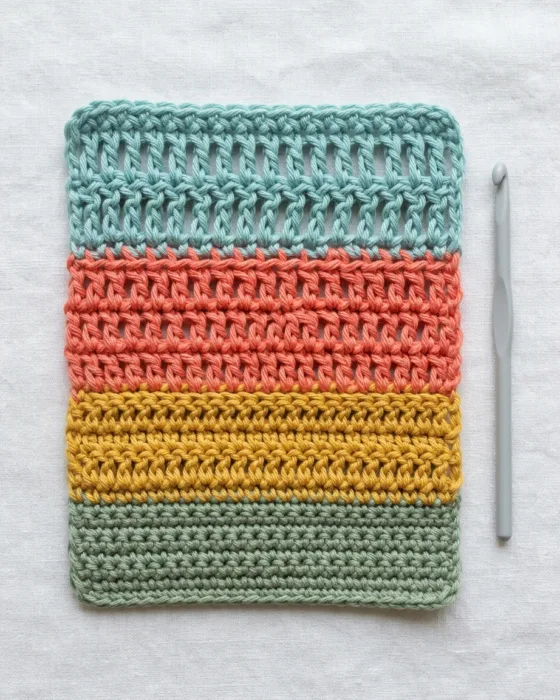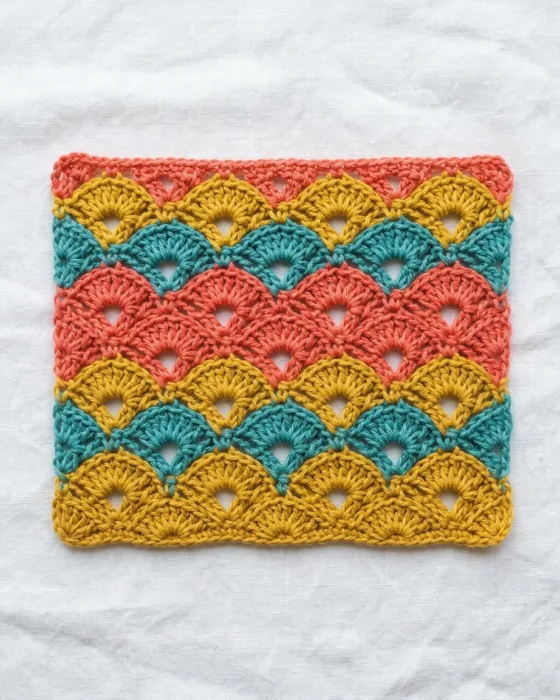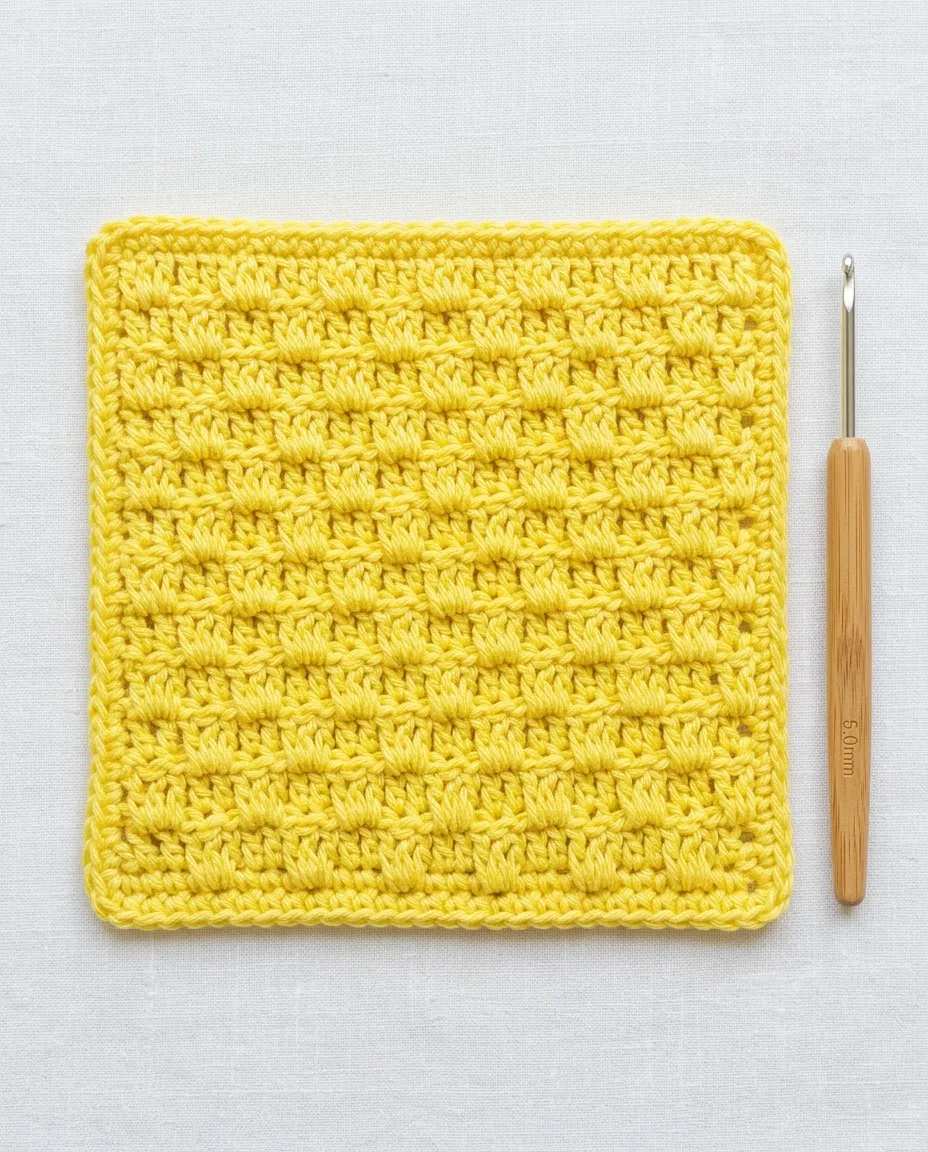
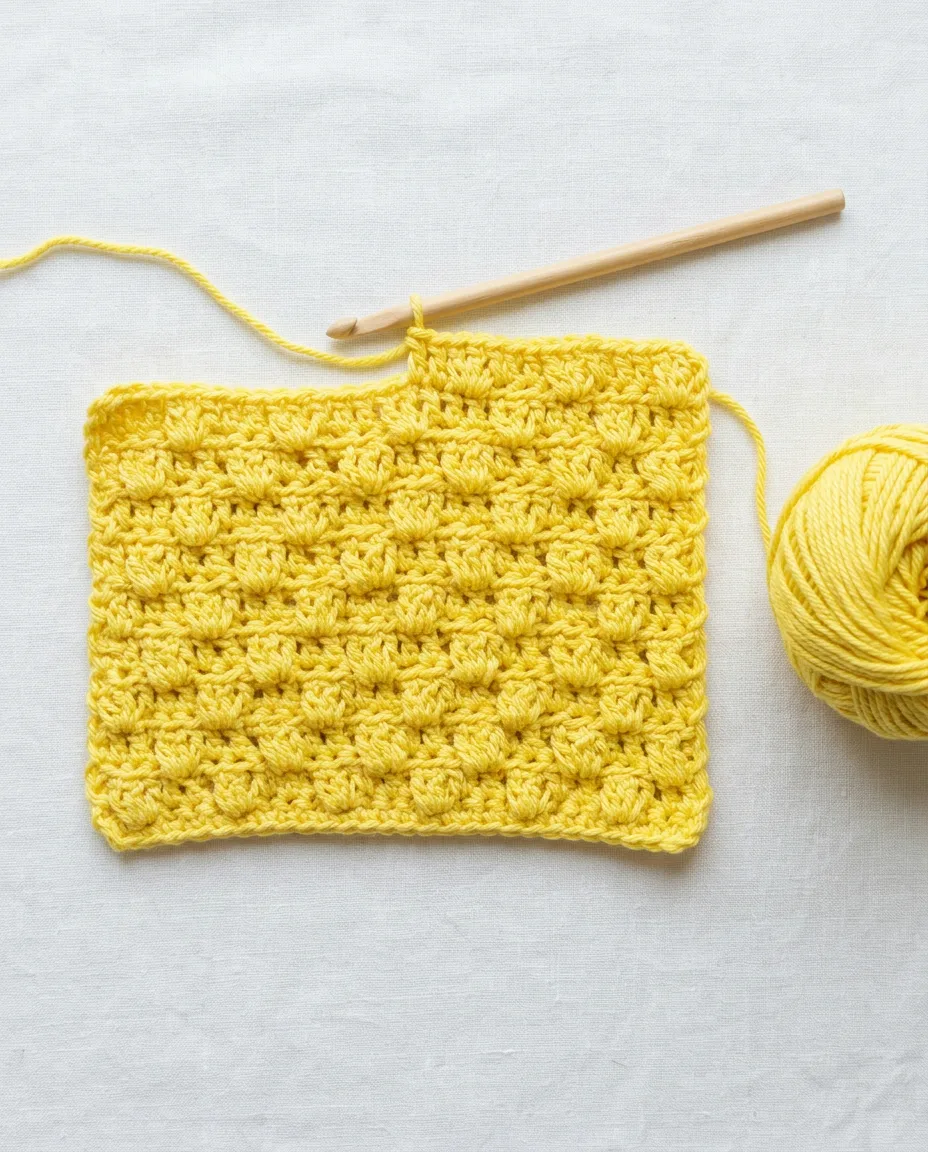
Alternate one single crochet and one double crochet across a row, then flip the order on the way back. That’s it. That’s the whole lemon peel stitch. The tall stitches can’t stand up straight next to the short ones. So they lean over and leave little bumps everywhere, like the dimpled skin of a lemon.
What you get is thick and grippy. It’ll hold a slippery jar lid. It’ll scrub a pan and not fall apart. And it grows faster than plain single crochet, since every other stitch is a tall one. If you can make a chain, you can learn this in an afternoon (the counting is the only fiddly bit).
Cotton keeps the bumps crisp. Acrylic? It works. But the texture goes soft and loses most of its grip.
Work the rows one stitch at a time
16 stitches come out of a chain of 17. That’s eight short-and-tall pairs. You can use any even number of stitches you like. Just chain one extra.
- Chain 17. Leave a 6-inch tail.
- Hook into the second chain from the hook.
- Wrap the yarn over the hook, back to front. That wrap is your yarn over.
- Pull back through the chain. Two loops on the hook.
- Yarn over again. Through both loops. One single crochet.
- Now the tall one. Yarn over first, then into the next chain.
- Yarn over, pull a loop through. You’ll have three loops now.
- Yarn over, through two. Two left.
- Yarn over, through the last two. That’s a double crochet.
- Short, tall, short, tall to the end. The row finishes on a tall one.
- Chain 1 and turn. That chain isn’t a stitch.
- First stitch is a single crochet. It goes into the last double crochet of the row below.
- Next, a double crochet into the single crochet.
- Short on tall, tall on short. Repeat until it’s as long as you want.
- Cut the yarn. Pull the tail through the last loop.
Count every row. Sixteen each time. Got 15? You probably skipped the first stitch after the turn, which likes to hide under the chain 1. Push that chain aside with a fingertip and you’ll find the top of the double crochet sitting right below it. The cluster stitch guide covers it round by round.
 Save
Why the surface feels grippy
A double crochet stands about twice as tall as a single crochet. Side by side, the tall one has nowhere to go. It bends over its short neighbor and puffs out. Then on the next row a short stitch lands right on top of it, and the bumps end up staggered like bricks in a wall.
Your hand feels that stagger before your eye does. Drag a thumb across a finished swatch and it catches on every single row, where plain single crochet just feels smooth. Both sides look nearly the same, too. Handy for a dishcloth or a coaster that gets flipped over a hundred times a week.
 Save
Where the lemon peel stitch shines
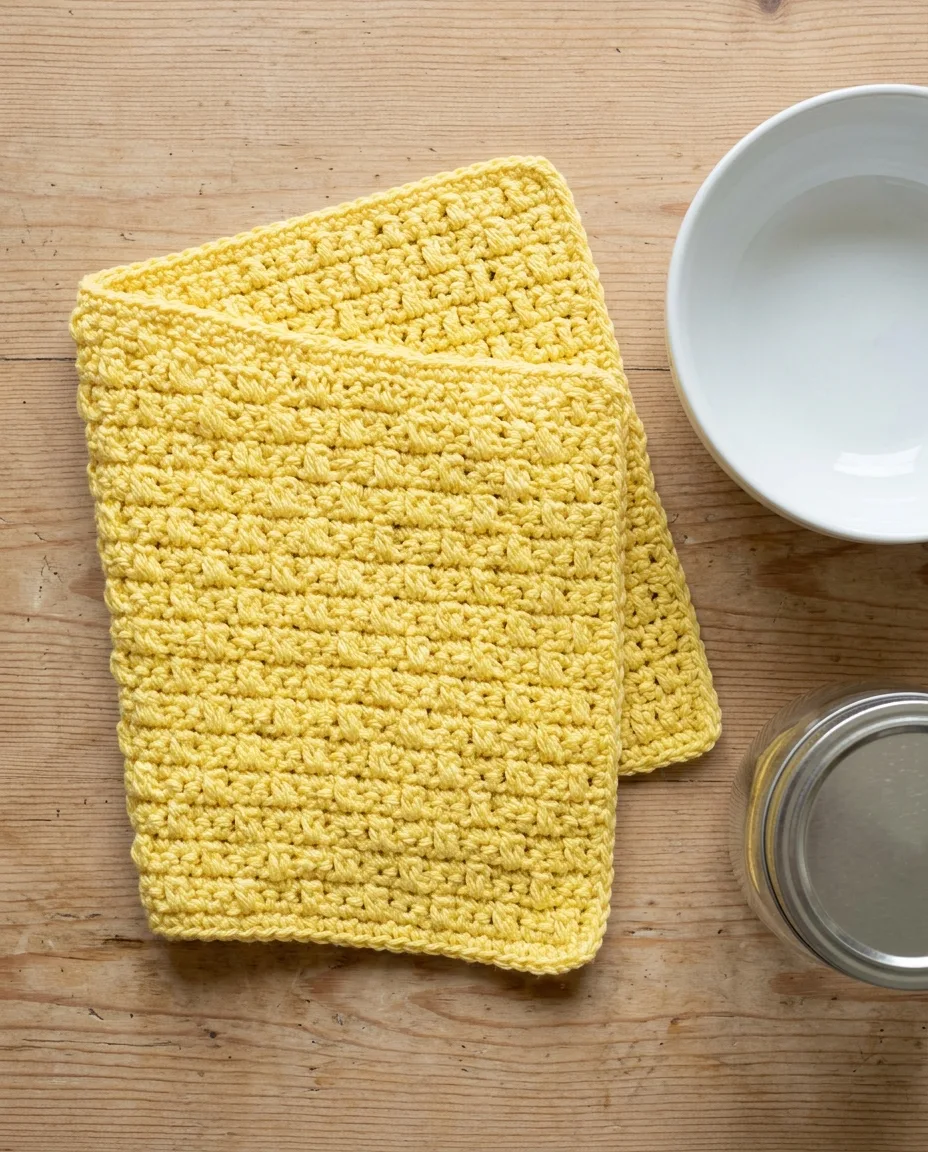
Dishcloths, easily. Cotton lemon peel scrubs well and shrugs off hot water. Start with a chain of 31 and the cloth comes out roughly 7 to 8 inches wide (your tension decides which). Keep repeating the second row. To check for square, fold one corner up to the opposite edge. If the fold lines up with the side, stop at the end of that row. Short by a little? One more row. The bumps scrub off dried food without scratching a nonstick pan, and the cloth dries fast draped over the faucet.
 Save
Jar grippers and coasters next. You don’t need much. A little square of 12 stitches, off a chain of 13, will grab a stuck lid that a smooth cloth just slides around on.
But skip it for scarves. It’s dense, and that’s great for bag bottoms and mug cozies, which need to keep their shape. Drape is another story. A lemon peel scarf hangs stiff and heavy, so anything meant to fall soft wants a looser stitch.
If your edges slant or the bumps vanish
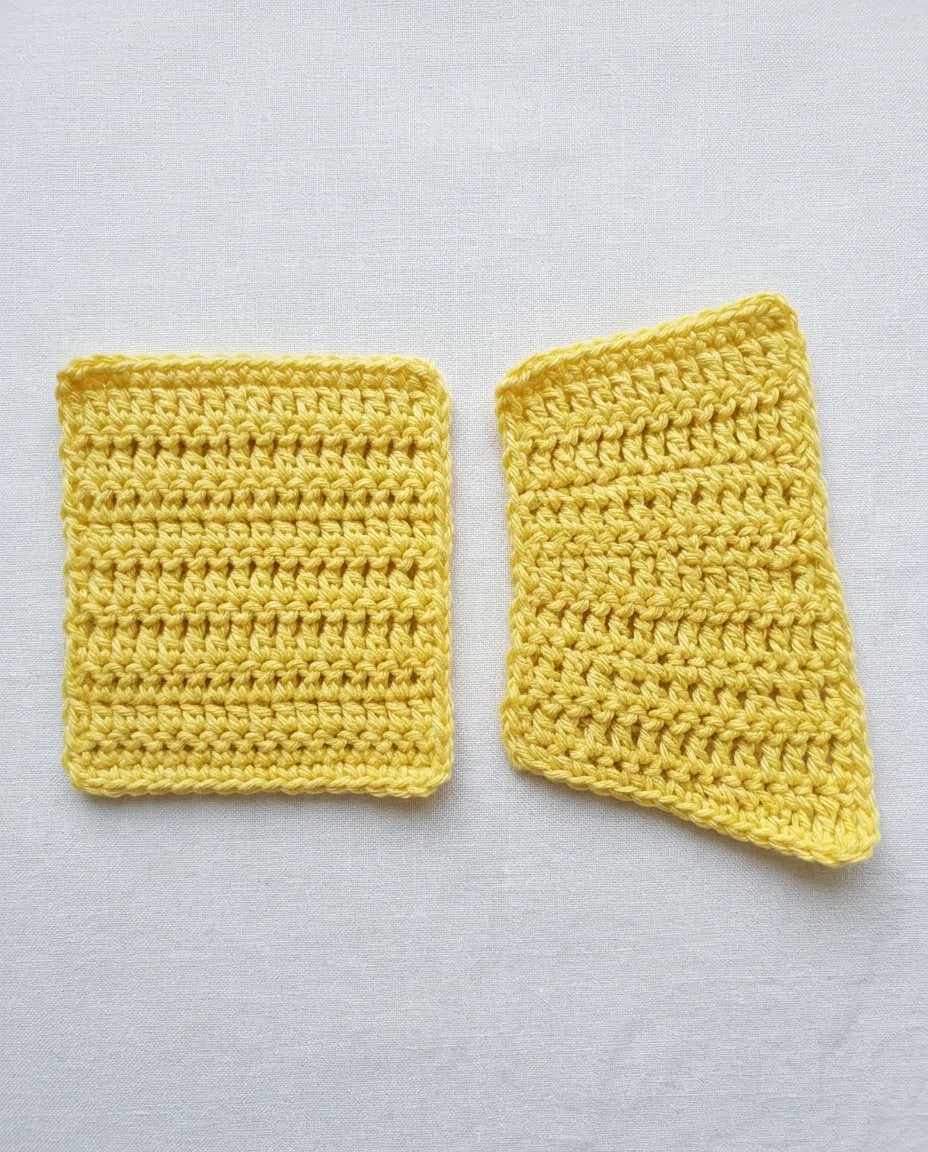
Blame the edges first. A slant nearly always means the first or last stitch of a row got skipped, the piece lost a stitch, and now it leans. The last one’s the sneaky one. It sits right at the edge after a double crochet and looks like nothing.
No bumps at all? Then your stitches are stacked short on short. Look at the first stitch after you turn. It has to be a single crochet going into a double crochet. Start the row with a double crochet instead and everything lines up in columns, and the texture’s gone. The guide to the crochet alpine stitch covers the whole method.
Not every problem is a counting problem, though. Very soft yarn flattens the bumps all by itself. If the fabric feels loose and floppy, drop one hook size to 4.5 mm (7) and it firms right up.
 Save
Change colors for stripes, or keep one for texture
Want to actually see the stagger? Use two colors and switch every two rows. The tall stitches lean across the line between stripes. So the color edges come out wavy, almost zigzagged, where single crochet stripes would sit dead straight.
Work the last double crochet of the row until two loops are left. Pull the new color through those two. Then chain 1, turn, and carry the resting color up the side of the work.
 Save
For a dishcloth, though, one solid color wins.
Finish the swatch and wash it
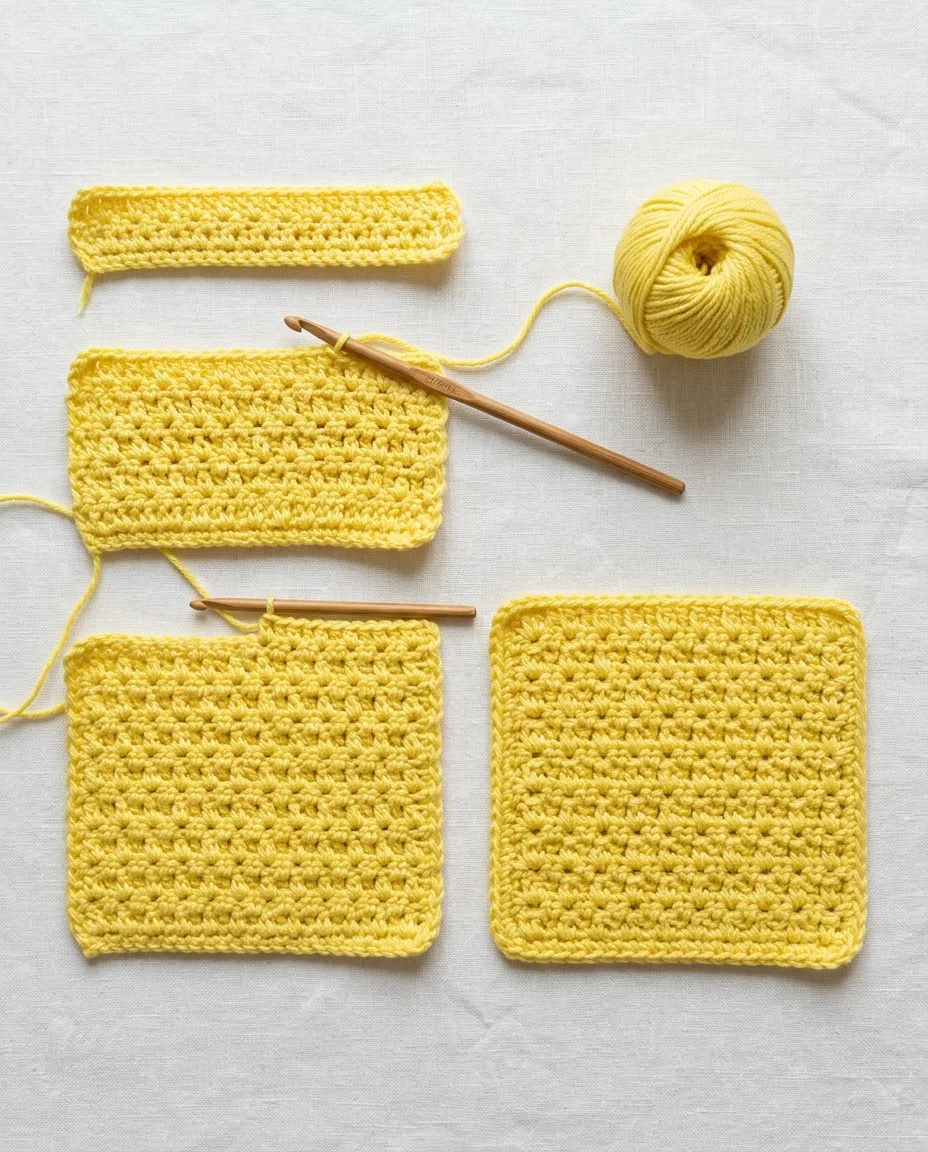
Weave each tail through the back of the stitches for about 2 inches, then double back once. Honestly, the bumpy surface hides tails better than most stitches. Cotton dishcloths can go in the washing machine on warm. They’ll shrink a little the first time. If the edges curl while drying, lay the cloth flat and pat them straight with your palm.
 Save
All that counting makes a lemon peel swatch slower than its size suggests. For a cloth that gets scrubbed against pans every day, the thicker fabric is worth the wait.