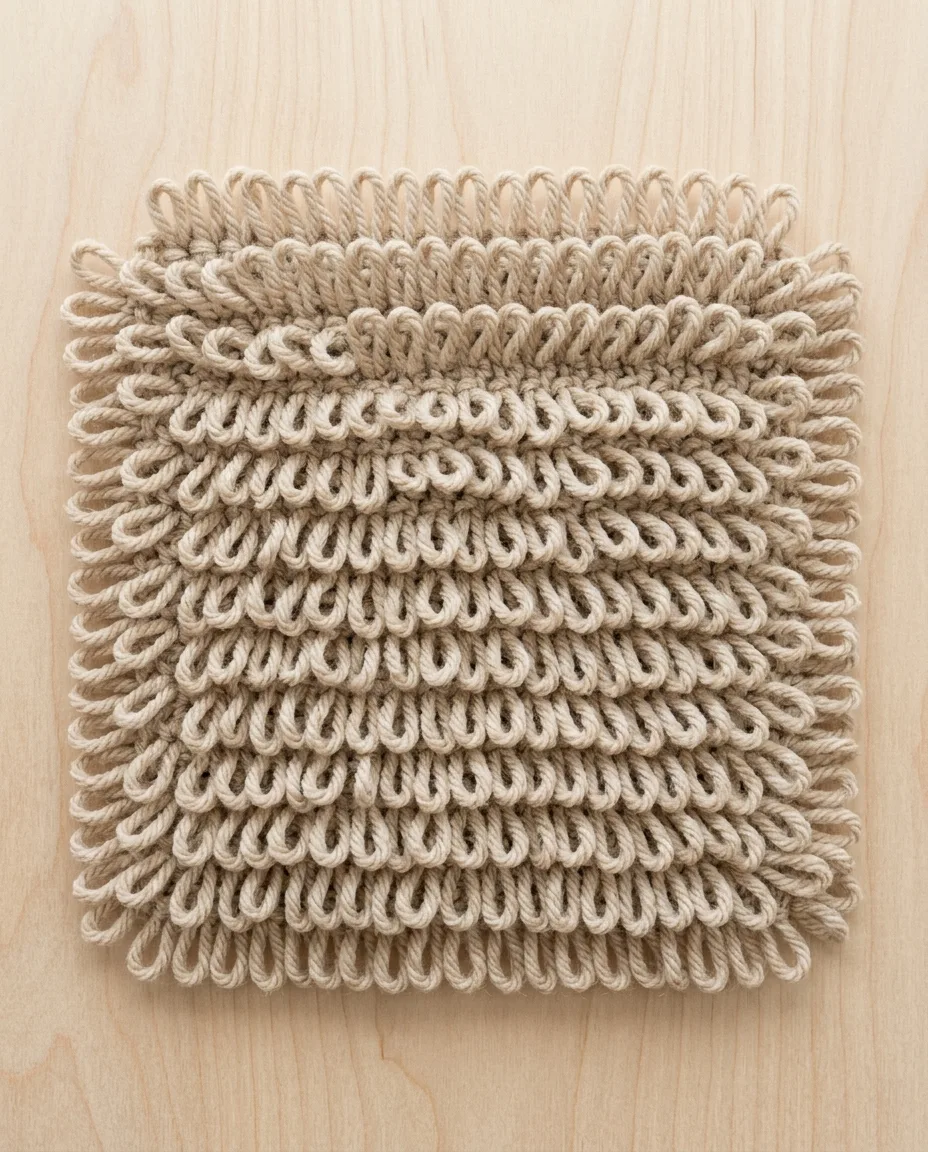
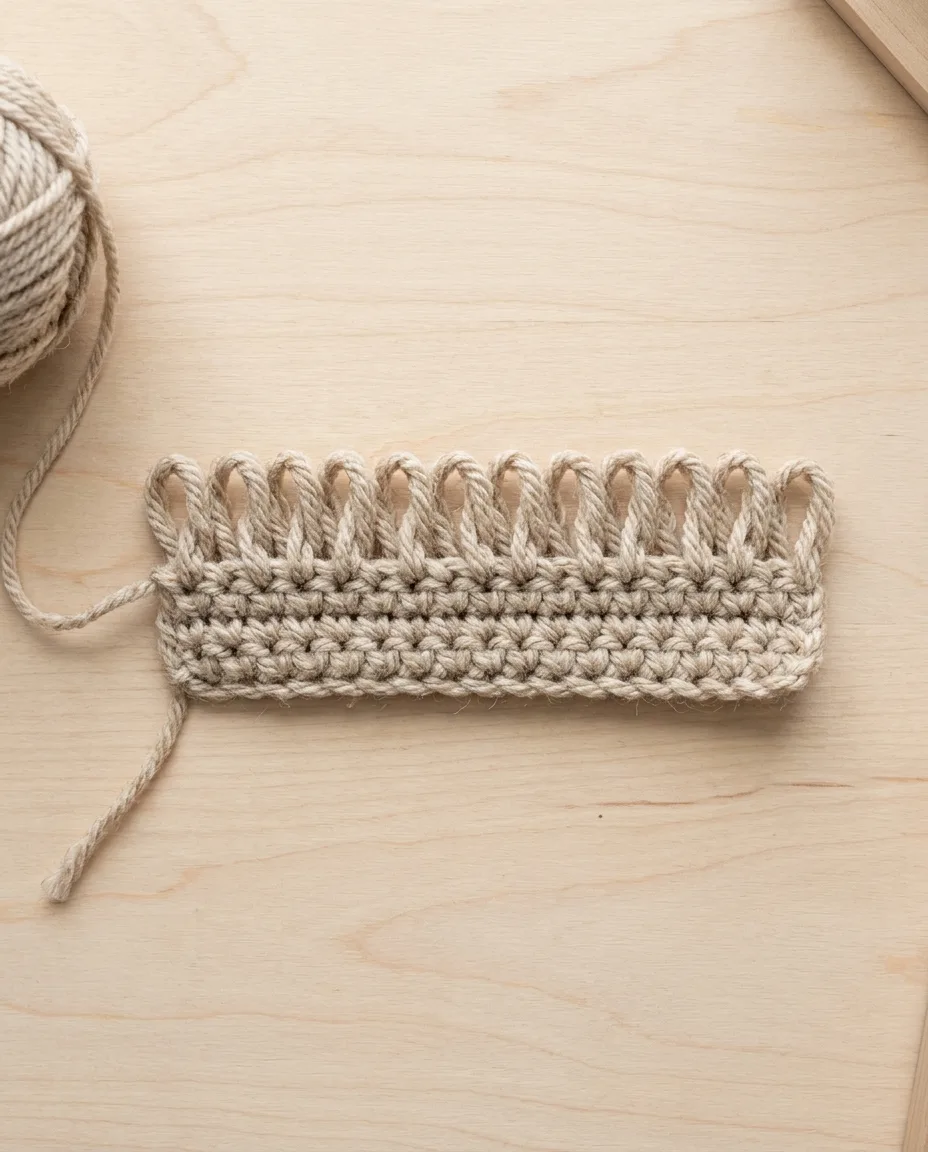
Someone lays a swatch on the table, and along one edge stands a row of loops, each about an inch long. Stack a few of those rows and plain single crochet starts to look like a sheep’s fleece. Or a lion’s mane. That’s loop stitch, and it’s how crocheters get fur on toys and beards on dolls. Rugs, too.
It’s a beginner stitch with one clumsy moment. Your finger holds a loop of yarn while the hook finishes the stitch. The first ten feel awkward (everyone’s do). By the end of a row your hands usually find the rhythm.
Terms here are US. Loop stitch is single crochet (sc) with a detour, so get comfortable with plain single crochet first if it’s new.
How to work one loop stitch
- Wrong side toward you.
- Hook into the next stitch, front to back.
- Now wrap the working yarn around your left index finger, front to back.
- Drop that finger below the hook. The loop hangs behind the work.
- Catch both strands behind your finger with the hook.
- Pull both through the stitch. Three loops on the hook now.
- Finger stays in the long loop. Don’t let go yet.
- Wrap the yarn around the hook once more.
- Pull through all three. Done.
- Slide your finger out. One loop, standing on the far side.
 Save
Loops pop out on the side facing away from you. Odd at first. That’s why the loop rows get worked with the wrong side toward you, and the fur lands on the right side, where people actually look.
Catch both strands. Plenty of tutorials only grab one, and sure, it’s faster. But tug a single-strand loop and it grows longer while its neighbor shrinks. Two strands locked into the stitch? The loop stays put.
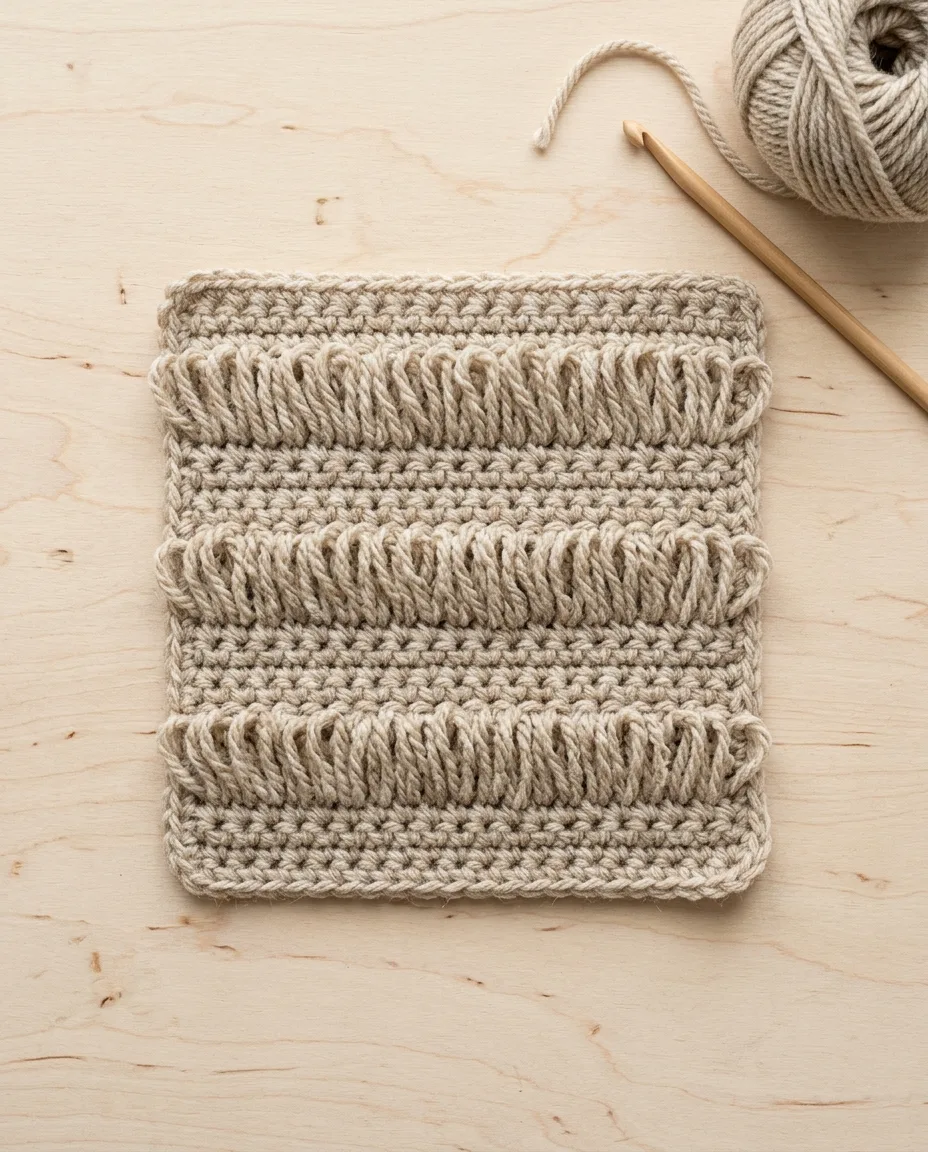
A practice swatch, row by row
Skip the plain row between loop rows and the fabric buckles. Loops crowd each other. A row of single crochet between each loop row gives the next loops something firm to sit on.
- sc in 2nd ch from hook and each ch across, turn 16 sts
- ch 1, lp st in each st across, turn 16 sts
- ch 1, sc in each st across, turn 16 sts
- ch 1, lp st in each st across, turn 16 sts
- ch 1, sc in each st across, turn 16 sts
- ch 1, lp st in each st across, turn 16 sts
Keep repeating the last two rows until the swatch is tall enough. Count after every loop row. You want sixteen loops. Fifteen? One stitch got skipped near the turn, and it’s almost always the last one.
 Save
Loop length decides what it looks like
Your finger sets the length, and most fingers give a loop about 1 inch (2.5 cm) long. Fingers drift, though. As your hand tires the loops creep longer, and by row six it shows. A pencil fixes it. Wrap the yarn around the pencil instead of your finger and every loop comes out the same.
Pencil loops are short and curly. Good for a lamb or a poodle. Wrap around two fingers and you get loops near 2 inches (5 cm) that hang down like a mane.
For a beard, work short loops on a small flat piece. Chain 9 and follow the swatch rows. Then sew it under the toy’s mouth. And here’s a small trick. Keep the loop rows along the bottom edge and the plain rows up near the mouth. The beard looks fuller where it falls.
 Save
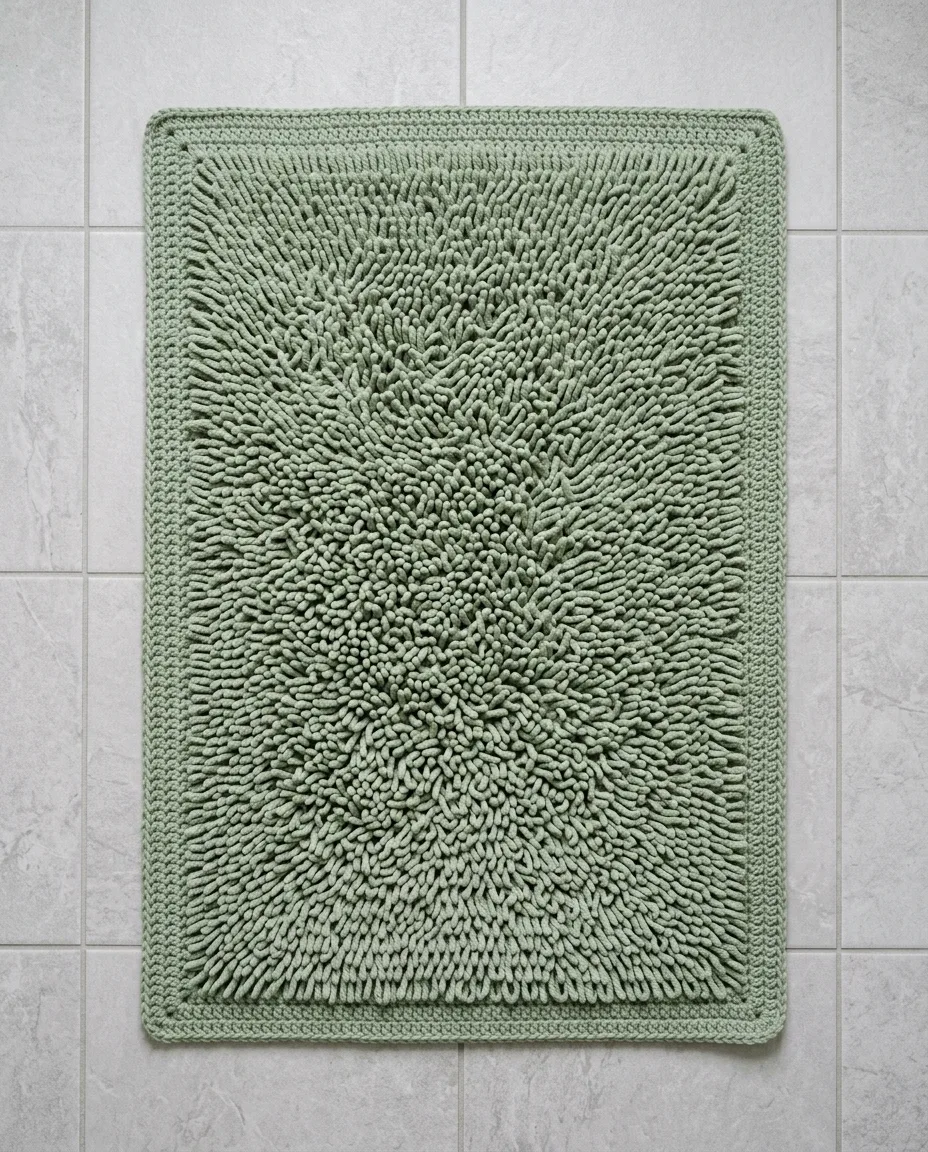
Two strands of worsted held together, or one strand of bulky yarn, with a 6 mm (J) hook. That’s the rug setup, and rugs are a different animal. The loops get heavy, so keep the stitches tighter than you would on a toy and the single crochet rows firm. On a hard floor, a loop rug slides. Put a non-slip pad under it.
 Save
Using loop stitch on a toy worked in rounds
Toys usually go round in a spiral with the right side facing out. Which puts every loop inside the toy. Not ideal. You’ve got two ways around it. Turn the piece inside out so the inside faces you while you work, and the loops land on the outside. Or make the fur as a flat strip and sew it on afterward (a lion’s mane works well as a long strip wrapped around the head).
Plan the fur before you stuff. Loops on a stuffed ball are a pain to reach. Work them on the open piece, then stuff and close.
No stitch eats yarn like this one. Every loop is extra yarn sitting on top of the stitch, so a loop row swallows far more than a row of single crochet. Buy an extra skein (one more ball of yarn) for anything bigger than a toy.
Cutting the loops for shaggy fur
Snip the loops and it looks like real fur. Run the scissors through each loop at its tip and cut. Then brush the ends with a stiff brush. Acrylic splits into a soft fuzz. Cotton just stays as separate strands.
Cutting costs you strength. Each cut loop now has two loose ends, and loose ends can pull out. Catching both strands back in step 5 is what holds them in. Never cut the loops on a toy for a baby. A pulled strand is a choking risk.
 Save
When the loops go wrong
Fur on the wrong side is the classic one. It happens when the right side faces you during a loop row. So check before each loop row starts: the smooth side should be looking at you.
Uneven loops mean a wandering finger. Grab a pencil. Loops that slide out mean only one strand got caught. The only real fix is to rip back the row and catch both.
Leaning loops are sneakier. They all tip the same way, like grass after rain, because the finger came out sideways. Slide it straight back and they stand up.
But what if the fabric curls? Your loop rows are tighter than your plain rows. Go up half a hook size for the loop rows only and leave the rest alone.
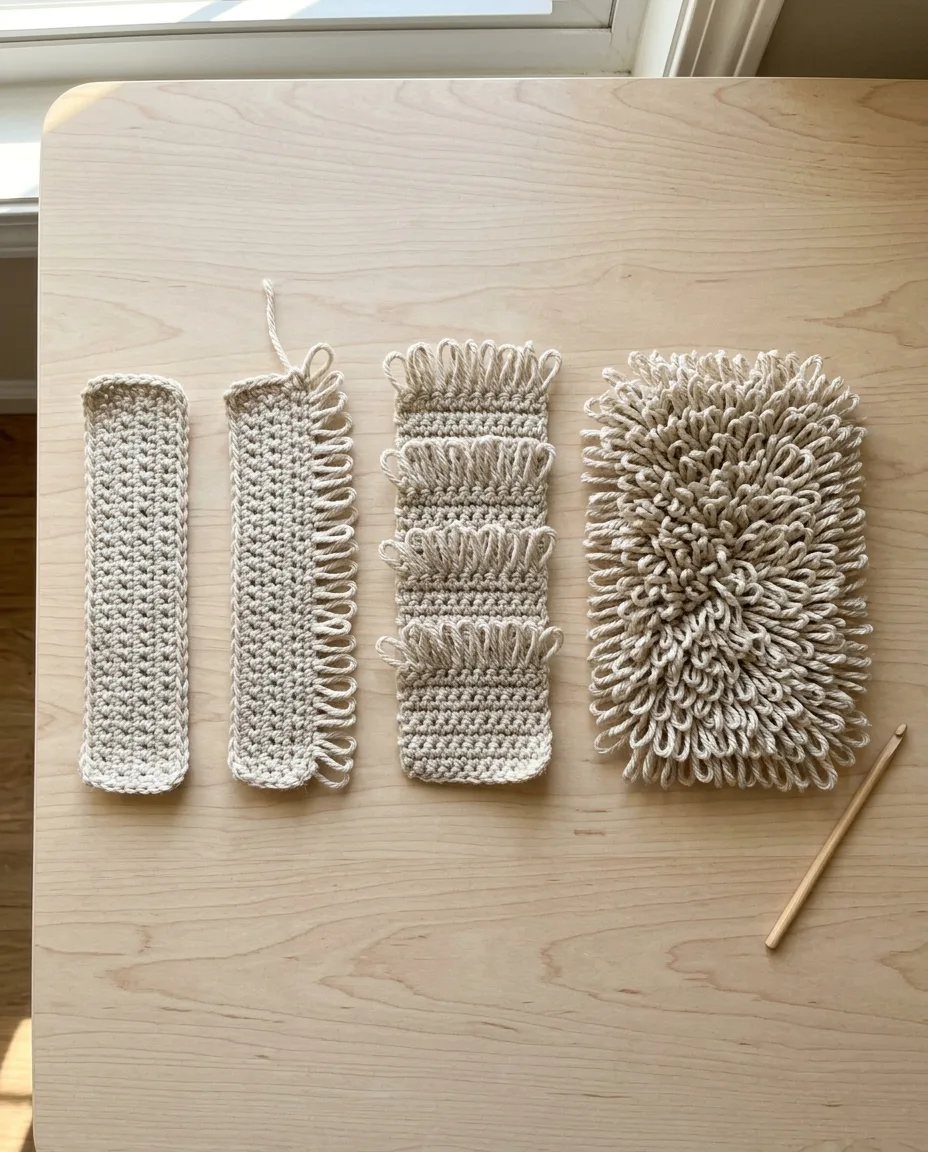
All the stages in one row
After the first plain row it looks like any other swatch. One loop row in, there’s a fringe along a single edge. By three loop rows the swatch underneath has vanished.
 Save
Hand wash a loop piece and lay it flat to dry, because a dryer knots the loops together. Cotton is tougher. It shrugs off a machine wash in a mesh bag. That’s why cotton wins for a bath mat, and acrylic stays on the toys.