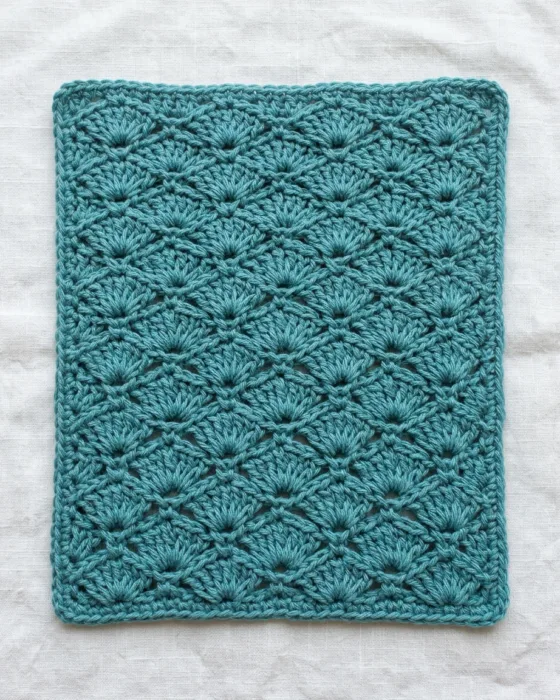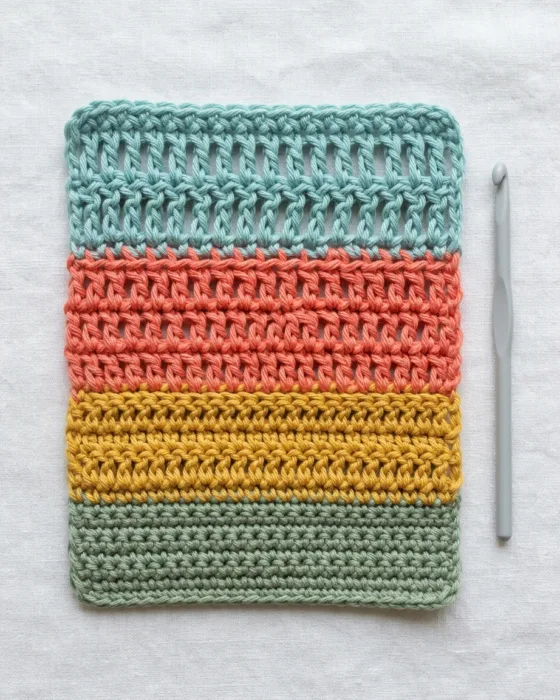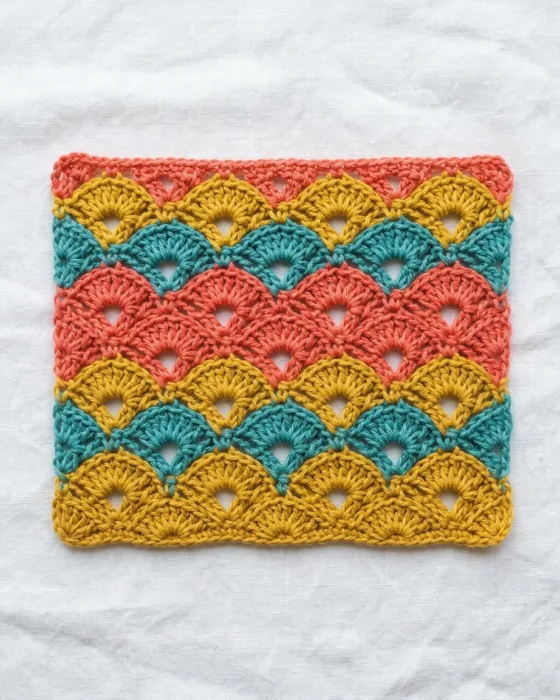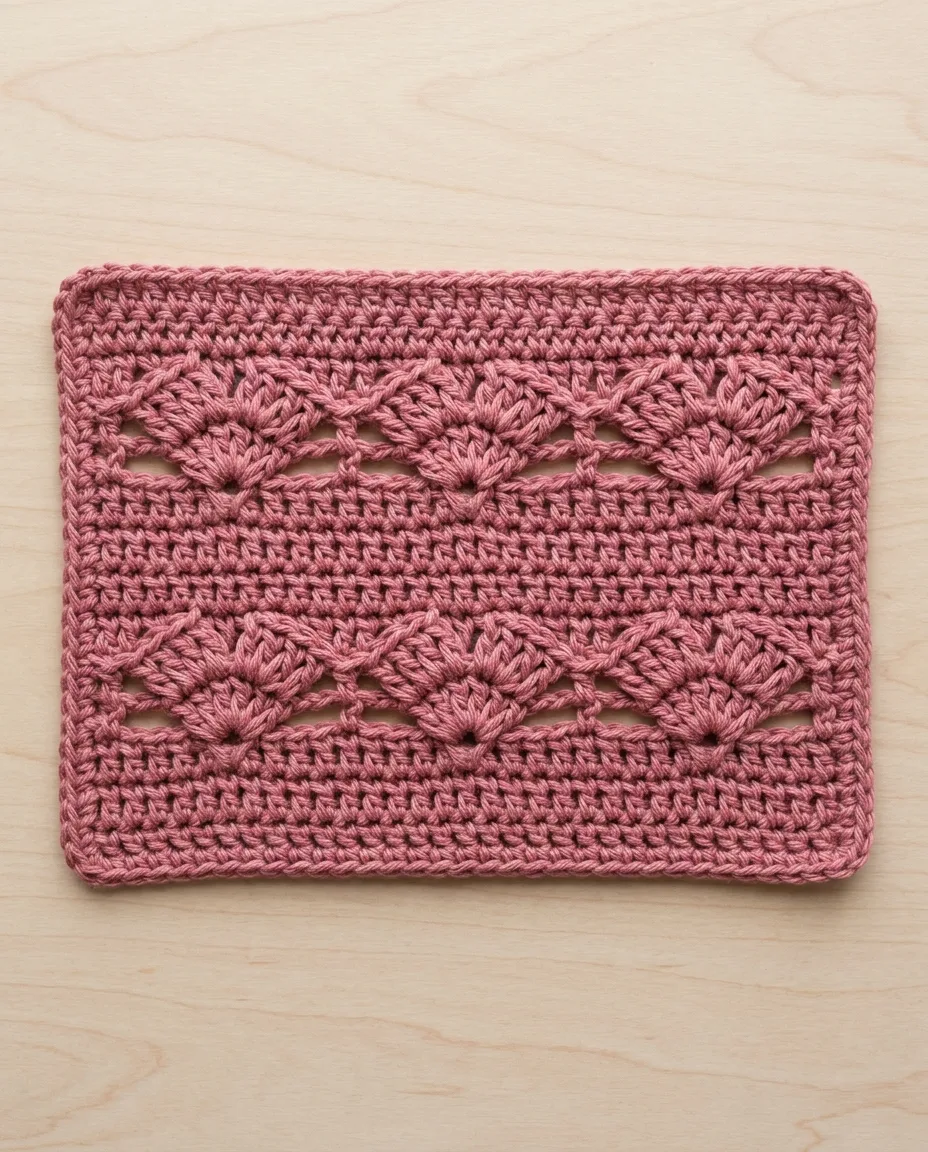
Most first tries at the heart stitch come out as a row of little fans. The stitches open up from one point, the tops round off evenly, and nothing about it says heart. That happens when every stitch in the group is the same height. Put two tall stitches on each side and one short stitch in the middle, and the top splits into two lobes. Now it’s a heart.
This stitch gives you a row of small hearts across a flat piece, all worked in one go with no motifs to sew on. It suits dishcloths and blanket borders. Baby bibs too. The hearts are about an inch wide in worsted cotton. It’s an intermediate stitch, mainly because of the trebles. If you can already make a double crochet, you’ll pick it up in one swatch, a small practice piece.
Worsted means a medium yarn, the weight printed as a 4 on most labels. This post uses US crochet terms throughout.
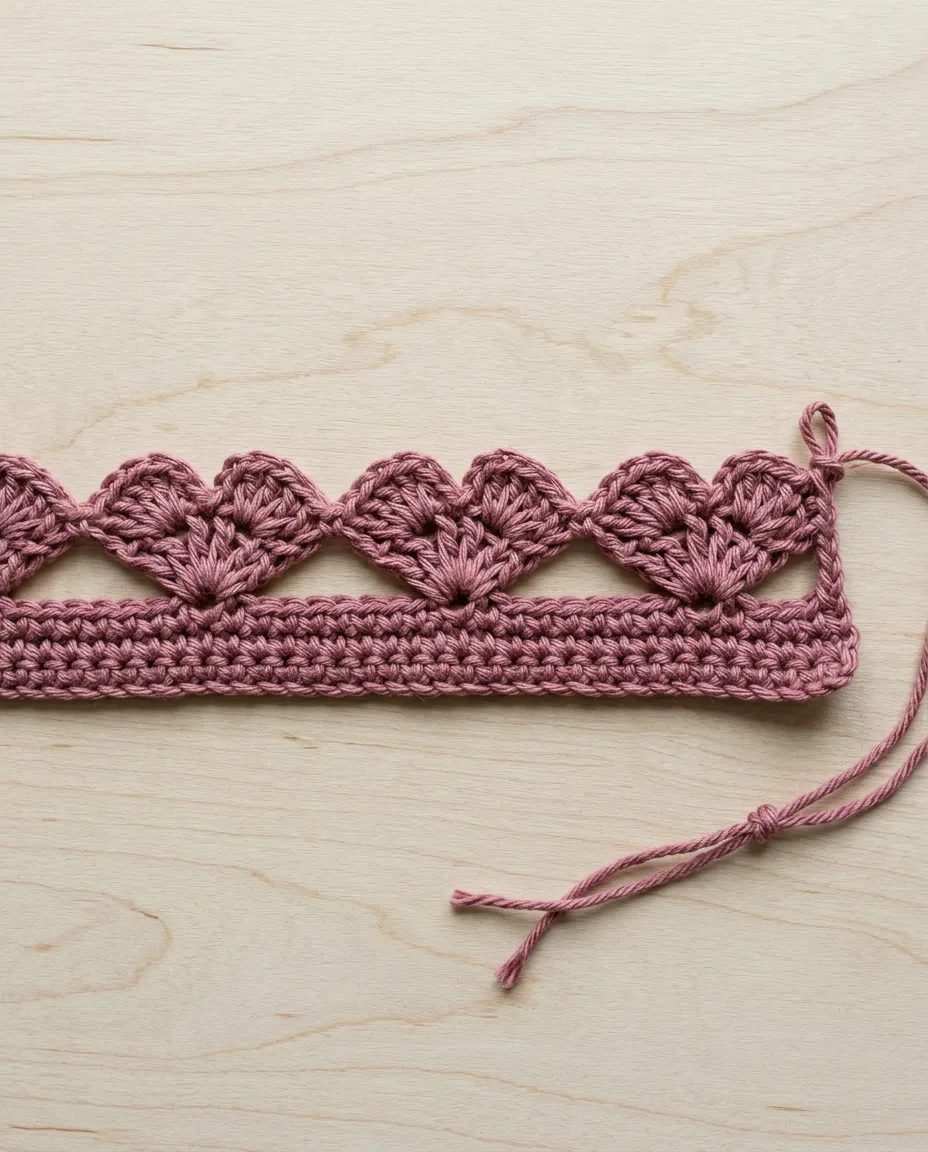
Make one heart group
Each heart is seven stitches crammed into one stitch of the row below. That single shared stitch becomes the point.
- Skip three stitches. The fourth one holds the whole heart.
- Wrap the yarn around the hook once. That move is called a yarn over, and you’ll do it constantly. Then go into that fourth stitch.
- Pull up a loop. Three loops on the hook.
- Yarn over and pull through two loops. Do it again. That’s one double crochet.
- Now a treble. Wrap the yarn twice before you go into the same stitch.
- Pull up a loop. You’ll have four loops.
- Yarn over, through two. Three times over until one loop is left.
- Same stitch, one more treble. Left lobe done.
- Yarn over once and go in again. Pull up a loop, then yarn over and pull through all three. That short half double crochet is the dip.
- Two more trebles in the same stitch. Right lobe.
- Finish with one double crochet, still in that stitch. Seven stitches now share one hole.
- Skip three stitches. Single crochet in the next one to anchor the heart.
Count seven before you move on. Six? You probably skipped the half double crochet, and the heart will look like a fan again. Pull it back and redo just that group. There is a fuller walkthrough in the guide to shell stitch crochet.
 Save
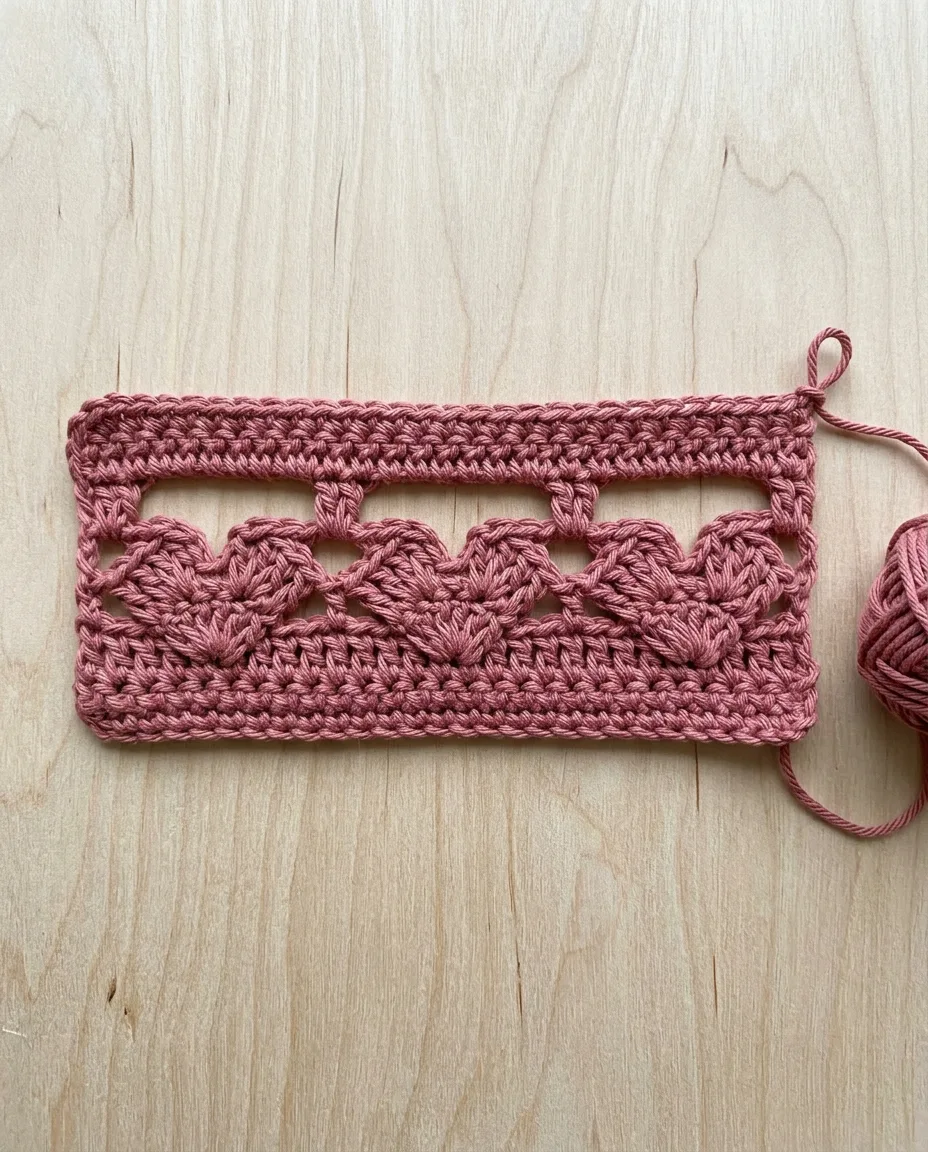
The full swatch, row by row
Here’s the whole pattern for a swatch with two rows of hearts. A single crochet (sc) is the plain short stitch: hook in, pull up a loop, yarn over and pull through both loops. The stitch count goes up in multiples of 8, plus 1. So chain any multiple of 8, add 2, and the hearts will fit.
- sc in 2nd ch from hook and in each ch across, turn 25 sts
- ch 1, sc in first st, *sk 3 sts, (dc, 2 tr, hdc, 2 tr, dc) in next st, sk 3 sts, sc in next st; rep from * across, turn 25 sts
- ch 4 (counts as tr), *sc in next 3 sts, hdc in next st, sc in next 3 sts, tr in next st; rep from * across, turn 25 sts
- ch 1, sc in each st across, working the last sc into the top of the ch-4, turn 25 sts
- ch 1, sc in first st, *sk 3 sts, (dc, 2 tr, hdc, 2 tr, dc) in next st, sk 3 sts, sc in next st; rep from * across, turn 25 sts
- ch 4 (counts as tr), *sc in next 3 sts, hdc in next st, sc in next 3 sts, tr in next st; rep from * across, turn 25 sts
- ch 1, sc in each st across, fasten off 25 sts
Row 3 does the quiet work. Each gap between two hearts is a deep valley. A treble fills it. The short stitches sit on top of the lobes. Skip that row and the next row of hearts tilts into the valleys.
25 stitches across comes out about 6 inches (15 cm) wide. Every heart row adds roughly an inch of height. Want a third row? Repeat Rows 2 to 4 once more before fastening off. The suzette stitch guide covers it round by round.
 Save
When the hearts don’t look like hearts
Hearts that ruffle up off the table usually mean the yarn is too thick for the hook. Seven stitches in one spot need room. And if the swatch buckles, go up half a hook size, to a 5.5 mm hook. Cotton is the worst for this, since it has almost no stretch. A softer acrylic forgives a tight hand much more. Gauge, meaning how many stitches fit in an inch, matters less here than whether the piece lies flat.
Lopsided hearts are a different problem. Count the skipped stitches on each side. Three on the left and two on the right will tip the whole heart sideways, and it gets worse every row. Tension on the trebles is the other culprit. Pull the first one tight and the second loose, and one lobe sits higher.
Sometimes the dip vanishes. Check that the middle stitch really is a half double crochet. A double crochet in that spot is nearly as tall as the trebles. The top goes flat and the heart turns back into a fan.
No amount of blocking saves a heart with the wrong count. Blocking, which means wetting a piece and pinning it flat to dry, will sharpen good hearts though.
Where heart rows look best
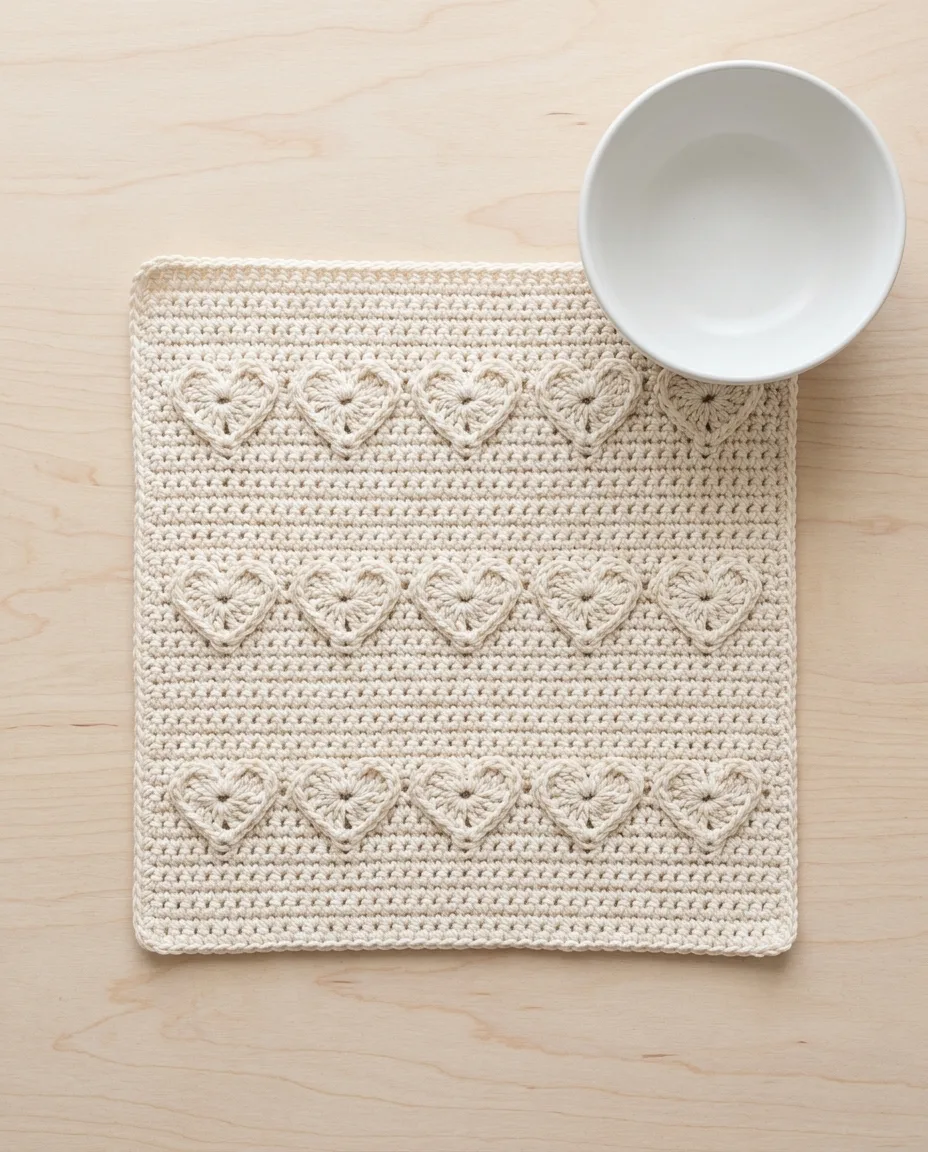
Cotton dishcloths are the obvious match. The raised lobes give the cloth a little texture for scrubbing, and cotton holds the shape after washing. Two or three heart rows across a square cloth is about right. More than that and the cloth gets thick in the middle. It takes longer to dry, too, and a damp cloth starts to smell. Space the heart rows with three or four plain single crochet rows between them. Easier to count, as well.
 Save
On a baby blanket, use one heart row as a border near each end. A whole blanket of them gets heavy fast, since each heart is seven tall stitches. For a bib, one row across the chest is plenty. Keep the yarn soft there. Acrylic is lighter than cotton and dries quicker, but the hearts look a touch fuzzier.
But skip it on anything that needs drape. The heart rows are thick. A scarf in this stitch will feel stiff, so use it as an edge band on the scarf ends only. The guide to the granny stitch in rows covers the whole method.
A two-color version
Red hearts on a cream background is the version people tend to ask about. It takes one change of plan. Work Rows 1, 3 and 4 in the background color and only the heart rows in red.
Switch to red at the very end of Row 1. On the final single crochet, pull up a loop in cream, then finish the stitch with red. The heart row starts clean that way. Do the same at the end of Row 2 to go back to cream for the filler row.
Carrying the unused color up the side is fine for a swatch. On a dishcloth, cut it and weave the ends in. Loose strands catch on things in the sink. Each heart row has only two color changes, so the ends add up slowly.
 Save
Finishing the edges
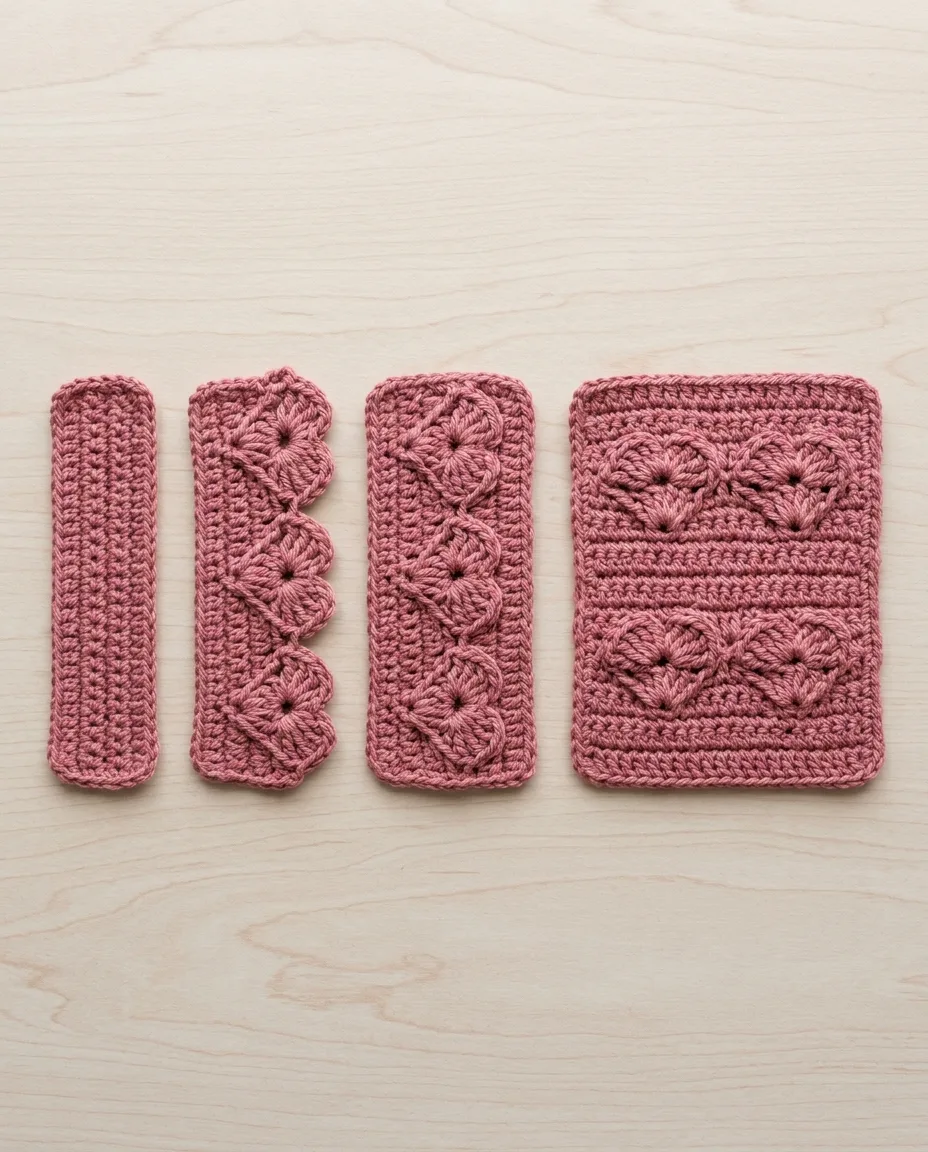
The side edges come out a little bumpy, because the turning chains on Rows 3 and 6 are long. One round of single crochet around the whole piece tidies that. Work 3 single crochets into each corner so it stays square.
Weave each tail through at least 2 inches of stitches before trimming. Cotton is slippery. A short tail works loose after a few washes. Then wet the swatch, press it flat with a towel and let it dry. The hearts stand out more once they’ve settled.
 Save