Short answer
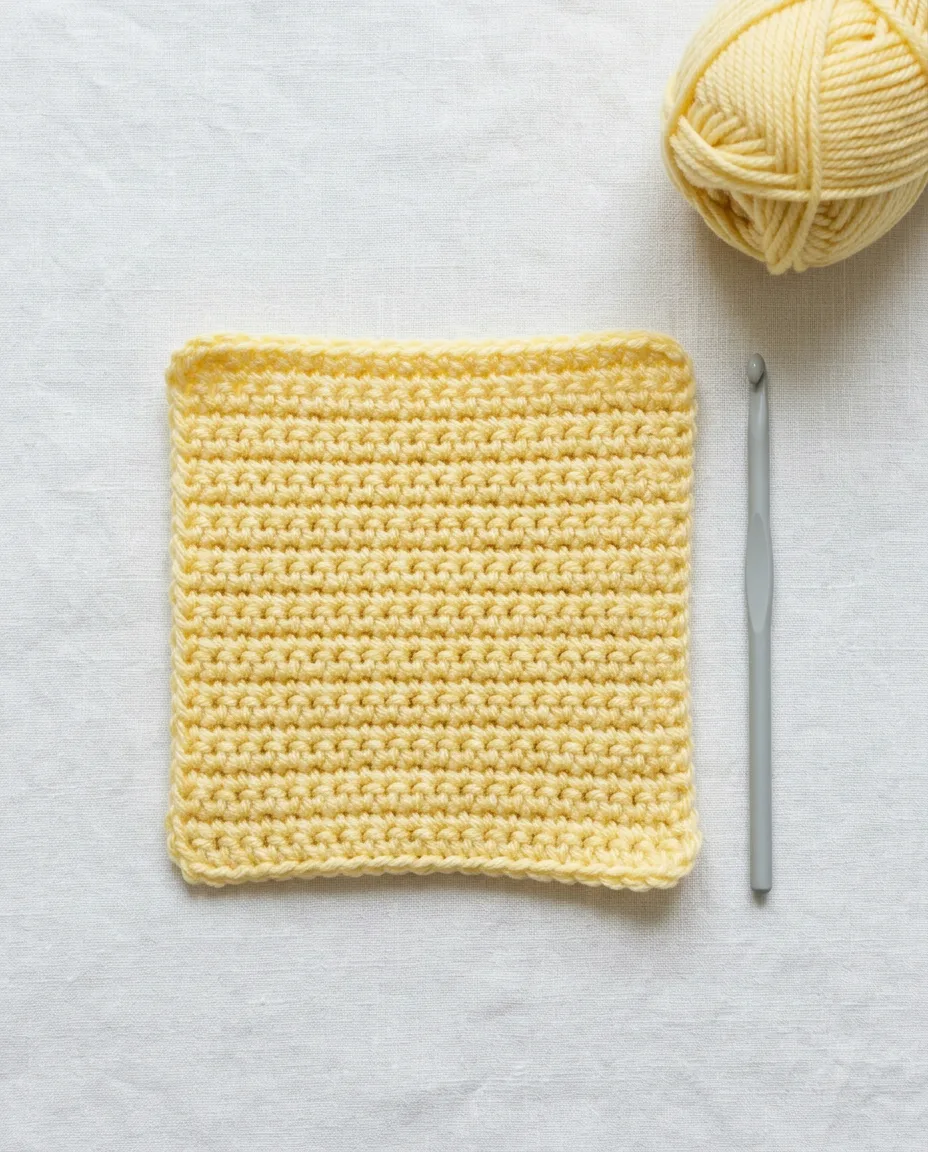
Buy a 4 mm (G) hook and one ball of smooth worsted weight yarn in a light color, then spend the hour on a slip knot, a chain of 11 and rows of 10 single crochet. By the end you will have a square about 3 inches across, and every stitch in it is the same one most toys are made from.
A 4 mm hook, one ball of medium weight yarn and a chain of 11 are enough to make a first row of single crochet in about 15 minutes. By the end of an hour that row can be a small square the size of a coaster. Those are the only two goals for the first sitting, and both are reachable with no experience at all.
This page walks through that hour in order. Hold the hook. Make a slip knot, which is the adjustable loop that goes on the hook before anything else. Chain. Work one row of single crochet into the chain. Turn and work a second row. Keep going until the square is done. Every move is written out with where the hook goes and how many loops come through, because that is the part a video skips past at speed.
Crochet uses US terms on this site. The same stitch has different names in British patterns, which matters once you start reading patterns and not before.
What to buy for the first hour
Two things, and the choice of each matters more than it looks.
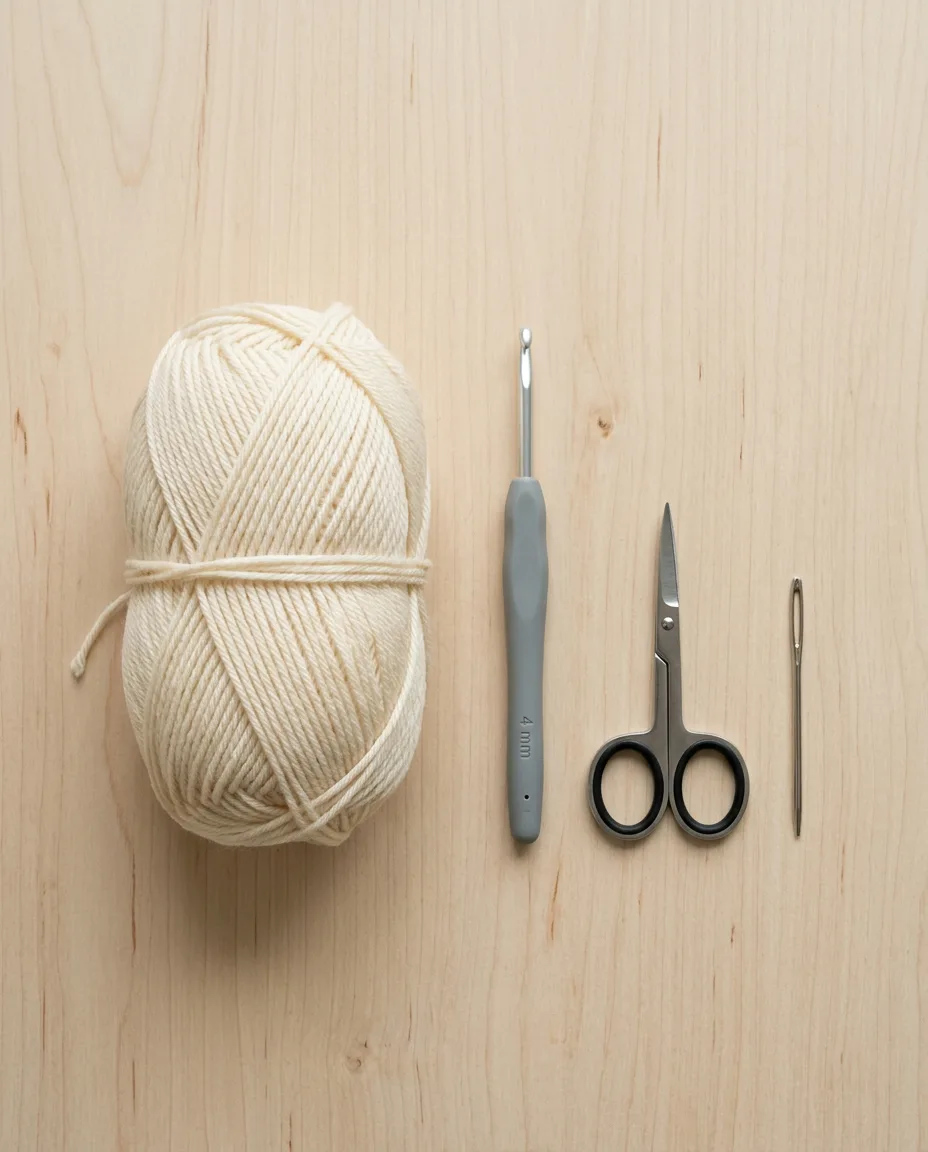
Buy a 4 mm (G) aluminum hook with a plain handle or a soft rubber grip. Aluminum lets the yarn slide. A wooden or bamboo hook grips the yarn and makes every stitch a little harder to pull through, which a beginner does not need. Some beginners find a 5 mm (H) hook easier to see. Either is fine, and the yarn below suits both.
Yarn comes next: worsted weight, the medium thickness marked with a 4 on the paper band. Pick a smooth acrylic or a wool blend in one light solid color such as cream, pale yellow or light blue. Dark yarn hides the stitches and fuzzy yarn hides them completely. A plied yarn, one made of several thin strands twisted together, splits less under the hook than a single soft strand does. One ball of about 100 grams is more than the first month needs.
| Item | Spec | Why |
|---|---|---|
| Hook | 4 mm (G), aluminum | Slides freely, standard size for medium yarn |
| Yarn | Worsted weight, smooth, light solid color | Stitches stay visible and countable |
| Scissors | Any small pair | Cutting the yarn at the end |
| Yarn needle | Blunt, wide eye | Weaving in the two ends |
Skip the beginner kits with six hooks and a dozen tiny balls of yarn. A single hook and a single ball is less to manage, and the yarn in kits is usually too thin for a first square.
 Save
SaveMinutes 0 to 10: holding the hook and tying the slip knot
Hold the hook in your dominant hand like a pencil, resting on the middle finger with the thumb and index finger pinching the flat part of the shaft. Some people hold it like a knife with the handle under the palm. Both work. Choose the one where your wrist stays straight.
Your other hand controls the yarn. Lay the yarn over the index finger of that hand, then under the middle finger and over the ring finger. The hook pulls the yarn off the index finger and the fingers below give it a little drag. That drag is called tension, meaning how firmly the yarn is held as it feeds, and even tension is what makes a square look even.
Now the slip knot. Pull out about 8 inches, 20 cm, of yarn from the ball. Lay it across your left palm and make a loop by crossing the yarn over itself, with the strand from the ball on top. Reach through the loop with the hook from front to back, catch the strand from the ball and pull it back through the loop. Slide the new loop onto the hook and pull the short end to snug it up. It should slide along the hook with a little friction and never pinch.
Ten minutes is about right for this. Do the slip knot five times until it goes on in one motion. Most of the stiffness beginners feel in the first hour comes from a slip knot pulled so tight the hook cannot move inside it.
Minutes 10 to 20: a chain of 11
A chain stitch (ch) is one move repeated. Wrap the yarn over the hook from back to front, which is a yarn over, and pull that strand through the loop already on the hook. One chain made. One loop remains on the hook. Do it again.
Make 11 chains. Do not count the loop on the hook as a chain, and do not count the slip knot. Each chain looks like a small V on the front, and the V’s are what you count. A chain of 11 comes out about 3 inches, 7.5 cm, long in worsted yarn on a 4 mm hook.
Nobody’s first chain is even. The first few will be tight and the later ones loose. The chain will twist. Expect it. Hold the chain between the thumb and middle finger of the yarn hand, just below the hook, and move that pinch up every three or four chains. Pinching close to the hook keeps each new chain the same size as the one before it.
Pull the chain out and make it again. Three chains of 11 in ten minutes is the goal, with the third one looking roughly like a row of matching V’s. Rip out the first two. Yarn does not mind.
 Save
SaveMinutes 20 to 40: the first row of single crochet
Single crochet (sc) is the shortest standard stitch and the one almost every toy is made from. It has four moves. Insert the hook, yarn over, pull up a loop, yarn over again and pull through two. Here is where the hook goes for the very first one.
- Hold the chain with the V’s facing you. Count back from the hook and find the second chain. The chain closest to the hook is skipped, and that skipped chain becomes the turning chain, the chain that lifts the yarn up to the height of a single crochet.
- Insert the hook into the second chain from the hook. Slide it under the top strand of the V, from front to back, so two strands of the chain sit on top of the hook.
- Yarn over. Wrap the yarn over the hook from back to front.
- Pull that strand back through the chain. Two loops are now on the hook.
- Yarn over again.
- Pull that strand through both loops on the hook. One loop remains. One single crochet made.
- Move to the next chain along and repeat the moves. Work one single crochet into each remaining chain, 10 in all.
Count the stitches at the end of the row. Ten is right, because 11 chains minus the skipped turning chain gives 10 stitches. Nine means a chain was missed in the middle, usually where the chain twisted. Eleven means a stitch went into the skipped chain or two went into one chain. Fix it now, before row two.
Nothing in crochet is harder than the first row. The chain is tight, the stitches have nothing under them to lean on and the hook catches on the chain strands. Expect to spend 20 minutes on it. Every row after this is worked into the open tops of real stitches, and those are far easier to find.
Minutes 40 to 50: turning and the second row
Turning is the move that takes one row to a second. Make one chain, then turn the work over like a page, so the back of the first row faces you and the hook is at the right-hand edge. That one chain is the turning chain for this row. It lifts the yarn to stitch height and is never counted as a stitch in single crochet. Turn the same direction every time.
Look at the top of the row. Each stitch has a V lying flat along the top edge, made of a front loop, the strand nearer you, and a back loop, the strand farther away. Insert the hook under both loops of the V, the whole V, for every stitch. Working under one loop alone makes a ridge, and that is a technique for another day.
But the first stitch of the row is the trap. Insert the hook into the very first V, the one directly below the turning chain, and work a single crochet there. Beginners skip it because the turning chain looks like a stitch and the real first stitch sits tucked under it. Skipping it loses one stitch per row and the square narrows into a triangle.
Work a single crochet into each V across and count. Still 10. The last stitch of the row goes into the last V, and never into the turning chain of the row below, which stands up on the end like a stitch and is not one.
Ten stitches in a row, 1 chain, turn, 10 stitches in a row. That is the whole rhythm of flat crochet from here on. Hats and toys add increases and decreases. Scarves add length. The move itself never changes.
 Save
SaveMinutes 50 to 60: a small swatch to keep
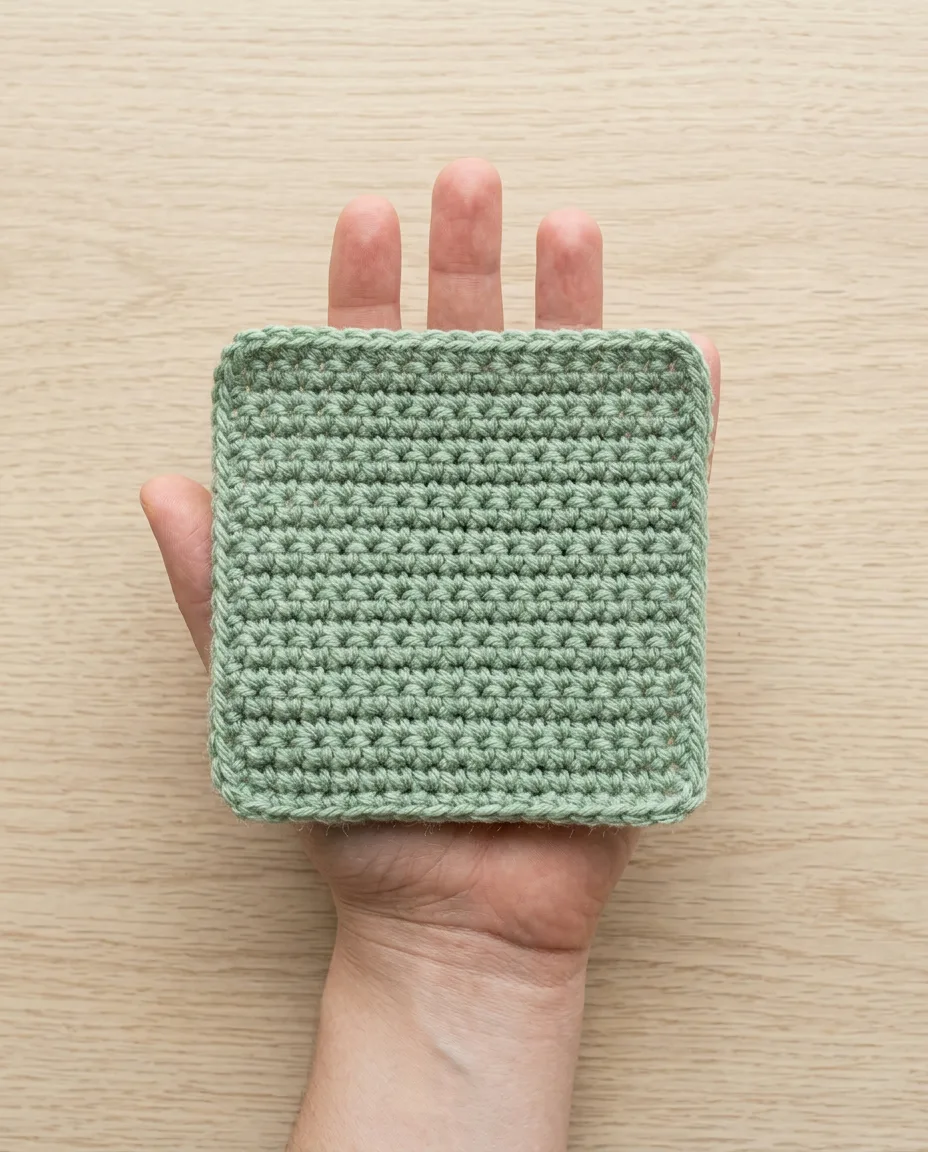
Keep going until the piece is square. A swatch, which is a small test piece made to check stitches, is the honest name for it. Worsted yarn on a 4 mm hook gives about 3 inches of width for 10 stitches, and single crochet rows run about 3 per inch, so 9 or 10 rows make a square. Nobody needs to measure. Stop when the height matches the width by eye.
To finish, cut the yarn about 6 inches from the hook. Yarn over and pull the cut end all the way through the last loop on the hook until the loop closes around nothing. Pull it snug. Thread each tail onto the yarn needle, the blunt one with the wide eye. Weave it back and forth through the stitches on the back of the square for about 2 inches, changing direction once. Trim what is left to half an inch.
Look at the square under a lamp. The bottom edge will be tighter than the top, because the chain was tighter than the stitches. The first two rows will be uneven and the last two will be fairly regular. This is what everyone’s first square looks like, and the gap between the bottom and top rows is the progress made in one hour.
Make a second one tomorrow. Then a third. Three squares of 10 by 10 can be sewn into a strip, and a strip of 10 squares is a scarf for a toy, which is where most crocheters on this site are headed. The hook, the yarn and the chain of 11 stay exactly the same.
Where the hour goes wrong
Stitch count drifting is the big one. A square that grows into a triangle lost a stitch at the start of each row. A square that grows into a trapezoid gained one by working into the turning chain at the end. Count every row for the first few squares. After about five squares, the hands learn where the first and last stitch sit and counting can stop.
Tension that is too tight is the second. If the hook has to be forced into each stitch, the yarn is being held too firmly. Let the strand slide more freely over the index finger. If the stitches look like loose netting, hold a little firmer. The right tension lets the hook into the stitch without effort and leaves no gap you can see light through.
Splitting the yarn is the third. The hook catches one strand of the ply and pulls it through alone, leaving a frayed stitch. A hook with a rounder head splits less than a pointed one. Slowing down on the insert move fixes most of it, and a smooth acrylic splits far less than a loosely spun wool.
Sore hands at 45 minutes are normal and are the signal to stop for the day. A grip that is too tight on the hook causes most of it. Loosen the pinch so the hook can rotate a little in your fingers. The square can wait until tomorrow, and the second sitting is always faster than the first.