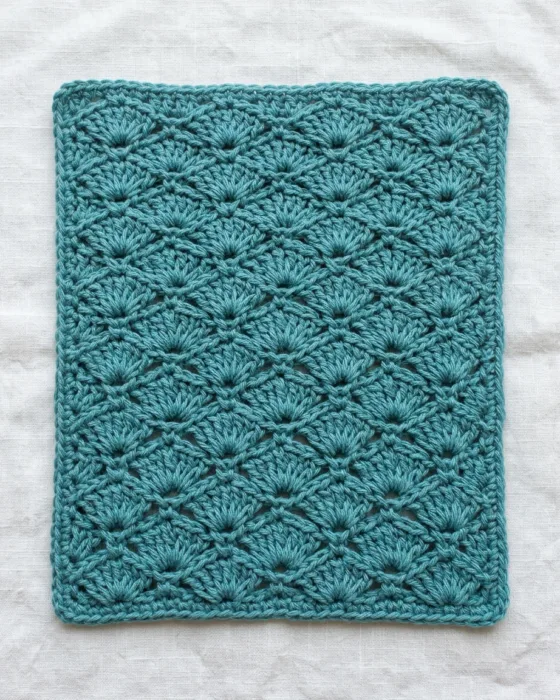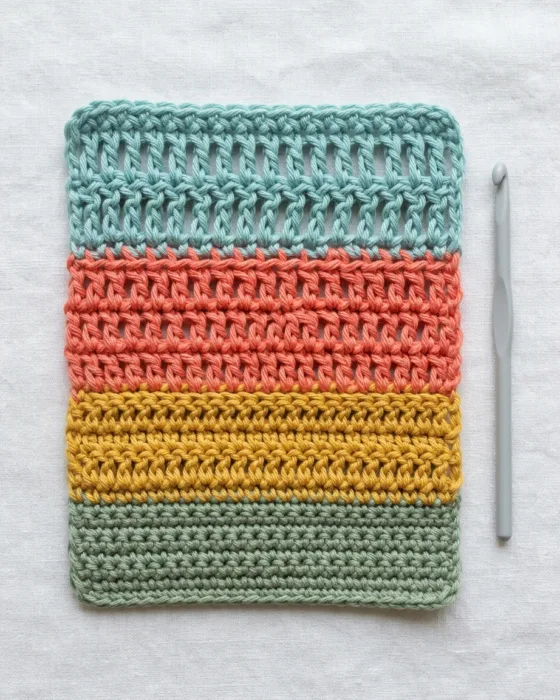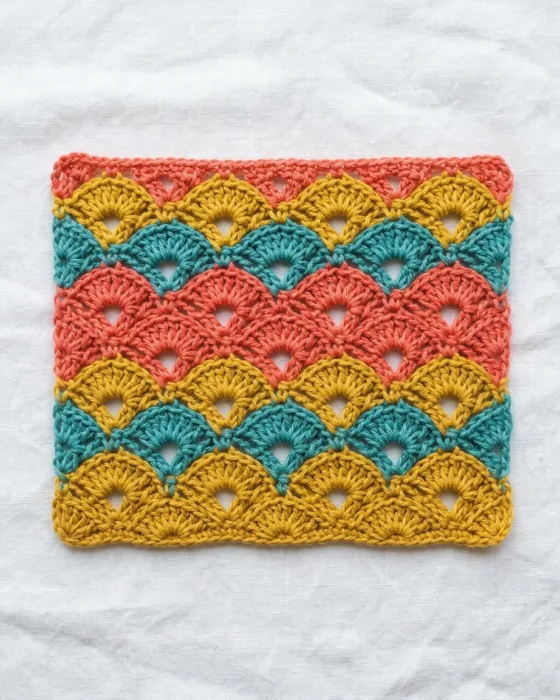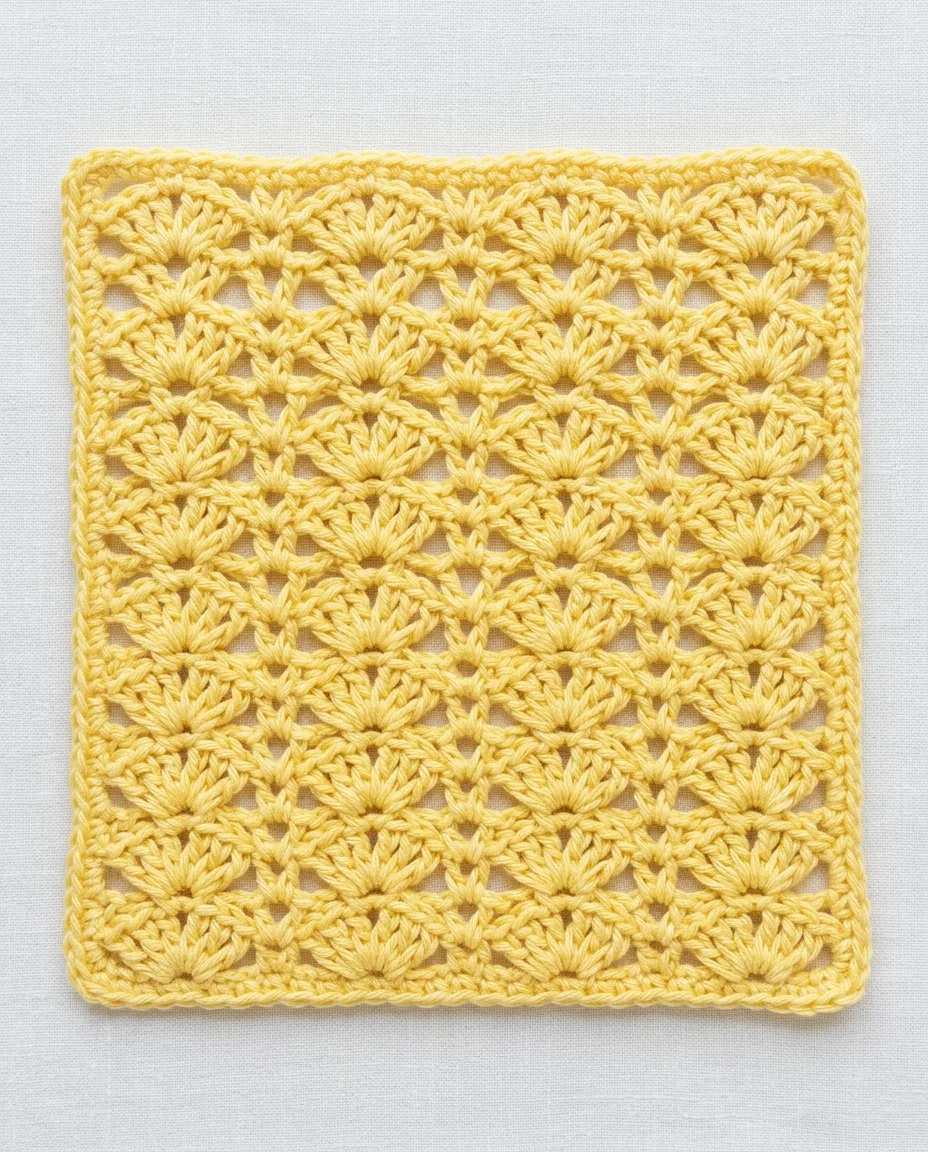
You want a crochet fabric that feels soft in the hand and hangs loose, with a pattern that shows from across the room. The primrose stitch gives you that. It stacks little fans of four double crochets in rows, and each fan opens like a rounded petal sitting inside a V. Baby blankets suit it well. So do light scarves.
How hard is it? Middle of the road. If you can chain and make a double crochet, one evening is enough. The only new move is working stitches into a gap instead of into a stitch, and that’s where most first tries go sideways.
Pick a pale shade of worsted weight (the medium-thick yarn that fills most store shelves) for the first try. Dark yarn hides the holes, and the holes are how you find your place. All terms here are US crochet terms.
Two shapes do all the work. A V is one double crochet, two chains, then a second double crochet in the same spot. A shell is four double crochets packed into one gap. Rows of Vs and rows of shells take turns, and that’s the whole stitch.
- Chain 19. Loosely. A tight chain pinches the bottom edge for good.
- Wrap the yarn over the hook once, front to back. That wrap is the yarn over you’ll repeat all through this.
- Push the hook into the 5th chain from the hook.
- Yarn over and pull a loop back through the chain. Three loops on the hook now.
- Yarn over, pull through two loops. Two left.
- Yarn over again and pull through both. That’s one double crochet.
- Chain 2.
- Make a second double crochet in that same chain. First V done.
- Skip 2 chains. Make a V in the next one.
- Keep going until 2 chains are left. Count your Vs. Four so far is right.
- Skip 1 chain, then one double crochet in the last chain. Five Vs on the row.
- Chain 3 and turn the work over. Those 3 chains are the turning chain, and they count as the first stitch of the new row.
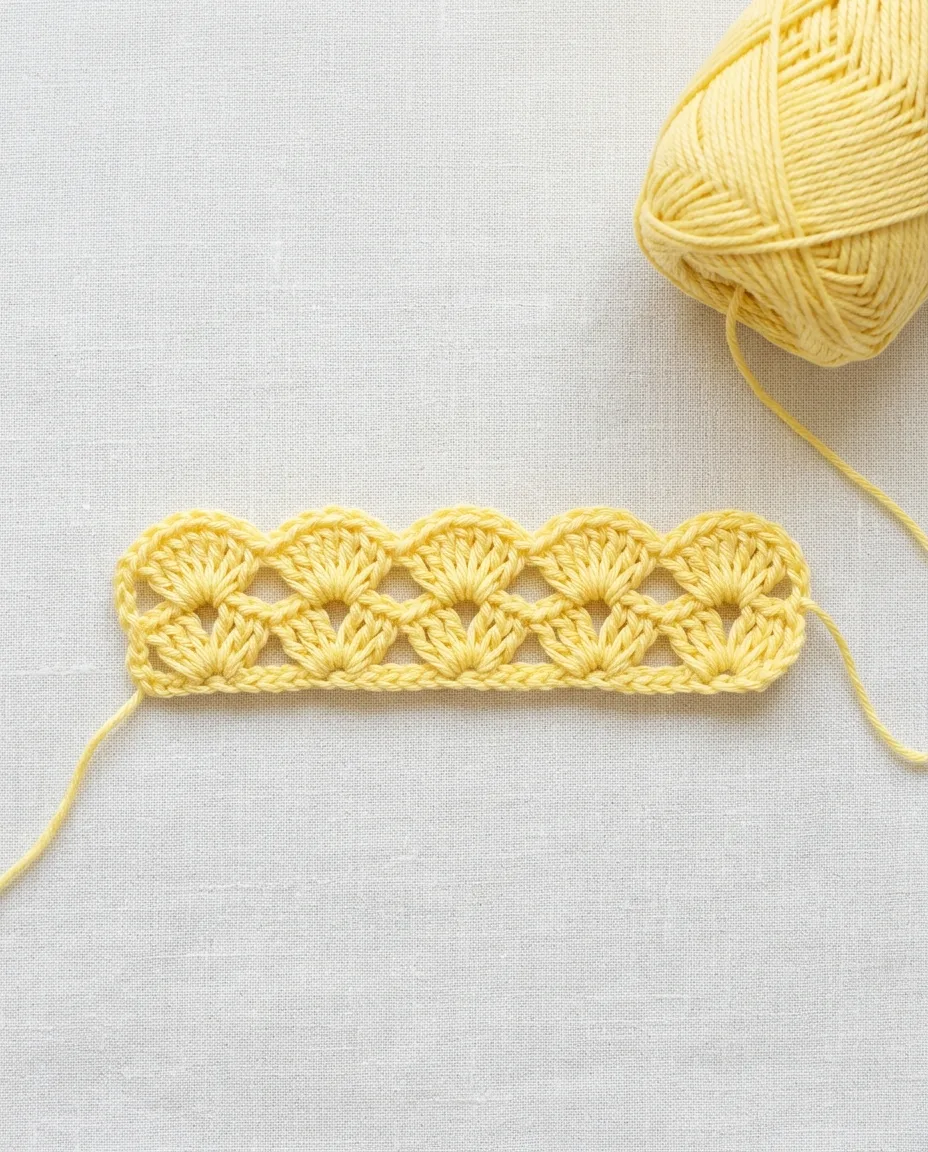
- Find the little gap in the middle of the first V. Work 4 double crochets into it, going under the chains instead of into them.
- Same thing in every V across. Five petals.
- One double crochet into the top of the turning chain from the row below.
- Chain 3 and turn again. Each petal has a middle now, right after its second stitch.
- Work a V into that middle space on every petal. Then a double crochet in the top of the turning chain.
The rows, written out
Once your hands know the two shapes, the written version is short. Here it is in standard shorthand, with V meaning (dc, ch 2, dc) in one spot and shell meaning 4 dc in one space.
- V in 5th ch from hook, (skip 2 ch, V in next ch) x4, skip 1 ch, dc in last ch (5 V)
- ch 3, turn, 4 dc in ch-2 sp of each V across, dc in top of tch (5 shells)
- ch 3, turn, V between 2nd and 3rd dc of each shell, dc in top of tch (5 V)
- Repeat Rows 2 and 3 to the length you want, ending on a Row 2 (5 shells)
Row 2 is the one to slow down on. You’ll feel tempted to stab the hook into the top of a double crochet. Don’t. Every shell goes into the open gap, with the hook passing under the two chains. Check the count after each row: five shells or five Vs, and a single double crochet hugging each edge.
 Save
Lost count? Look at the holes. Each shell sits directly over a V.
If one petal looks lopsided, the V under it went in off-center. Pulling back one row is faster than fudging it.
Where a primrose fabric earns its place
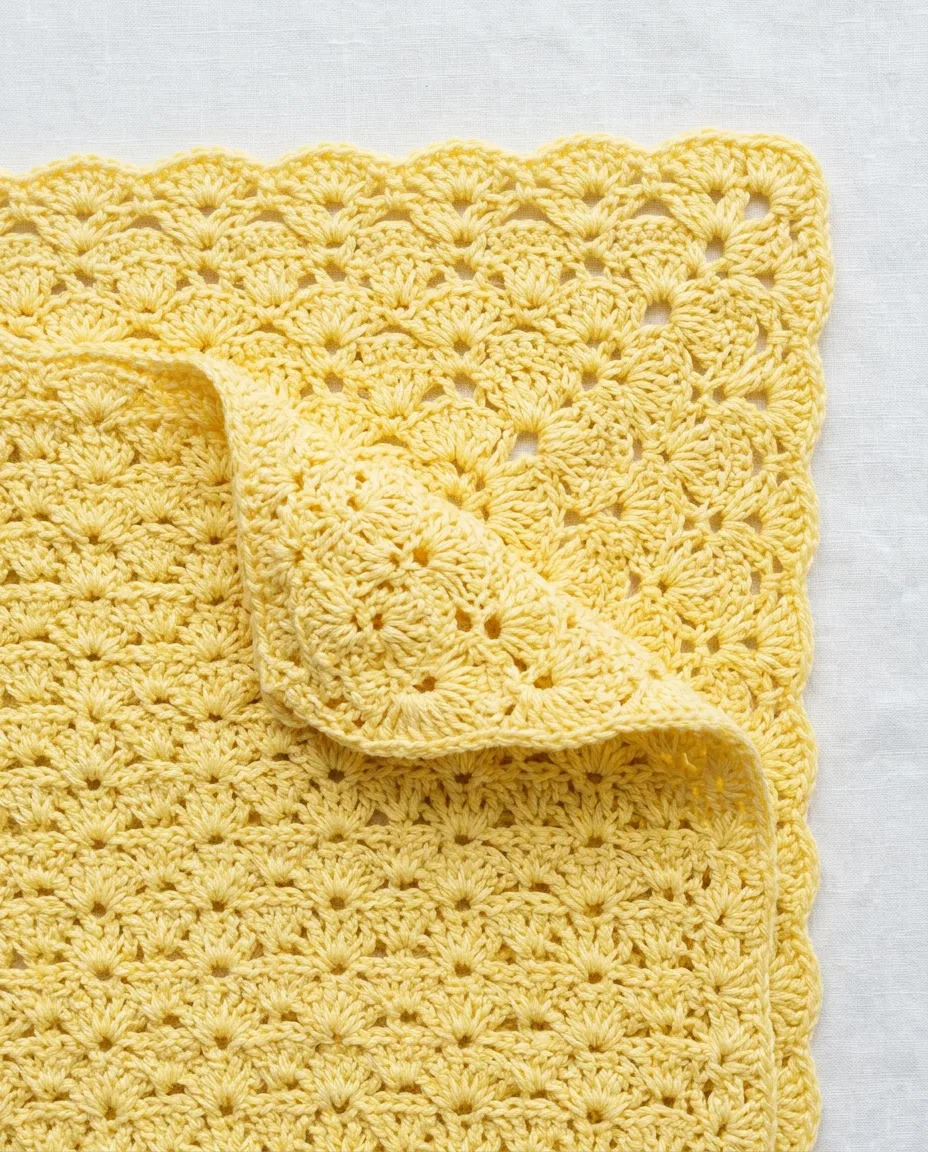
All those double crochets make a tall, airy stitch. The fabric bends easily and folds without a crease. It also uses yarn quickly, since every row stands about as tall as a double crochet. That’s a plus on a blanket and a minus if you’re short on yarn. There is a fuller walkthrough in the guide to the crochet chevron stitch.
 Save
Baby blankets are the classic use. Light shawls and spring scarves come next, especially in cotton, which keeps the petals crisp after a wash. And a cowl worked flat and seamed at the short ends looks far fussier than it is.
Some projects fight it, though. Bags stretch out of shape because the holes open under weight. Toys are worse. Stuffing pokes straight through the gaps. Potholders are a bad idea too, since heat passes through the holes. For anything that needs to be solid, pick a closed stitch and save this one for drape.
A note on babies. Small fingers can catch in open stitches, so a primrose blanket belongs on a lap or a stroller, under a grown-up’s eye. Worsted cotton with a 5 mm hook keeps the gaps small.
If the edges flare or the petals drift
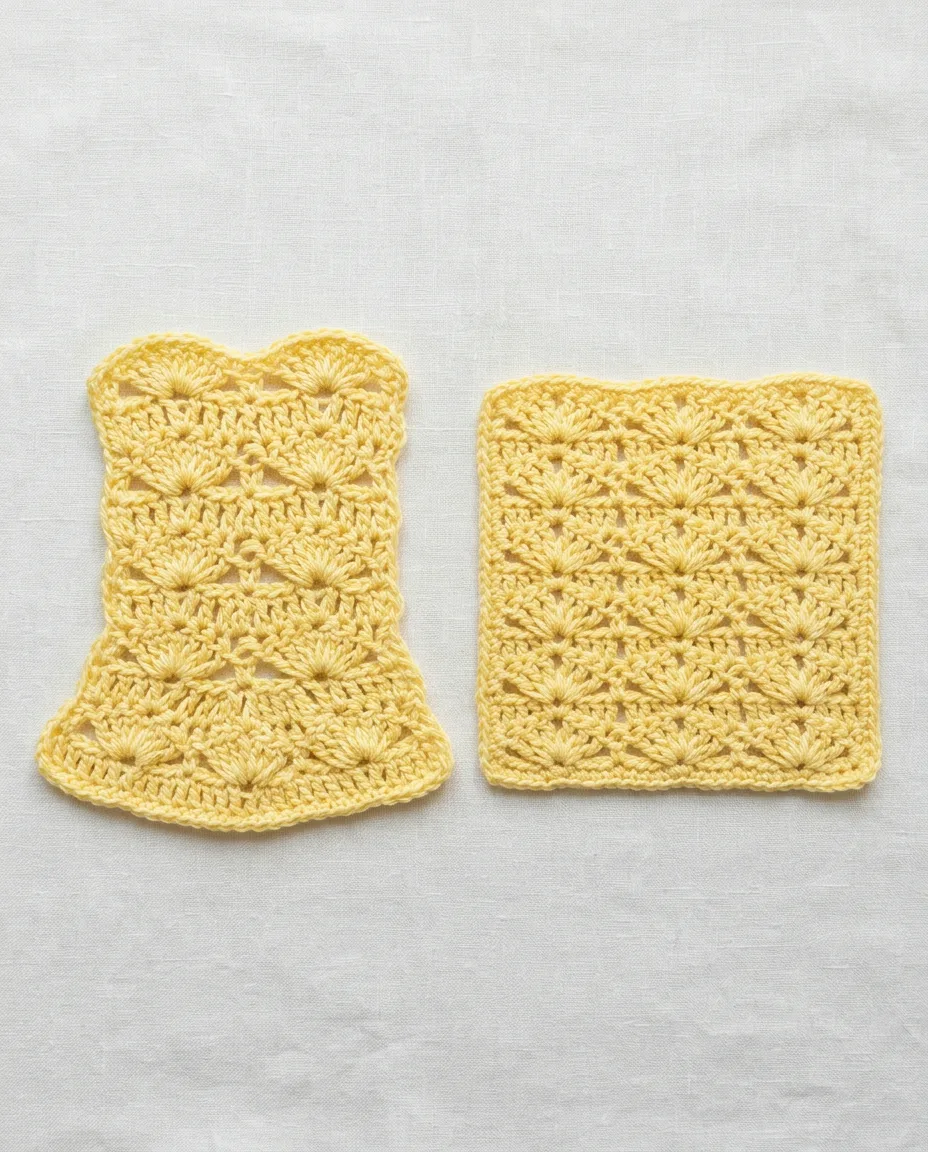
Wavy edges are the most common complaint, and they nearly always come from one habit. Shells worked into the tops of stitches add width every row. After six or seven rows the piece flares like a fan. Rip back to the last good row and put each shell into the gap. The guide to the crochet braid stitch covers the whole method.
 Save
Edges that creep inward are the opposite problem. Somewhere a turning chain got skipped, or the last double crochet missed the top of the turning chain. Count five shells or five Vs, plus one stitch at each edge. If an edge stitch is missing, that’s your culprit.
Petals that lean to one side mean the V went in beside the middle of the shell instead of right in it. Four stitches have one true center: between the 2nd and the 3rd. Count them with the hook tip before you work the V. It feels slow for two rows. Annoying, even. Then something clicks. Your eye starts finding the middle on its own, and the hook goes there without counting. Give it a few rows.
Tension matters more here than in solid fabric. Pull the chain-2 tight inside each V and the next shell has no room, so the four stitches bunch up and the petal flattens. Leave those two chains relaxed. A shell needs space to spread.
Try it smaller in cotton thread
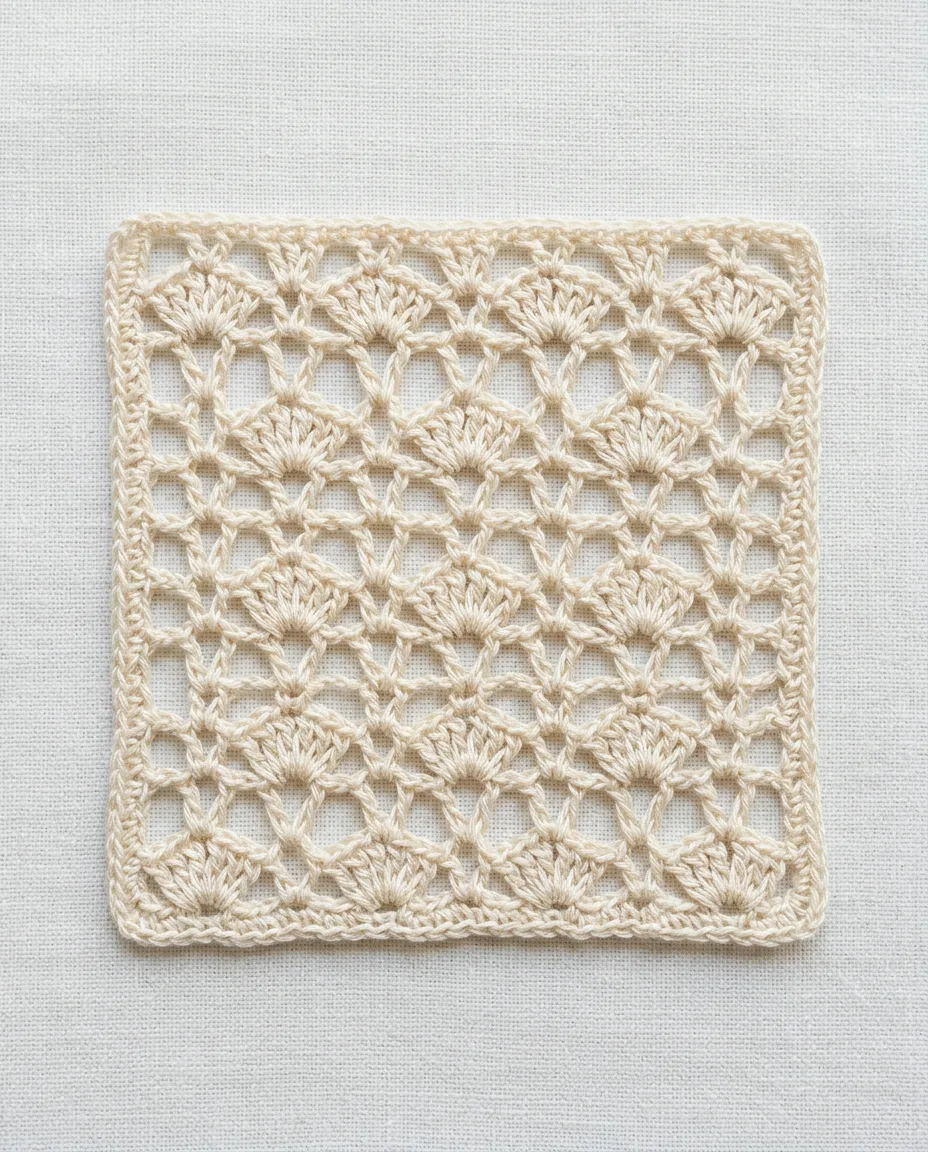
Swap the worsted yarn for size 10 cotton thread and a 1.75 mm steel hook. Same rows, same counts. The petals shrink to the size of a fingernail and the fabric turns into lace.
 Save
Thread work is fiddly, and there’s no point pretending otherwise. The gaps are tiny. Your hook has to find them by feel as much as by sight, so a good lamp helps a lot. It does make a pretty edging for a pillowcase hem or a narrow shelf runner, where yarn would look clumsy.
But try it in yarn first. Thread hides nothing, and every off-center V shows. Learn the rhythm in yarn, then shrink it.
Making it wider, and finishing
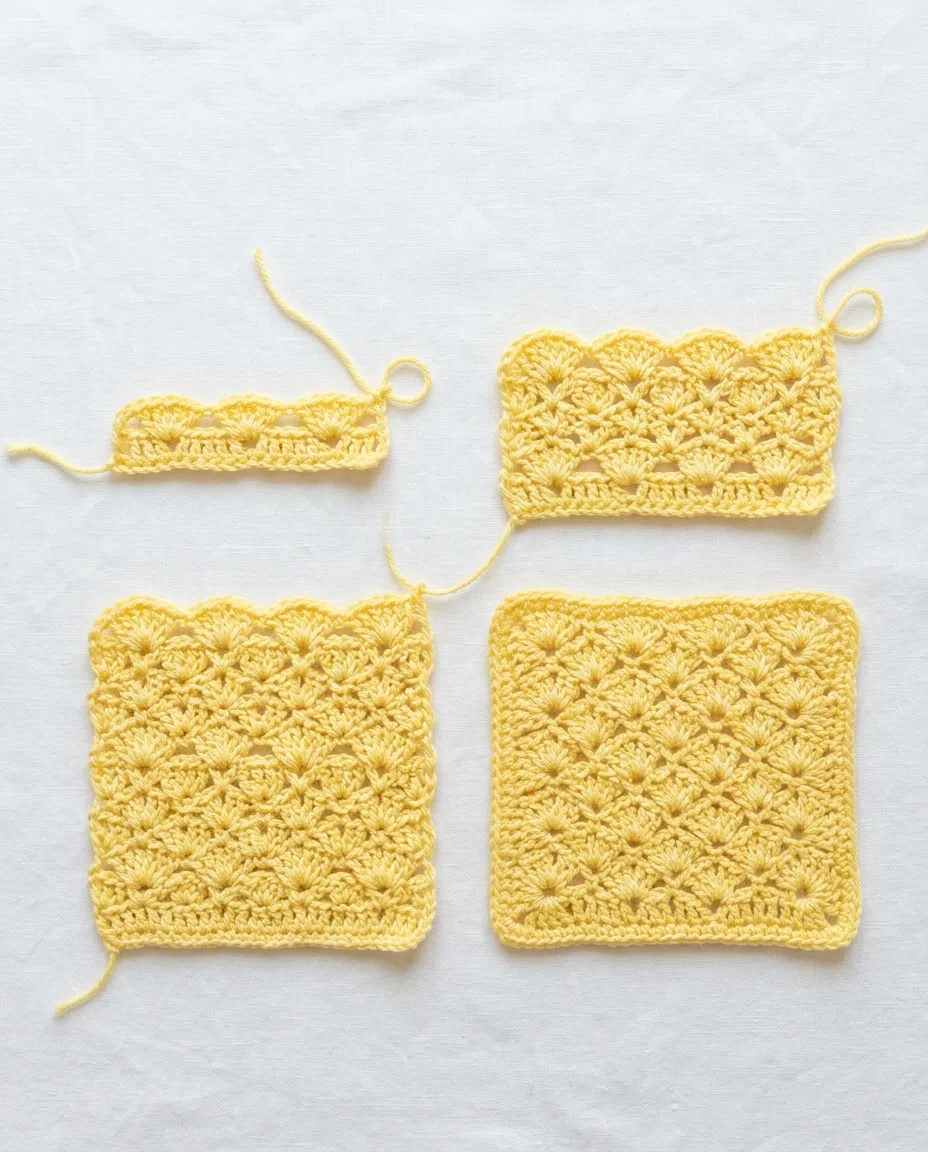
Need a whole blanket? Add 3 chains for every extra petal. A starting chain of 19 gives five petals. Chain 25 and you get seven. Any chain that is a multiple of 3 plus 1 works, so pick a width and round to the nearest count that fits.
Make a test swatch first, a small sample square in your real yarn, and measure it. Hooks and hands differ, and nobody else’s numbers will match your tension. Then multiply out from there.
 Save
Never finish on a V row. A shell row gives the top edge the same scalloped look as the petals all through the middle, which a V row can’t match. Weave the ends in along the side edge, through the double crochets, where they won’t show through the holes. The camel stitch guide covers it round by round.
Blocking helps a lot with this stitch. Wet the finished piece, roll it in a towel to squeeze out the water, then pin it flat to dry. The petals open up and the edges square off. Acrylic needs a light steam instead of a soak, held above the fabric and never pressed down. Press an iron flat on acrylic and the fibers go limp for good.