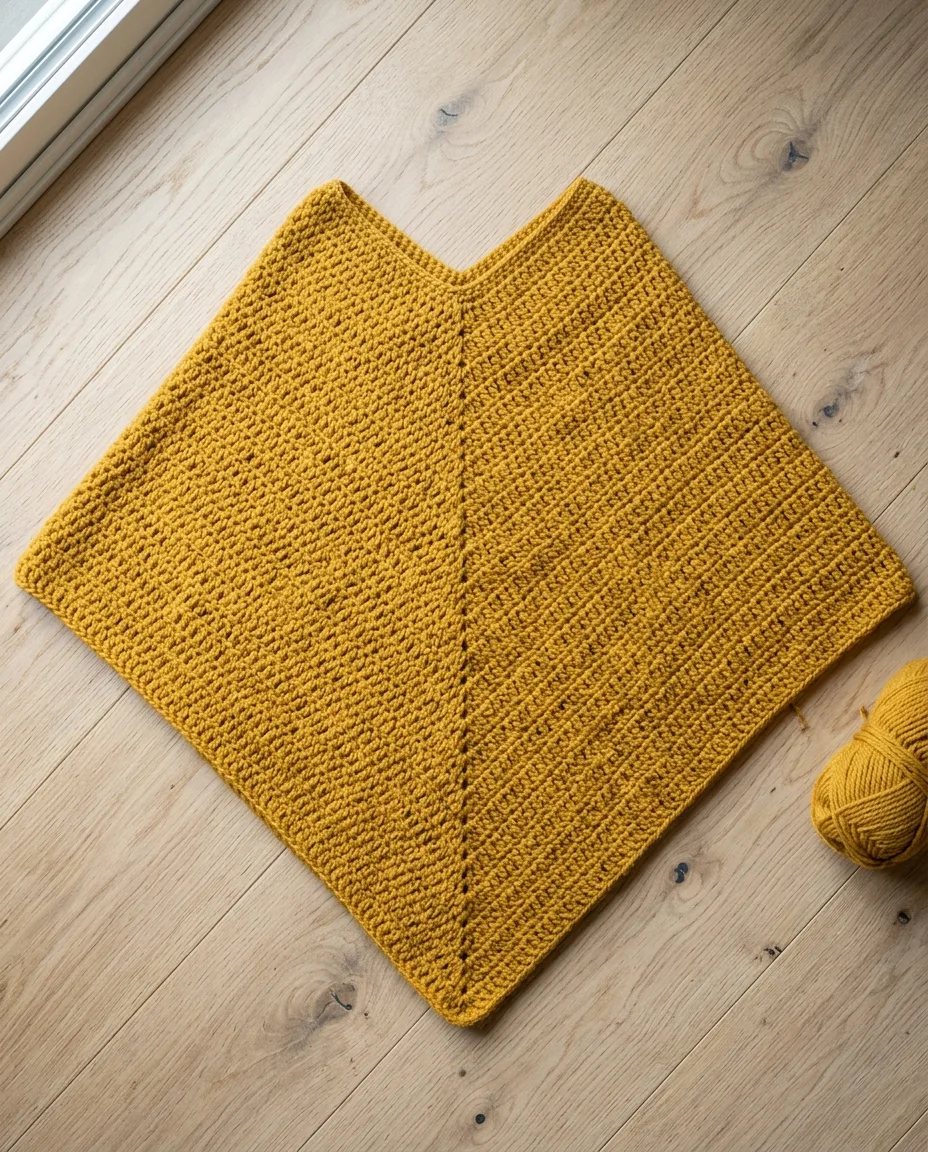
Two rectangles, each 18 by 30 inches, and two short seams. That’s the entire poncho. No shaping, no counting increases, no neck to work in the round. Every row is the same row. If you can keep a straight edge on a scarf, you can make this, and it hangs with a point at the front and another at the back.
It does take a while. Each piece is a big flat stretch of double crochet, so plan on a few weekends. The pattern uses US crochet terms throughout.
The whole make, start to finish
Here’s the order, so nothing later surprises you.
- Crochet a swatch, just a small test square. Measure it. Four inches tells you everything.
- Work the first rectangle in rows until it reaches 30 inches.
- Now the second one. Same chain, same number of rows.
- Lay them out in an L. One short end meets one long edge, at the corner.
- Sew that first seam.
- Fold the free short end over to the other long edge. Second seam.
- One round of single crochet around the neck. That’s the poncho.
- Weave in every tail before you try it on.
Check your gauge before the long stretch
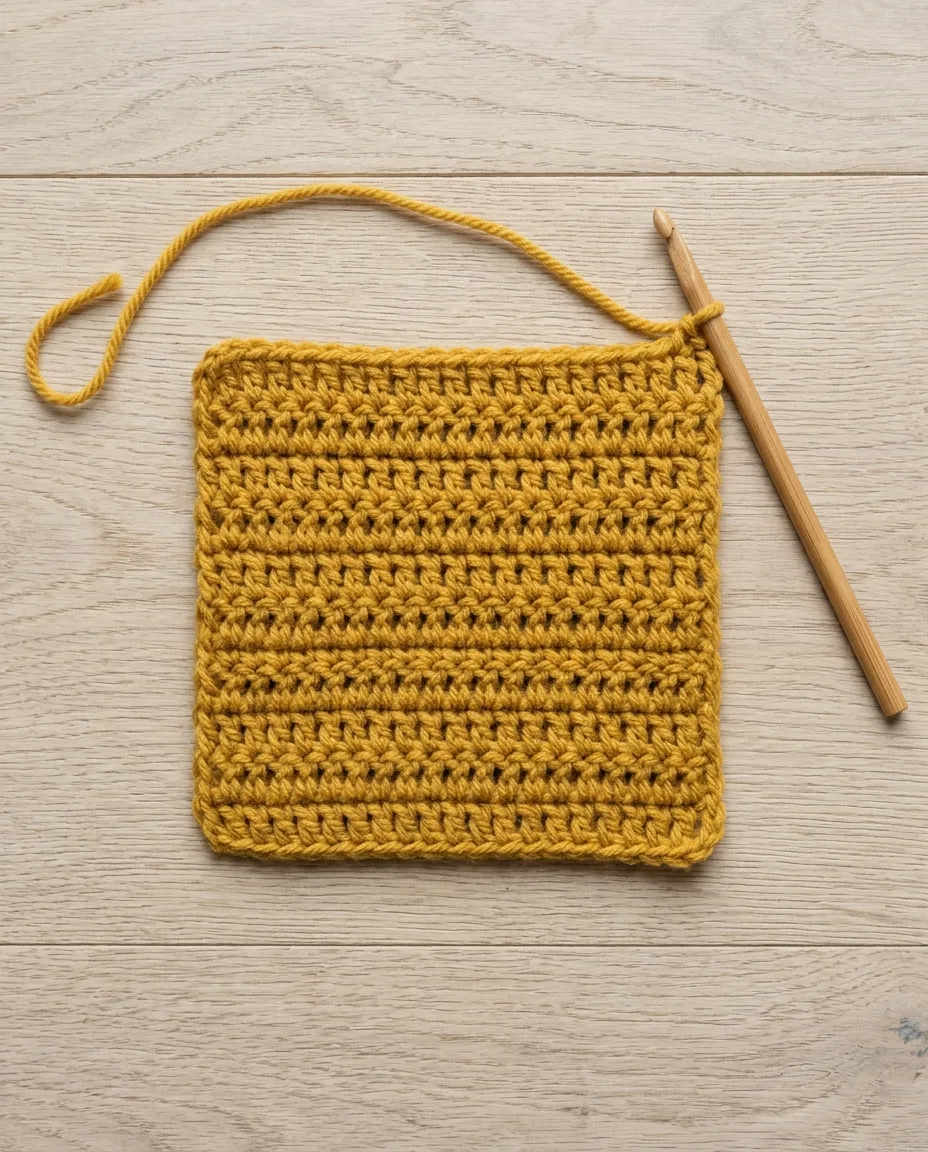
Gauge means how many stitches and rows fit into a set width, and here it decides whether the poncho fits. The target is 12 double crochet stitches and 7 rows to 4 inches (10 cm). Chain 16, work 7 rows, then lay the swatch flat and measure the middle.
 Save
Never skip this one. A swatch that’s half an inch too wide sounds harmless. Across 54 stitches it adds up to a poncho two inches wider than planned. Too many stitches in 4 inches? Go up to a 6.5 mm hook. Too few means a smaller hook.
Quick refresher on double crochet, since it’s the only stitch in the body. Wrap the yarn over the hook from back to front (that wrap is a yarn over). Push the hook into the next stitch and yarn over again. Pull up a loop, and you’ll have three loops on the hook. Wrap again and draw it through two of them. Then wrap once more, through the last two. One double crochet, standing about as tall as three chains.
Crochet the first rectangle
Rows run across the short side, 18 inches wide. You keep adding rows until the piece is 30 inches long. Most people find this part goes faster than they expect once the rhythm settles in.
- Ch 56, dc in 3rd ch from hook and in each ch across 54 sts
- Ch 2 (does not count as a st), turn, dc in each st across 54 sts
- Repeat Row 2 until the piece measures 30 in, 76 cm, from the foundation chain 54 sts
At the gauge above that works out to about 52 rows. Fasten off and leave a 6 inch tail. And count your rows as you finish, because the second piece has to match it exactly.
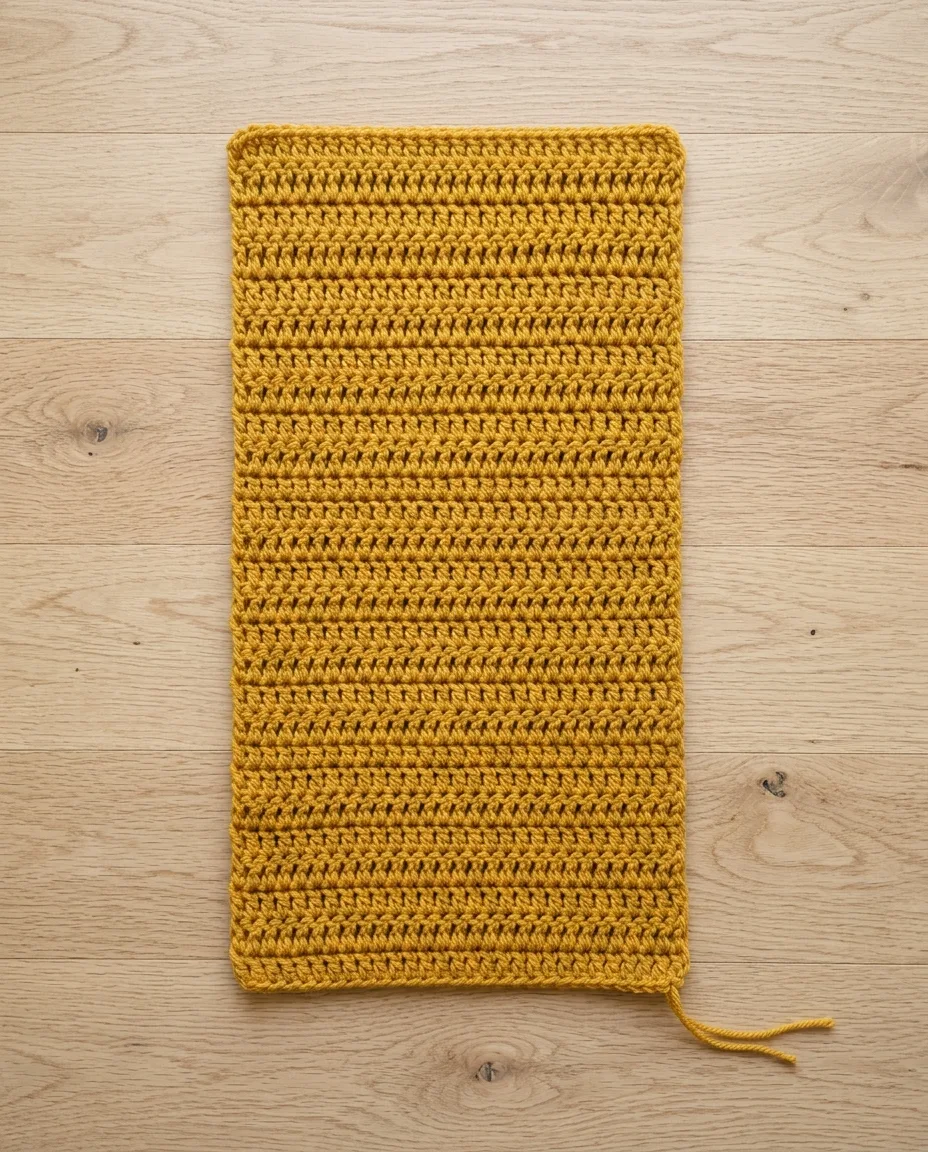 Save
Edges wandering in? Check the last stitch of each row. The final double crochet goes into the top of the last stitch of the row below. That stitch hides right next to the turning chain (the chain 2 that starts each row). Miss it and you lose a stitch every row, so the rectangle narrows into a long trapezoid. Counting to 54 every few rows catches it early.
The second rectangle has to match
Same chain of 56, same 54 stitches, same row count. Don’t measure this one by eye against the first. Count rows. Yarn relaxes as you work, and a piece that looked like 30 inches on your lap can be an inch short once it lies flat.
Clip a stitch marker into every tenth row. It saves recounting the whole thing at midnight. If the two pieces end up one row apart, nobody will notice. Three rows apart and the points will hang at different heights.
Sew the two seams
Lay piece A flat in front of you. Its long edges run left to right. Stand piece B upright on the right end of A, so B’s short end touches A’s top long edge. The two corners line up at the right. That’s the L.
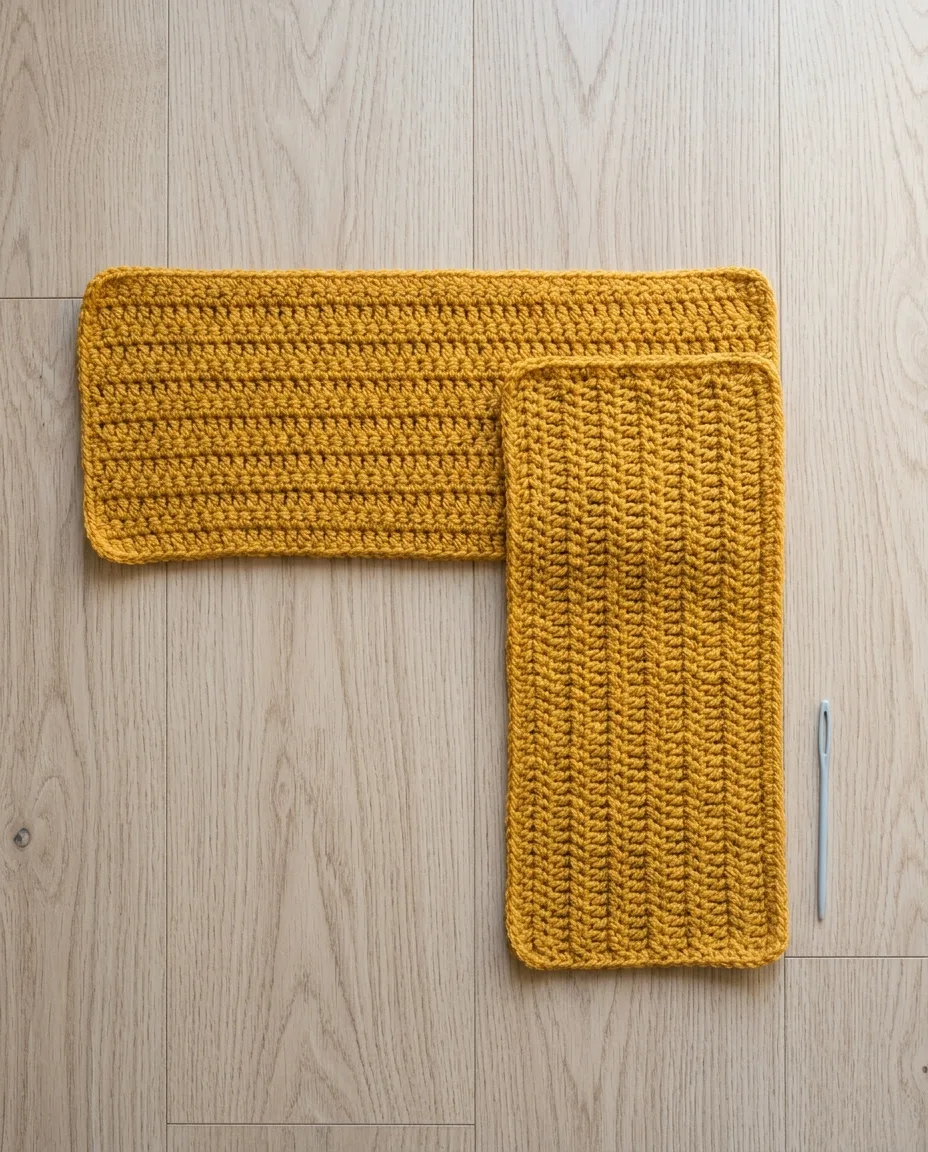 Save
- Pin B’s short end to the right-hand 18 inches of A’s top edge. Pins at both ends first, then one in the middle.
- Thread the tapestry needle with a long tail of the same yarn.
- Sew from the outer corner inward. Push the needle through both layers from front to back, bring it over the edge, and go in again one stitch along.
- Stop at the last pin and knot the yarn on the wrong side.
- Pick up the poncho. Bring A’s free short end around to meet the left edge of B, matching the outer corners again.
- Pin and sew that second seam the same way.
Rows and stitches don’t match one for one here. A short end has 54 stitches. The long edge it meets has fewer row ends in the same 18 inches. Easing it in with pins is the fix. Sew a little more fabric on one side per stitch and the seam lies flat.
No seam should pucker. If it does, the yarn is pulled too tight, so pick out a few inches and redo it looser. Some people prefer a slip stitch seam with the hook instead. Put the hook through both layers, yarn over, and pull the loop through everything on the hook. It’s quicker, though it leaves a ridge you can feel on the inside.
Finish the neckline
Unfinished, the neck edge is just the row ends of both pieces, and row ends stretch. One round of single crochet firms it up. Single crochet is the short stitch: insert the hook, yarn over, pull up a loop, then wrap again and draw it through both loops.
- Join the yarn at one of the V points with a slip stitch.
- Chain 1.
- Work 2 single crochet into the side of each double crochet row, all the way around.
- Slip stitch into the first single crochet and fasten off.
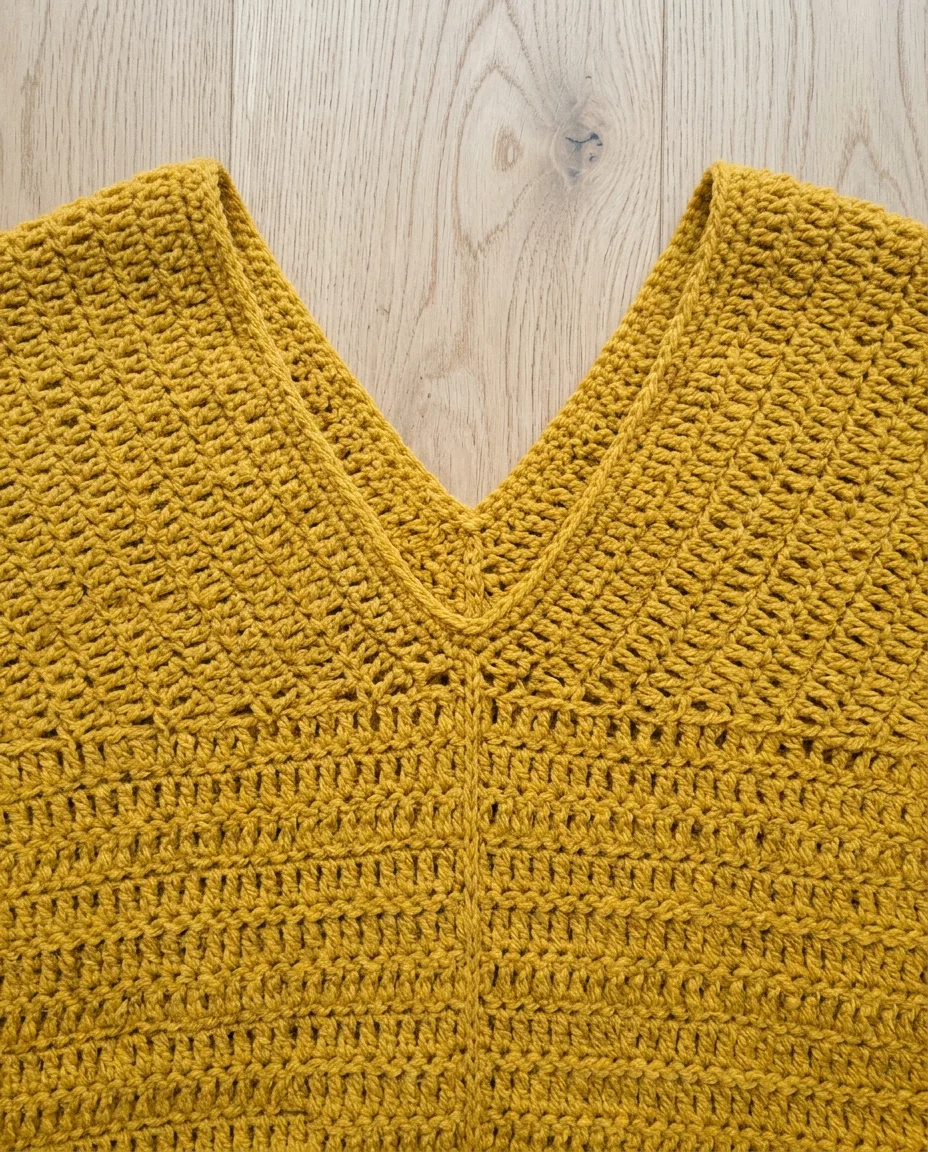 Save
Two per row is a starting point. If the edge ripples, you’ve added too many. If it pulls in and the neck won’t go over your head, add a stitch every few rows. Try it on before fastening off. Getting a pullover over your head with the hook still in it is ungraceful but worth it.
Fringe at the two points is optional. A border round along the hem works too, though it adds another 150 or so yards and an evening of work.
Sizing for a child or a longer drape
The neck opening depends on one difference: length minus width. The opening is twice that number all the way around. For the adult size, 30 minus 18 is 12, so the neck measures about 24 inches before the edging. That fits over most adult heads with room to spare.
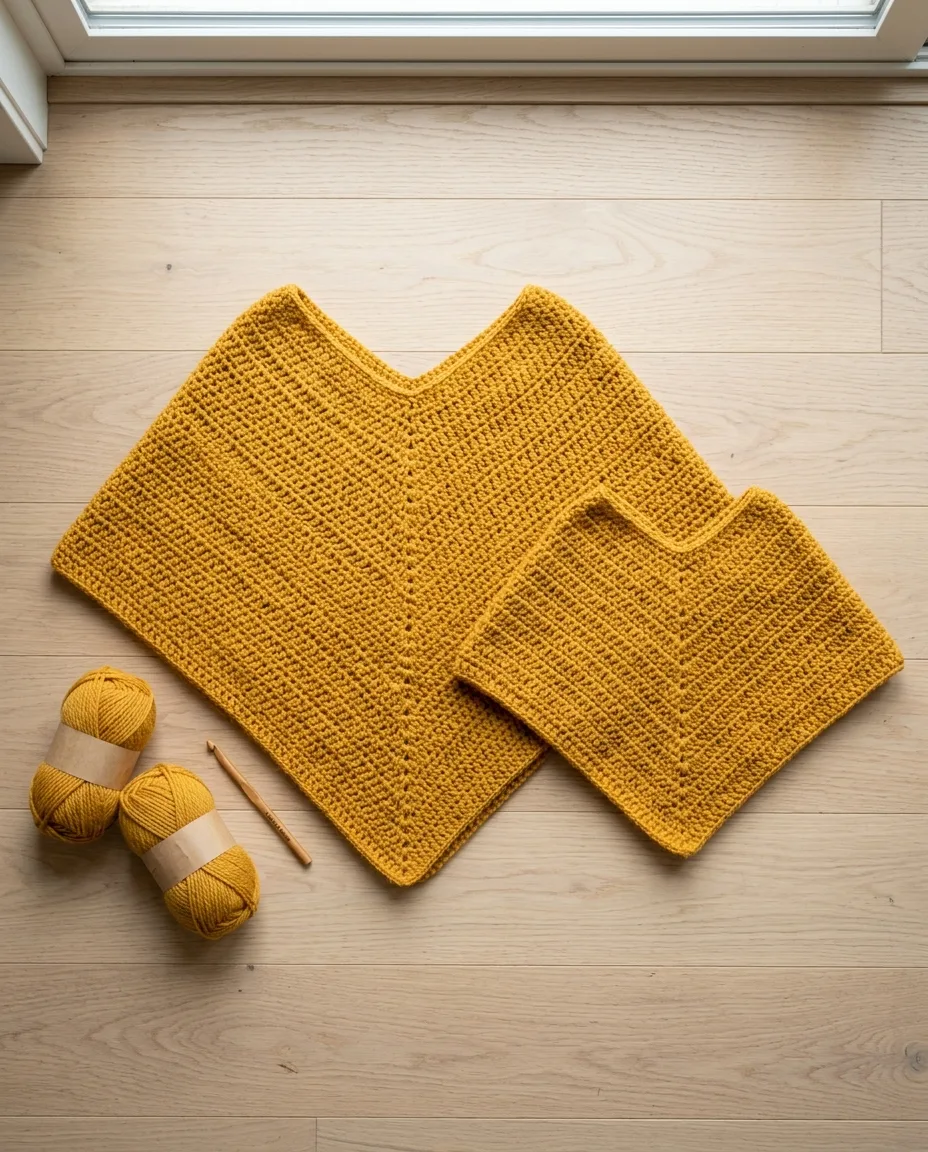 Save
| Size | Each rectangle | Chain | Neck opening | Yarn, roughly |
|---|---|---|---|---|
| Child, about 4 to 8 years | 12 × 23 in (30 × 58 cm) | 38 | 22 in | 500 yd |
| Adult | 18 × 30 in (46 × 76 cm) | 56 | 24 in | 950 yd |
| Adult, longer drape | 20 × 33 in (51 × 84 cm) | 62 | 26 in | 1,150 yd |
Want it longer but not wider? Add length and width together. Keep the gap between them about the same, otherwise the neck grows with every inch you add. The yarn figures are estimates for double crochet in worsted. Buy one extra skein from the same dye lot, since a second batch rarely matches exactly.
If it doesn’t hang right
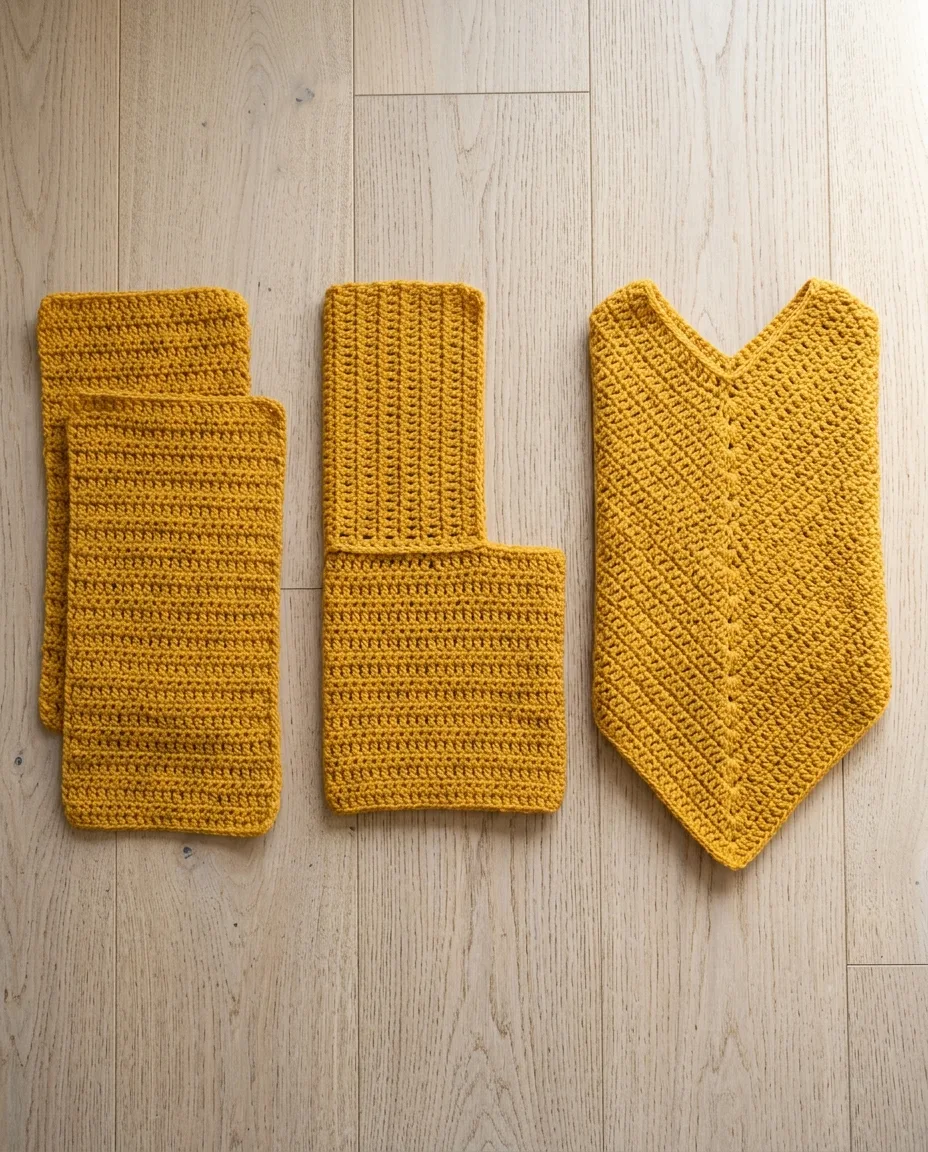
Most problems trace back to the seams. A poncho that twists to one side usually has its second seam sewn onto the wrong long edge. Lay it flat again. The two seams should sit on opposite sides, each starting at an outer corner.
 Save
Points uneven? Count rows on both pieces. One piece a few rows longer pushes its point lower. Pull back the extra rows and redo the seam. It’s annoying. It’s also quicker than living with a lopsided hem.
But the neck too tight is the complaint heard most. Check the table against your measurements. A swatch that came out denser than 12 stitches to 4 inches shrinks everything, the neck included. The cure is one round of single crochet worked with fewer stitches, or a pair of slightly longer rectangles next time. Wash it on a gentle cycle and dry it flat, because wool or acrylic double crochet hung up wet will stretch toward the floor.