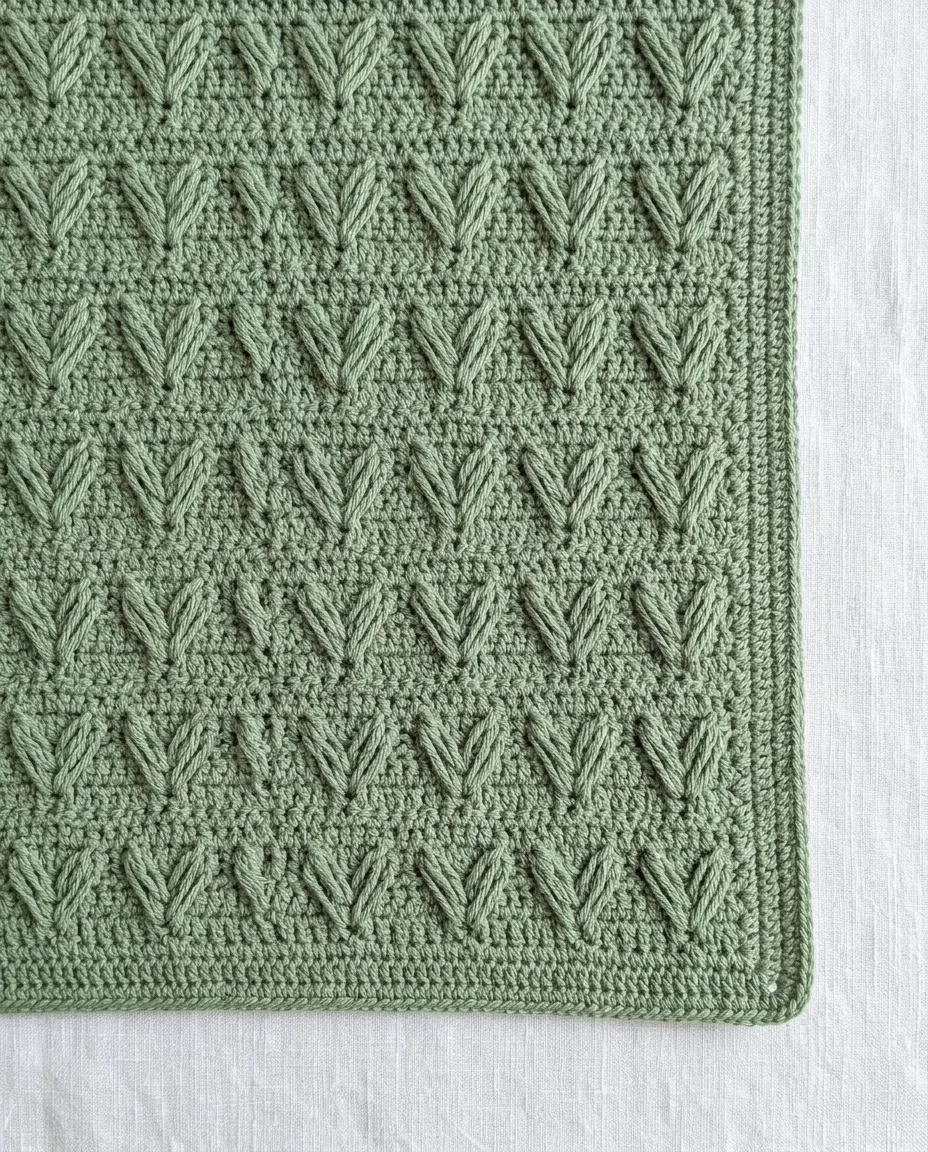
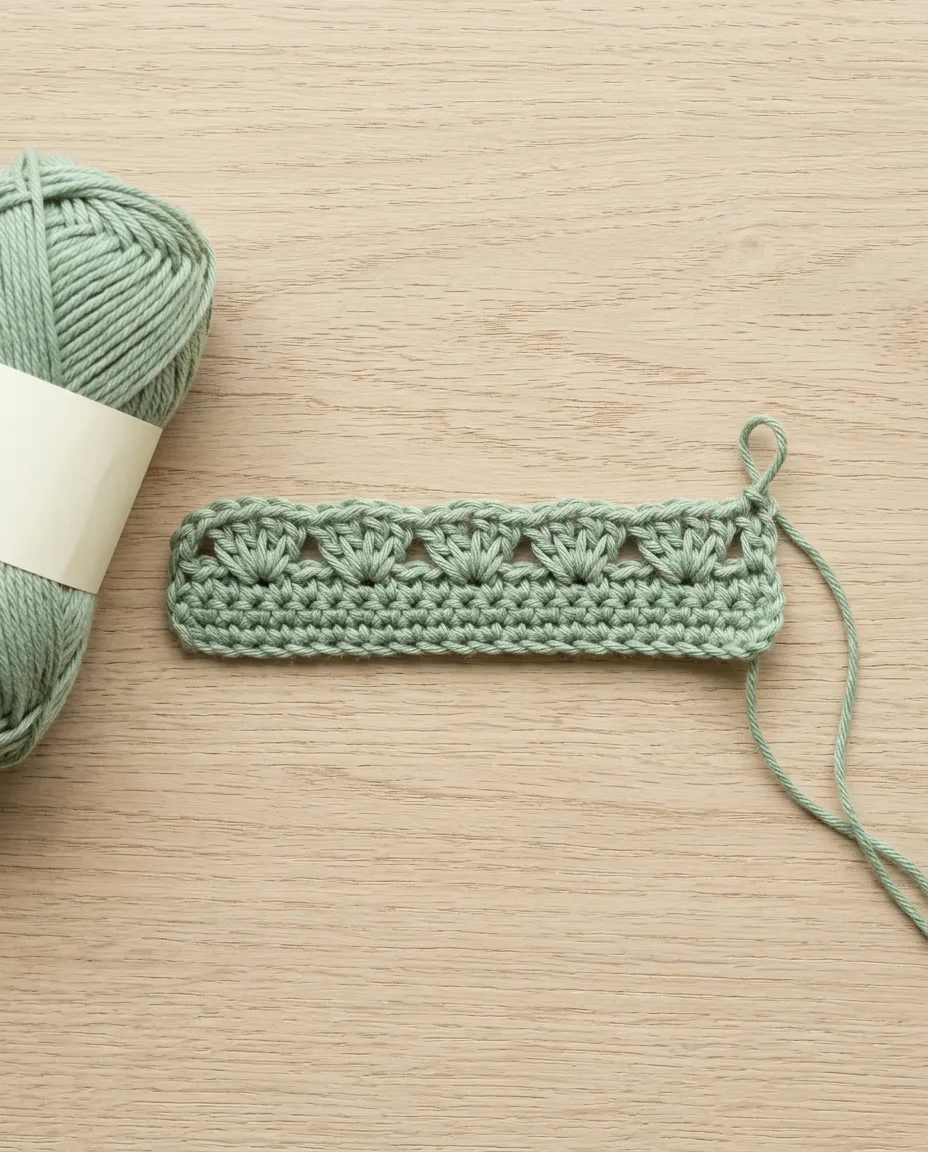
Seventeen stitches go into a leaf row and seventeen come out, and eight of them are leaves. That balance is the whole trick. Each leaf is two slanted double crochet legs that meet at the top, with a single chain between neighbors. Then a flat row of single crochet locks them in place. Repeat that pair of rows and the fabric fills up with small upright leaves, which looks lovely on a baby blanket or a throw.
Is it hard? Not really. If you can chain and work a double crochet, you can make this. The only fiddly bit is the first leg of each leaf, which goes into the same stitch the last leaf finished in. Miss that and the rows grow wider. A few different stitches get sold under the name “leaf stitch,” so check the photos before you mix patterns. This one has a short two-row repeat and works on any odd number of stitches. The terms here are US crochet terms.
- Chain 18. Keep the chains loose, since the next row goes back into them.
- Single crochet into the second chain from the hook. Push the hook in and wrap the yarn around it from back to front (that wrap is called a yarn over). Pull a loop through. Two loops on the hook now.
- Yarn over again and pull through both loops. That’s one single crochet.
- Work one in every chain to the end. Count them. You want 17.
- Turn the work and chain 3. It stands in for the first double crochet.
- Start the first leaf. Yarn over, then put the hook into the very first stitch. Yes, the one the chain 3 grew out of.
- Yarn over and pull up a loop. Three loops on the hook.
- Yarn over and pull through two. Two loops left. That’s the first leg.
- Skip one stitch. Yarn over and go into the next one.
- Pull up a loop, yarn over, pull through two. Three loops now.
- Yarn over and pull through all three. One leaf, closed at the top.
- Chain 1.
- Next leaf. The first leg goes into the stitch that holds the last leg. Easy to miss. The second leg goes two stitches along.
- Keep going. The eighth leaf ends in the last stitch of the row.
- Work one plain double crochet into that same last stitch. Count again. Seventeen.
- Turn and chain 1. Single crochet across, one in every stitch. Each leaf top and each chain gap counts. The last one goes into the top of the chain 3.
If you haven’t met double crochet yet, it starts with a yarn over before the hook goes in. You pull up a loop and have three on the hook. Then yarn over and pull through two, twice. Each leaf leg is that same stitch stopped halfway, which is why both legs can close together.
- Sc in 2nd ch from hook and in each ch across, turn (17)
- Ch 3 (counts as dc), leaf with first leg in same st and second leg in 3rd st, *ch 1, leaf with first leg in same st as last leg and second leg 2 sts over; rep from * 6 more times, dc in same last st, turn (17)
- Ch 1, sc in each st across, turn (17)
- Rep Rows 2 and 3 to the length you want, ending on a Row 3 (17)
 Save
Why it suits a blanket
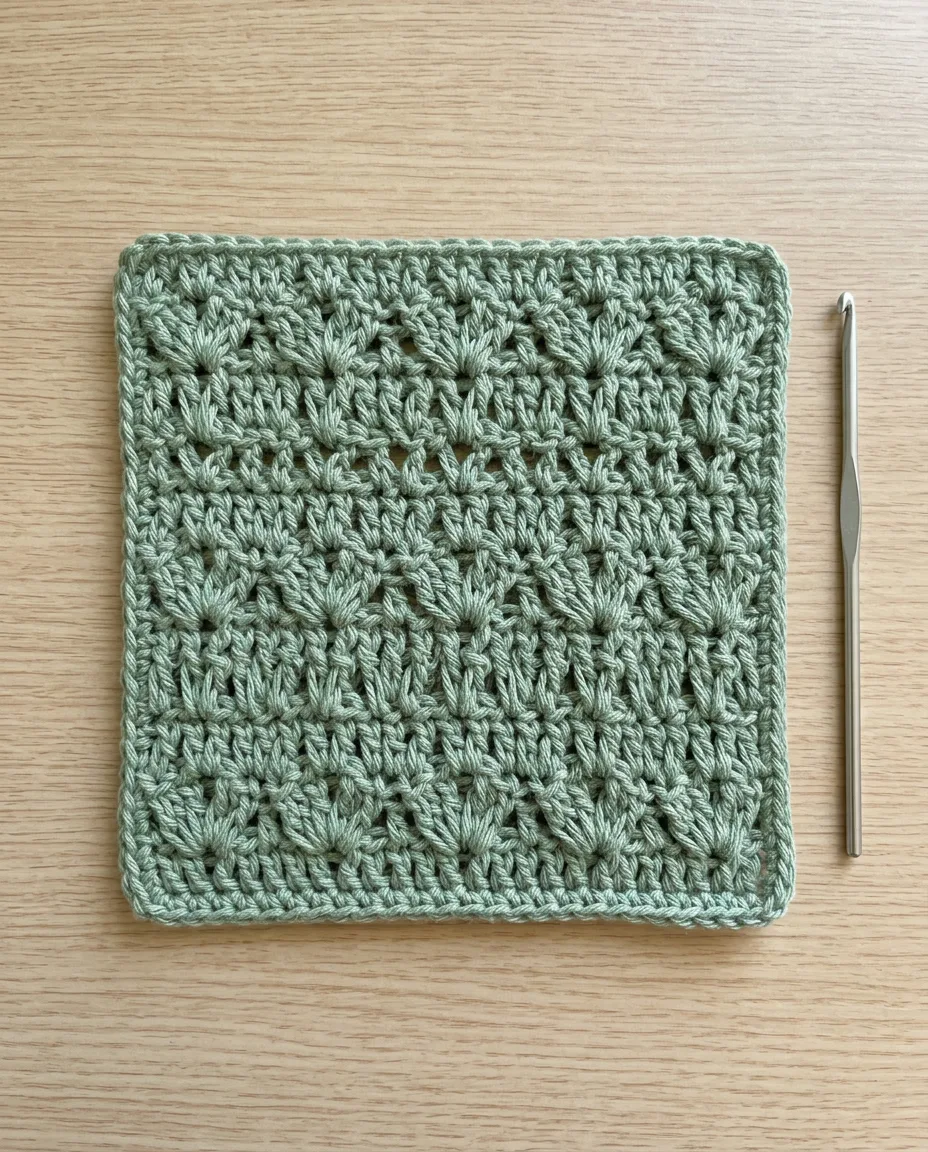
Blankets get washed a lot. This stitch handles that well, because the single crochet rows are dense and hold the leaves in shape. There are no long loops for small fingers to catch. And the leaves stack in neat columns, one directly above the next, so the texture looks planned from across a room. The star stitch guide covers it round by round.
It also lies flat. Plenty of textured stitches pull in or ripple at the sides, but this one keeps the same 17 stitches on every row. Here’s the honest downside: the leaf rows drink more yarn than plain single crochet. Buy an extra ball of the same dye lot before you start.
 Save
Light colors show the leaves best. A dark navy or charcoal hides the slant of each leg, and the blanket can look like plain rows from a few feet away. Sage green is the classic. Cream and pale gray look good too. Cotton gives crisper leaves. Acrylic is softer and cheaper for a big throw.
Rows for a full-size blanket
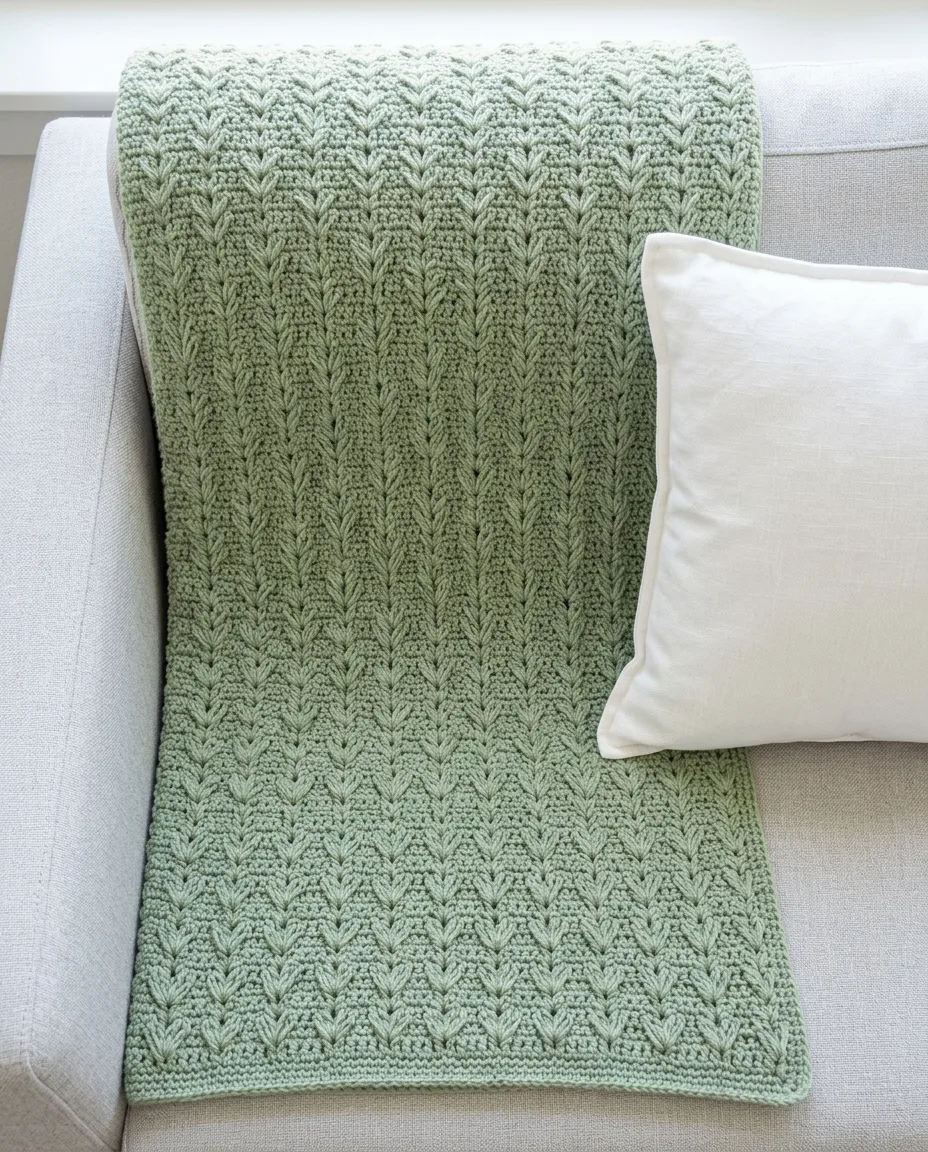
Any odd number of stitches works. So the chain is always an even number, one more than the stitches you want. Make the practice swatch first. Measure how wide your 17 stitches came out, then scale up to the blanket width and round to an odd count.
Want a guide? A baby blanket is usually around 30 inches (76 cm) wide. A lap throw is closer to 50 inches. Your own swatch decides the stitch count, because everyone’s tension differs and a 5 mm hook in one hand gives a different width in another. That swatch is called a gauge swatch, and skipping it is how blankets end up a foot too narrow. There is a fuller walkthrough in the guide to the crochet cable stitch.
 Save
Long rows bring one new problem. Counting 103 stitches every row gets old fast. Clip a stitch marker (a little plastic clip that hangs on one stitch) every 20 stitches on the first single crochet row. Then you only count between markers. Move them up every few rows.
Stop on a single crochet row. It gives a straight top edge for the border.
If the edges start to wander
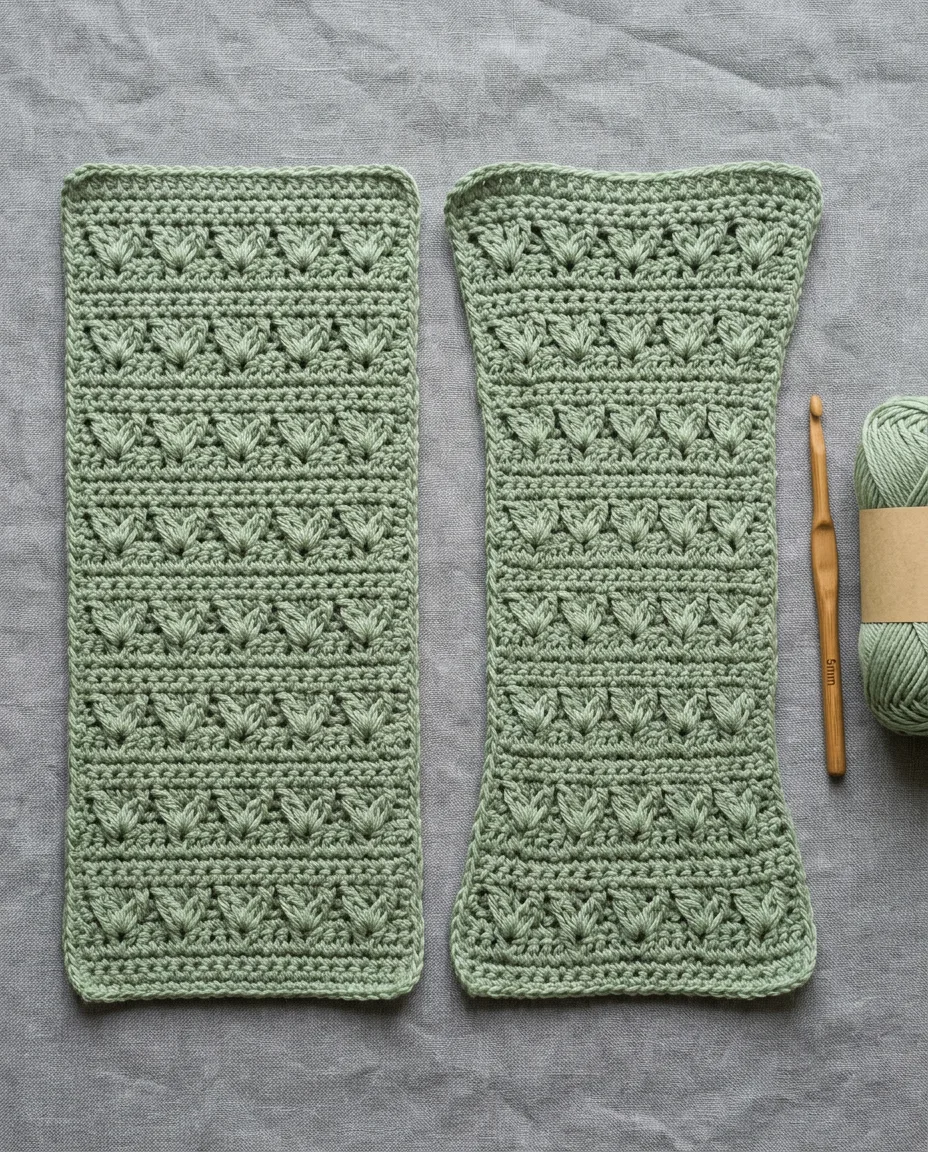
Most problems with this stitch show up at the sides. A swatch that flares wider toward the top almost always has one extra stitch per leaf row. Usually the culprit is the first leg going into a new stitch instead of the shared one. Every leaf row then grows by a stitch or two. Count every leaf row for the first ten rows. After that your hands remember.
 Save
The opposite problem looks like a swatch that narrows. That one comes from the single crochet row. The last stitch belongs in the top of the chain 3, and it’s easy to skip because the chain sits sideways. Lose one there per row and the right side creeps inward.
Leaves that look floppy or open usually mean the chain 1 between them was pulled long. Keep it snug. Leaves that lean all one way are normal, by the way. The second leg always travels in the direction you work, so the tips tilt slightly. Turning the work each row keeps the tilt from building up.
And if the whole piece feels stiff? Go up half a millimeter to a 5.5 mm hook. Worsted cotton on a small hook makes a fabric that stands up by itself, which is fine for a placemat and wrong for a blanket.
Two colors, one for each row
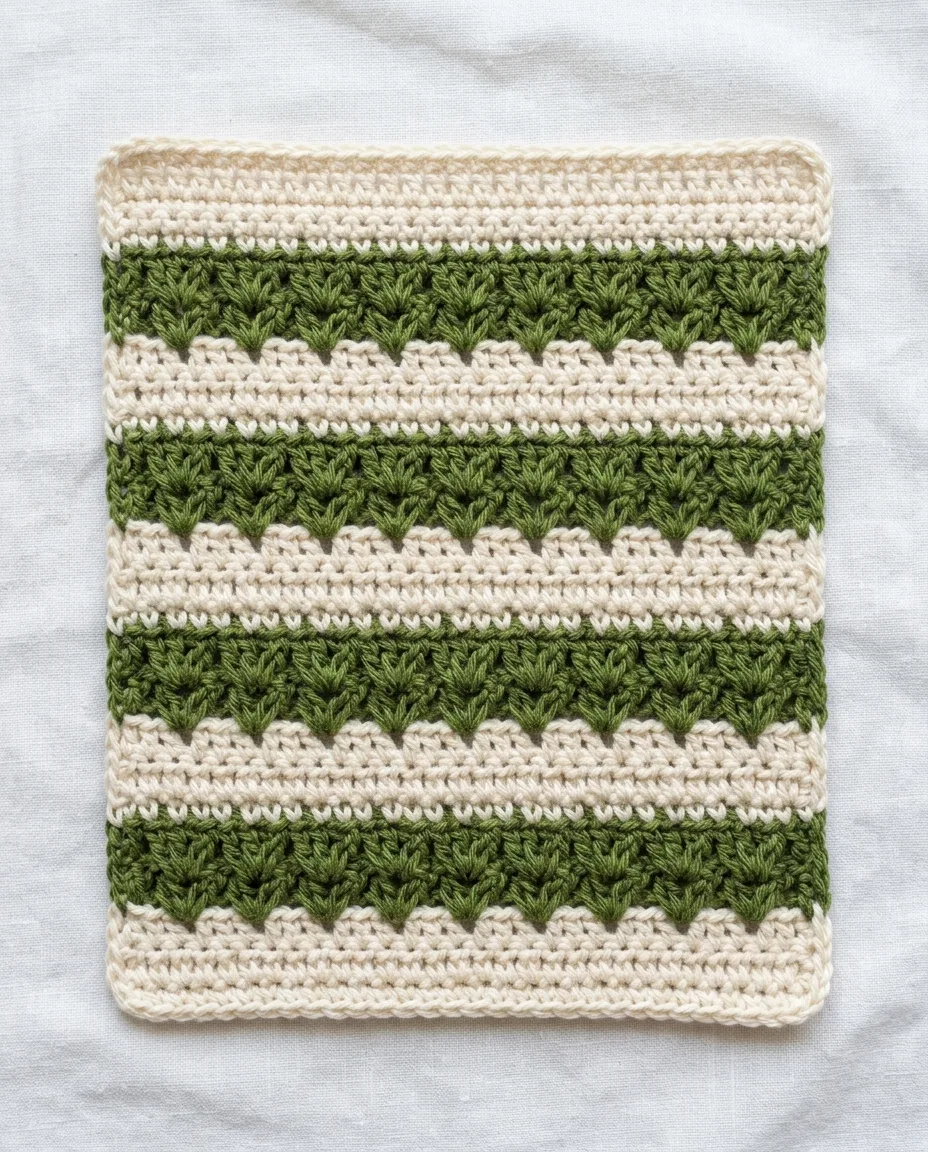
Stripe it. Work every leaf row in a green and every single crochet row in cream, and the leaves pop forward from pale bands. You end each color at the side, so there are a lot of ends. Carry the unused color up the side instead of cutting it. Two rows apart, it only travels a short way and hides inside the border later.
 Save
Change color on the last pull-through of the row before. Finish the final stitch of a cream row up to its last yarn over, then pull the green through instead. The new color starts clean on the chain 3. Done the other way, a little cream bump sits at the base of the first leaf.
Three colors gets busy fast. Two is plenty for a blanket this textured.
Adding a border
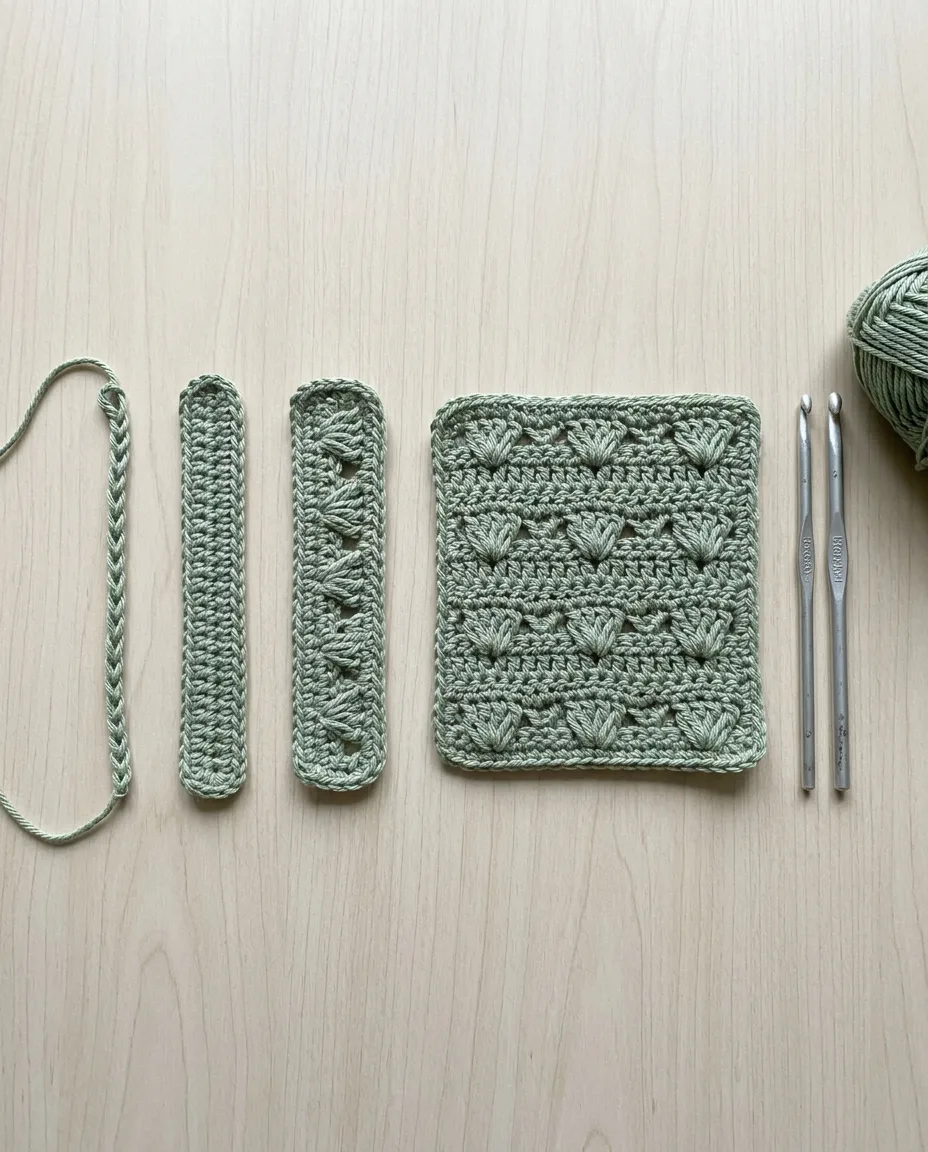
None of the leaf rows give a smooth side edge. Down the sides you’ll find a mix of chain 3 posts and single crochet ends. A border tidies that up. Work one round of single crochet all the way around. Put three stitches into each corner so it turns without cupping. The guide to the crochet picot stitch covers the whole method.
 Save
Along the sides, work two single crochet into the side of every leaf row and one into the side of every single crochet row. That spacing usually keeps the edge flat. If it ripples, there are too many. If it pulls tight, too few.
One more round of single crochet is enough for most blankets. Weave each end back along a single crochet row for about 2 inches, then turn and go back a short way. Machine wash cotton on a gentle cycle and lay it flat to dry so the leaves keep their shape.