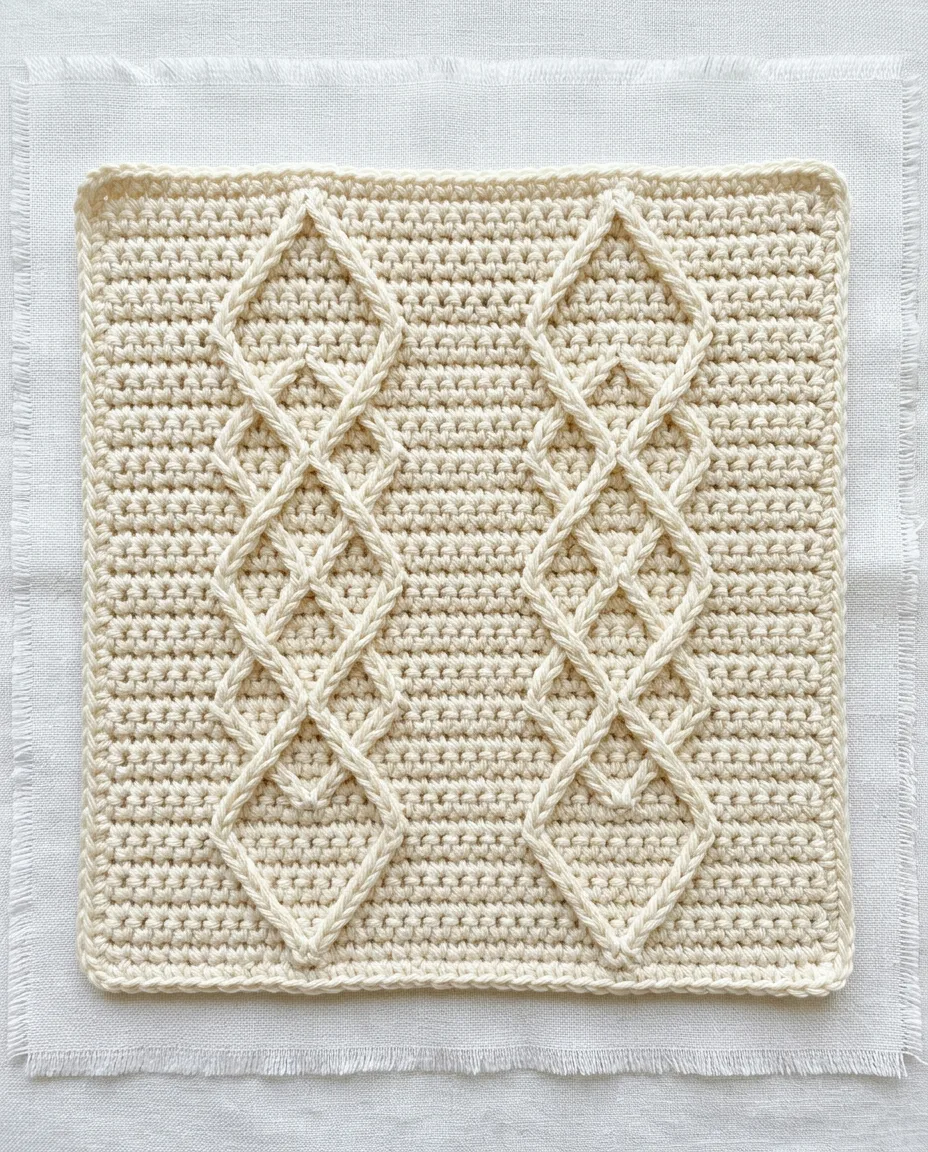
You want raised diamonds standing up off a flat crochet fabric, and you want to know which stitch draws them. It’s the front post treble crochet. You wrap it around a stitch two rows down, then shift it one stitch sideways on every front-facing row. The lines split apart, close up again, and leave thick diamond outlines on a plain background.
Difficulty sits in the middle. Single crochet plus careful counting gets you most of the way. The fiddly part is finding the right post to wrap, so the rows below name every one. This pattern uses US crochet terms.
Worsted weight, the medium thickness marked 4 on most yarn bands, makes posts you can actually see. Light colors help too. Dark yarn hides the shadow that each raised line throws.
Work the front post treble
Every diamond is drawn with this one stitch. You wrap a tall treble around the post (the upright bar) of a stitch below. Going in from the front pushes the new stitch forward. That ridge is the raised line.
Each treble starts with two yarn overs, where you wrap the yarn around the hook from back to front. Then the loops come off two at a time. Here it is in order.
- Yarn over twice. Three loops on the hook, counting the one you started with.
- Look two rows down and find the post of the stitch you’re wrapping.
- Hook in from the front, just right of that post.
- Out to the front again on its left side. The post now sits across your hook.
- Yarn over and pull a loop up around the post. Pull it tall, level with the row you’re on. Four loops now.
- Yarn over, through two. Three left.
- Again. Yarn over, through two, and you’re down to two.
- Yarn over, through the last two. That’s one front post treble.
- Skip the stitch hiding behind it. Your post stitch, the raised one, takes its place.
Check the height before going on. The new stitch should reach the top of your current row. If it sits low, the fabric gets dragged down around it. And that pucker is the most common problem with this stitch, so pull the first loop up generously every single time.
The diamond pattern, row by row
18 stitches wide, with two diamonds side by side. That’s the swatch, a small test square. Odd rows are plain single crochet worked on the back of the fabric. Posts only go in on the even rows, with the front facing you. The guide to the crochet bean stitch covers the whole method.
Single crochet (sc) fills all the background. Put the hook into the next stitch and pull up a loop. Two loops on the hook. Wrap once more and draw through both. Done. The ch 1 at the start of a row lifts you up and doesn’t count as a stitch. From Row 6 on, each FPtr wraps the nearest raised stitch two rows below, then lands one stitch to the side. Rows 6 and 8 step the lines outward. Rows 10 and 12 bring them back in.
- sc in 2nd ch from hook and in each ch across 18 sts
- ch 1, sc in each st across 18 sts
- ch 1, sc in each st across 18 sts
- ch 1, sc in next 4 sts, FPtr around each of next 2 sts 2 rows below, sc in next 6 sts, FPtr around each of next 2 sts 2 rows below, sc in last 4 sts 18 sts
- ch 1, sc in each st across 18 sts
- ch 1, sc in next 3 sts, FPtr, sc in next 2 sts, FPtr, sc in next 4 sts, FPtr, sc in next 2 sts, FPtr, sc in last 3 sts 18 sts
- ch 1, sc in each st across 18 sts
- ch 1, sc in next 2 sts, FPtr, sc in next 4 sts, FPtr, sc in next 2 sts, FPtr, sc in next 4 sts, FPtr, sc in last 2 sts 18 sts
- ch 1, sc in each st across 18 sts
- ch 1, sc in next 3 sts, FPtr, sc in next 2 sts, FPtr, sc in next 4 sts, FPtr, sc in next 2 sts, FPtr, sc in last 3 sts 18 sts
- ch 1, sc in each st across 18 sts
- ch 1, sc in next 4 sts, FPtr x2, sc in next 6 sts, FPtr x2, sc in last 4 sts 18 sts
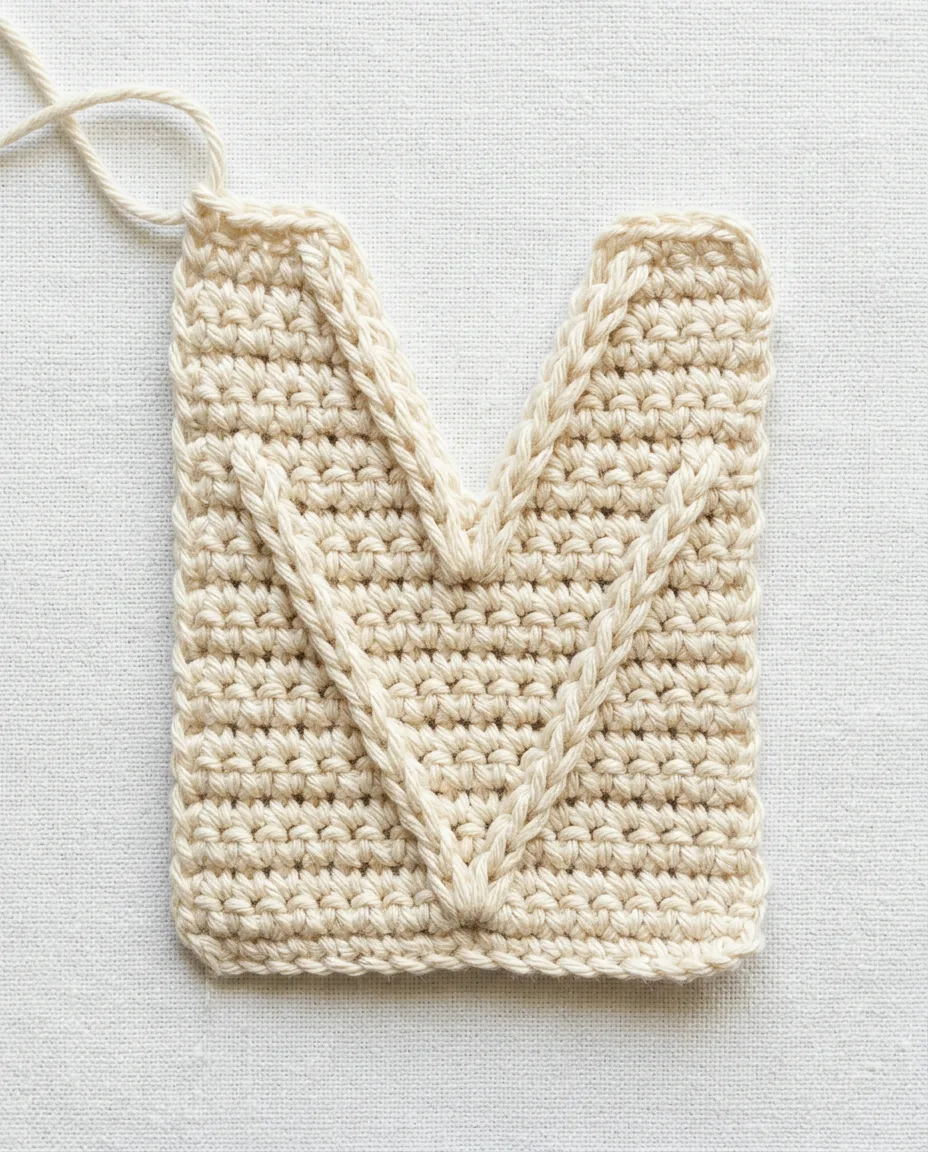
Row 4 is the slow one. Its posts wrap plain single crochet stitches sitting straight below them, in Row 2. After that you’ll see two pairs of short posts, side by side, a little above the bottom edge. The trinity stitch guide covers it round by round.
By Row 8 the pairs have opened into Vs with four stitches inside. Row 12 pulls each pair shut, and that’s one row of diamonds. Count 18 at the end of every row. Nineteen means a stitch behind a post didn’t get skipped. Seventeen? One got skipped twice.
 Save
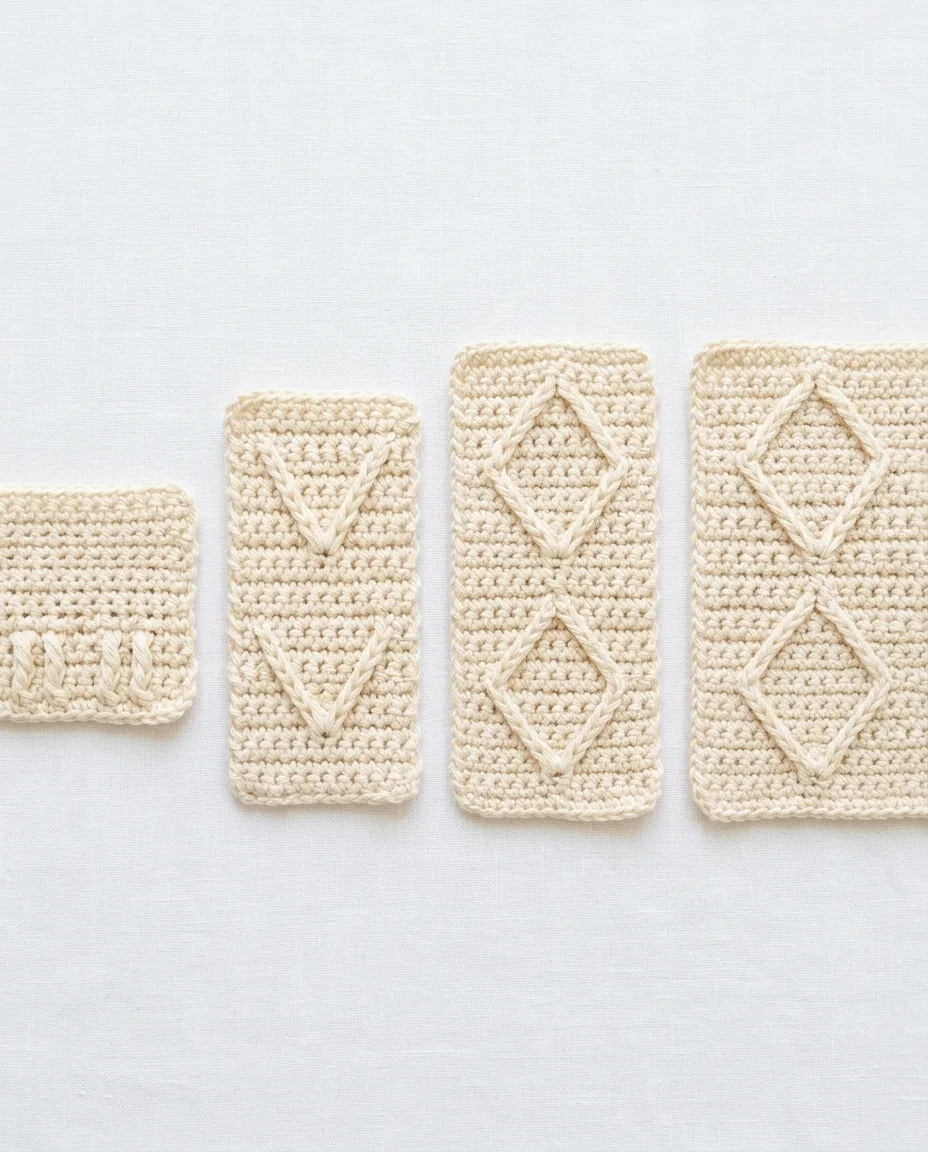
Repeat Rows 5 to 12 for as many diamonds as you like. Then finish with two plain rows after a Row 12, and the top edge stays level.
 Save
Where the diamonds look best
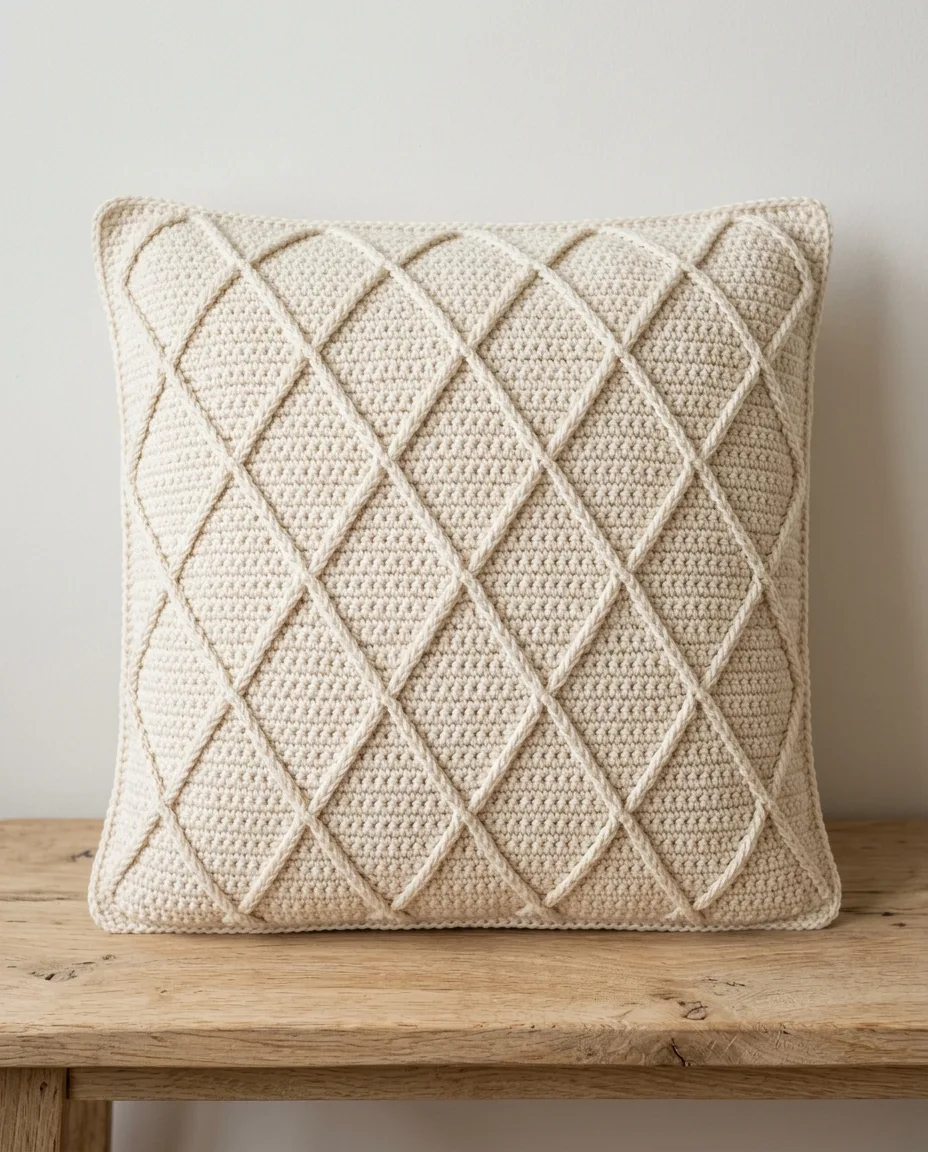
And it makes thick, firm fabric. Each post lays a second layer over the front. Cushion covers suit it. So do bag panels, where the texture can sit up proud and nobody needs the piece to drape.
 Save
Smooth yarn gives the sharpest ridges. Cotton is the best choice here, and a plain acrylic comes close. Fuzzy or variegated yarn blurs the lines until the diamonds barely read. Want them crisper still? Go down half a millimeter in hook size and the background tightens up behind the posts.
Skip it for a sweater body. Posts across the whole width make the fabric heavy and stiff. Expect it to eat more yarn than plain single crochet too, because every treble is a much taller stitch than the one it replaces. Buy an extra ball for anything bigger than a cushion. There is a fuller walkthrough in the guide to the crochet hexagon stitch.
When the diamonds go wrong
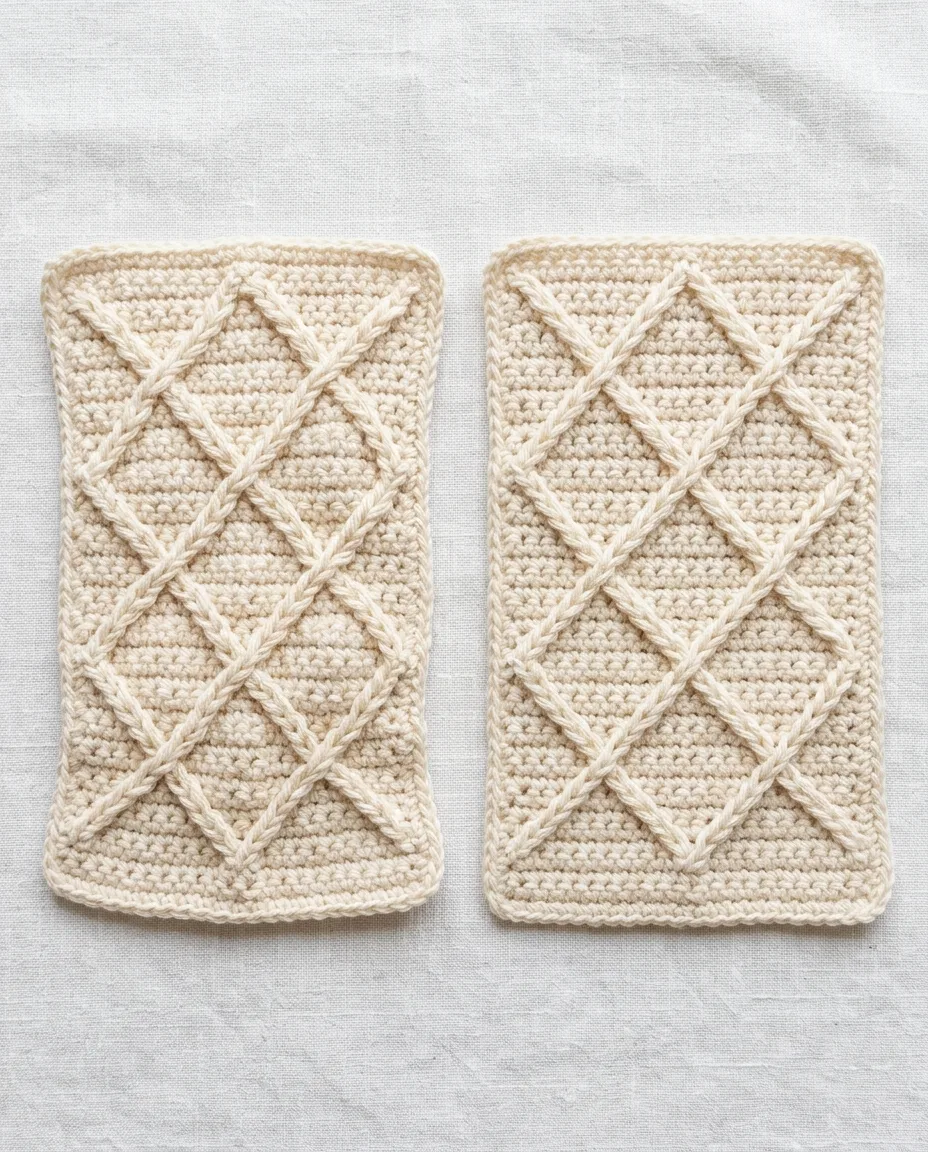
Puckering comes first, and almost always from short post stitches. A treble has to travel two rows down and back up. Pull that first loop too short and it hauls the background in like a drawstring.
 Save
The fix is height. Lift the loop until it’s level with the hook’s working loop. Already finished? Blocking, which means wetting the piece and pinning it flat to dry, helps a bit. It won’t rescue a swatch that’s badly gathered, though.
Lines that wobble usually mean the wrong post got wrapped. The right one is always the nearest raised stitch two rows down, one stitch to the side. Wrap a plain stitch by mistake and that line just stops. Grab a post three rows down and the diamond goes lopsided.
Posts showing up on the back? Then they went in on a back-facing row. Row 1 faces away from you, so every post row has an even number. If your first post row landed wrong, add one plain row and start over from there.
No pattern survives a drifting count. Edges that creep inward mean a last stitch is getting missed. Edges that flare mean the ch 1 is being worked as a stitch. Count to 18 at the end of each row, both ends included, for the first full diamond.
Wider diamonds and a bobble in the middle
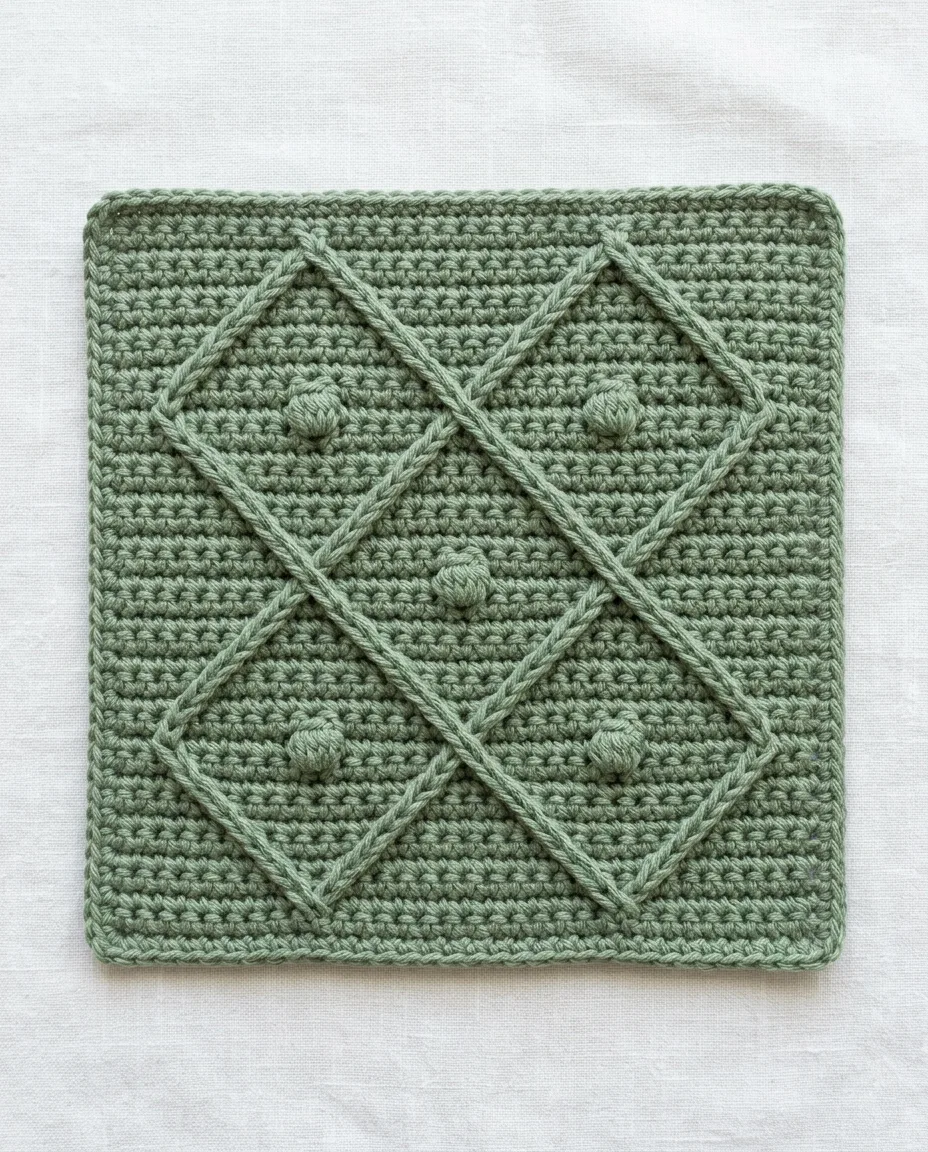
Bigger diamonds take one change. Start with a chain of 23 for 22 stitches. Then place the first pair on stitches 6 and 7. The second pair goes on 16 and 17. Step the lines out three times instead of two, then back in three times. The repeat runs from Row 5 to Row 16, and each diamond holds six stitches at its widest.
That wider middle has room for a bobble. Work it on Row 11, the plain row just after the widest point, in stitches 6 and 17. A bobble is five half-finished double crochets gathered together. For each one, yarn over and go into the same stitch.
Pull up a loop, wrap again and draw through two. Five times. You’ll end with six loops on the hook. Yarn over and pull through all six. Because Row 11 faces away from you, the bobble pops out on the front, right inside the diamond.
 Save
Pale colors show the shadows well. A bobble adds weight, though, and on a bag strap or the back of a cushion it’s the first spot to catch on things. Keep it for blanket panels and cushion fronts.