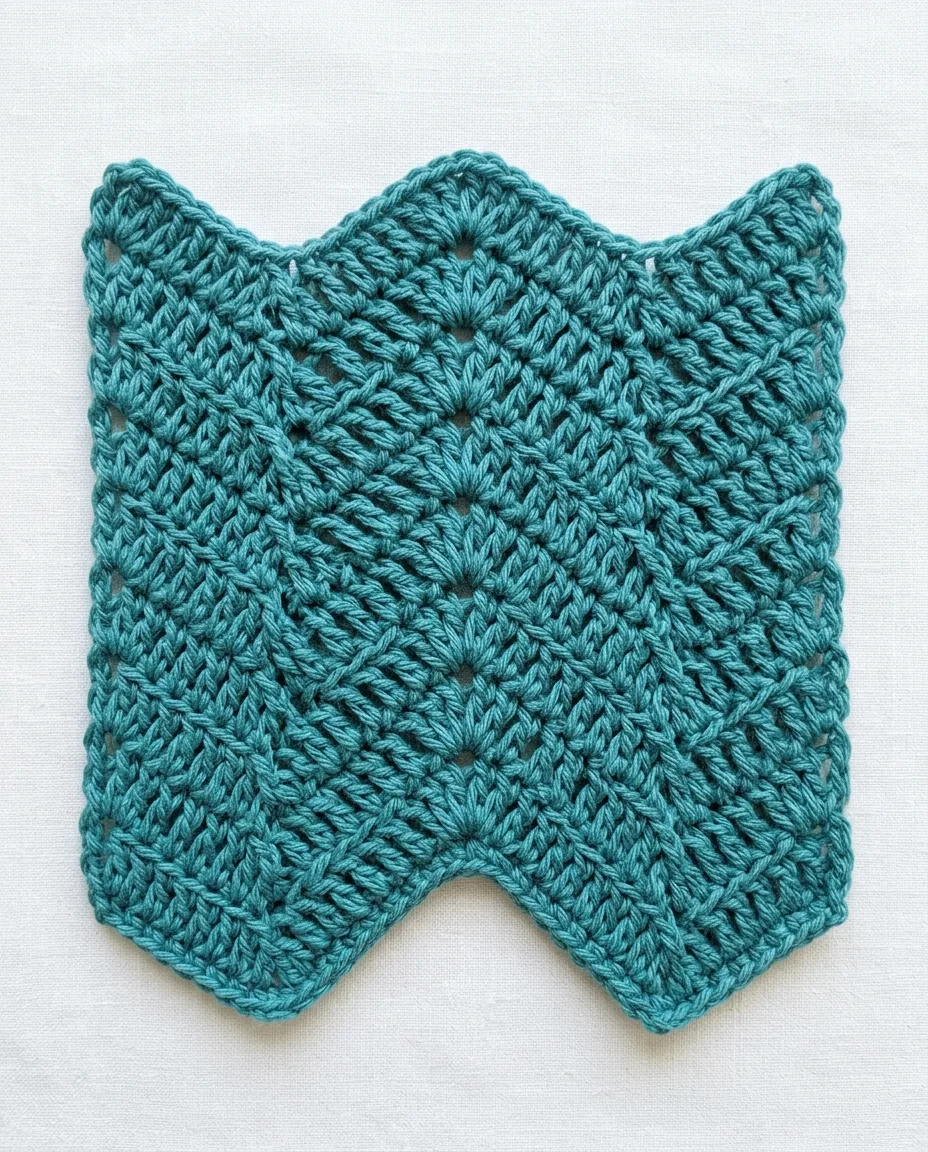
Three stitches into one at every peak. Three stitches closed into one at every dip. That’s the ratio behind a chevron with sharp points, and it’s the part most patterns fudge. They spread the extra stitches over two or three neighbors instead (a perfectly reasonable choice, just not this one). And the tip goes blunt.
What you get here is a crisp zigzag in double crochet. That’s a tall stitch, made with one wrap of yarn around the hook before it goes in. Good for blankets and pillow covers. The stitch count never changes from row to row, which helps a lot. But the first two rows do ask for careful counting. Not hard, exactly. Just fussy until the shape shows up.
Pick cotton if you can. Acrylic relaxes in the wash and the points round off over time. Worsted, the medium yarn thickness marked 4 on most bands, is easy to count stitches in.
How to work the sharp chevron
US crochet terms throughout. The steps walk you through the first row, worked straight into the chain. You’ll meet the yarn over in every step: the yarn wrapped around the hook, back to front.
- Chain 28. Keep it loose. Each one’s just the yarn pulled through the loop already on the hook.
- Yarn over once.
- Into the 4th chain from the hook. Those 3 skipped chains? They count as your first stitch.
- Yarn over, pull up a loop. Three loops now.
- Yarn over, through 2. Two left.
- Yarn over, through the last 2. That’s one double crochet.
- One double crochet in each of the next 4 chains. Downhill.
- Now the dip. Yarn over, into the next chain, pull up a loop.
- Yarn over, through 2 only. Stop there.
- Same thing in each of the next 2 chains. You’ll have 4 loops on the hook.
- Yarn over and pull through all 4. Three half-made stitches just became one point. That’s a double crochet three together (dc3tog).
- One double crochet in each of the next 4 chains. Uphill.
- Three double crochets, all in the very next chain. Your peak.
- Then 4 slope stitches, a dip, 4 more slope stitches.
- Two double crochets in the last chain. Turn.
Count before you go on. You want 25 stitches, with the skipped chains counted as one. Got 24? It’s nearly always the last chain, which likes to hide right under the hook.
Every row, written out
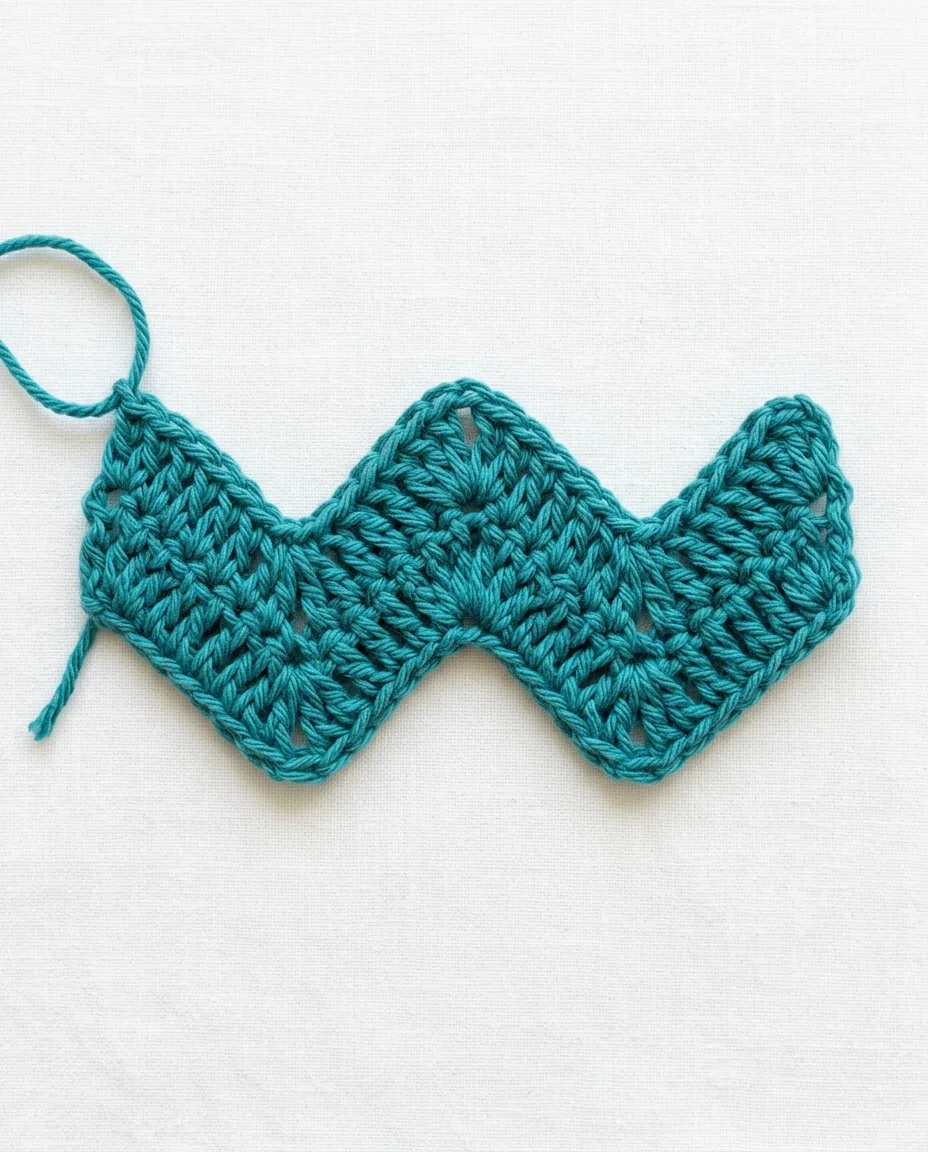
Here’s the full swatch, your small test piece, in pattern shorthand. Each row starts and ends on half a peak, so the side edges stay close to straight.
- dc in 4th ch from hook, dc in next 4 ch, dc3tog, dc in next 4 ch, 3 dc in next ch, dc in next 4 ch, dc3tog, dc in next 4 ch, 2 dc in last ch, turn 25 sts
- ch 3 (counts as dc), dc in first st, dc in next 4 sts, dc3tog, dc in next 4 sts, 3 dc in next st, dc in next 4 sts, dc3tog, dc in next 4 sts, 2 dc in top of turning ch, turn 25 sts
- rep Row 2 until the piece is 14 rows tall 25 sts
After Row 2, look for one point in the middle with a dip on each side. Each peak’s center stitch should sit right on top of the center stitch below it. Off by one? The count slipped somewhere in that row. Pull it back and recount, because it won’t fix itself later. The guide to the crochet bobble stitch covers the whole method.
 Save
Expect a swatch about 7 inches (18 cm) wide. Want it wider? Add 12 chains for every extra point. A chain of 40 gives you two full peaks and 37 stitches.
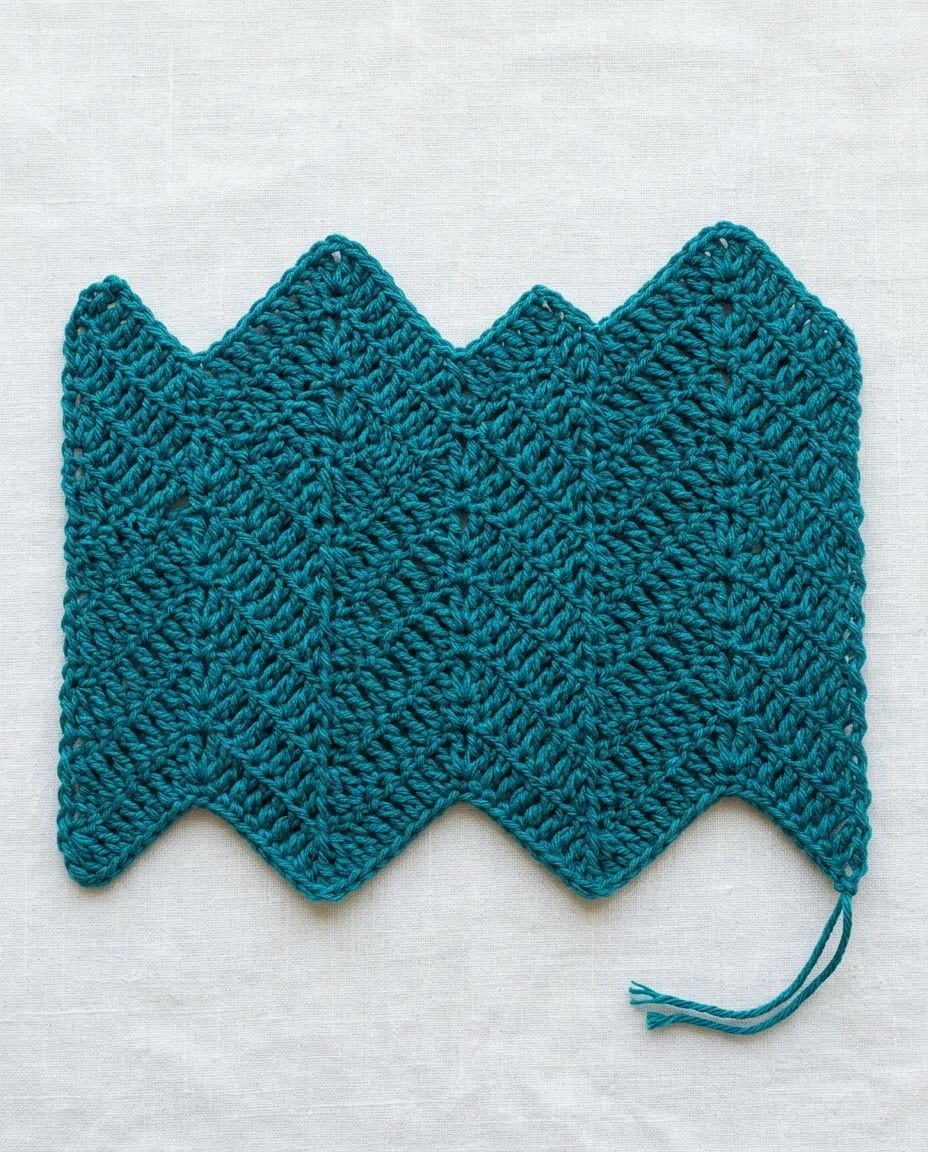
By Row 6 nobody could miss the zigzag. The bottom edge gets dragged into points too. Totally normal.
 Save
Why your points come out soft
Blame the increase, nine times out of ten. “2 dc in each of the next 2 stitches” adds just as many stitches as 3 dc in one. It does it over a wider base, though, so the tip turns into a hill.
Dips go round the same way. You can make a valley by skipping two stitches, and plenty of patterns do. You’ll get a little gap and a rounded bottom. The dc3tog pulls three stitches up into a single top, and that pinch is what makes the V.
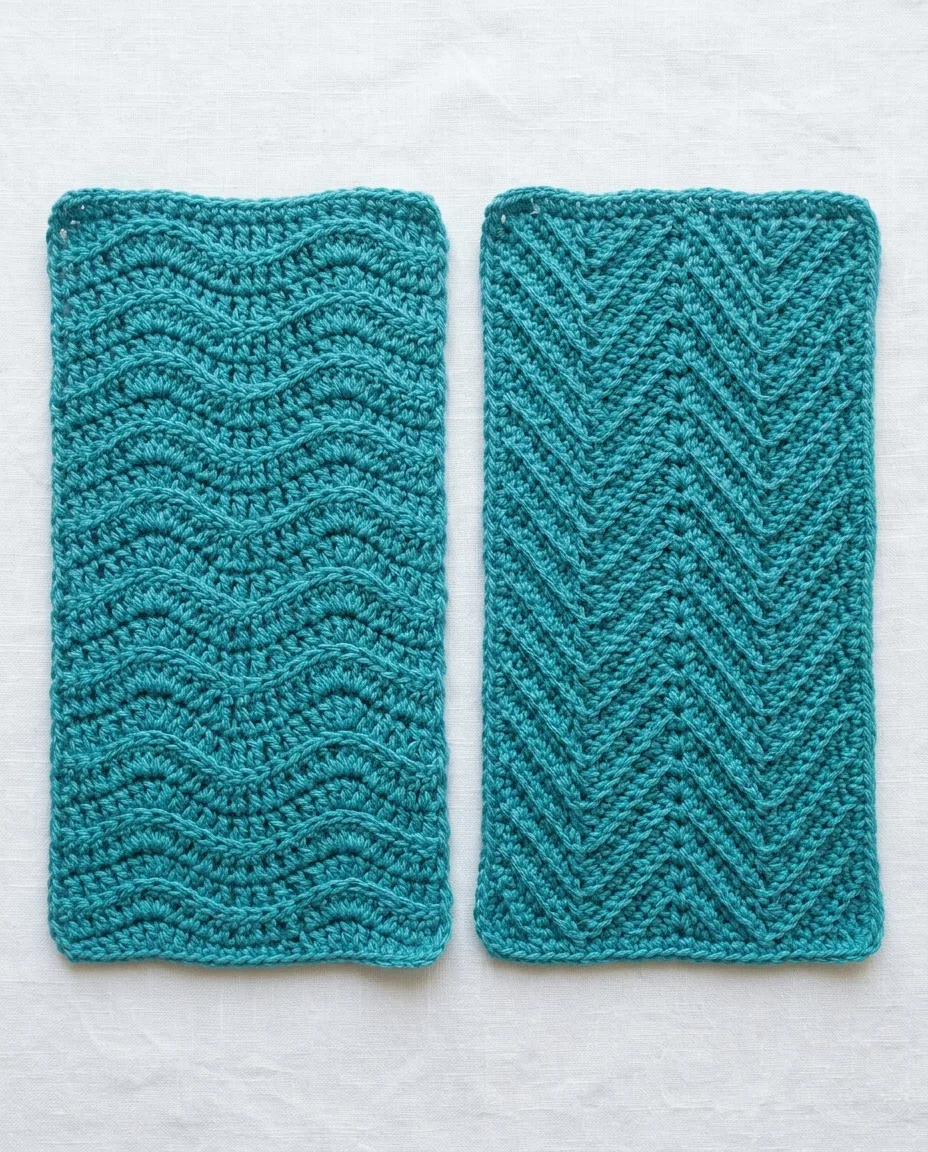
Then there’s mixed stitch heights. Short stitches down in the dips and tall ones up on the peaks give you a wave instead. Pretty stitch. Different stitch.
But tension, how tightly you hold the yarn, matters less than you’d think. Even a loose peak points if all three stitches come out of one base.
 Save
Pin the points when you block
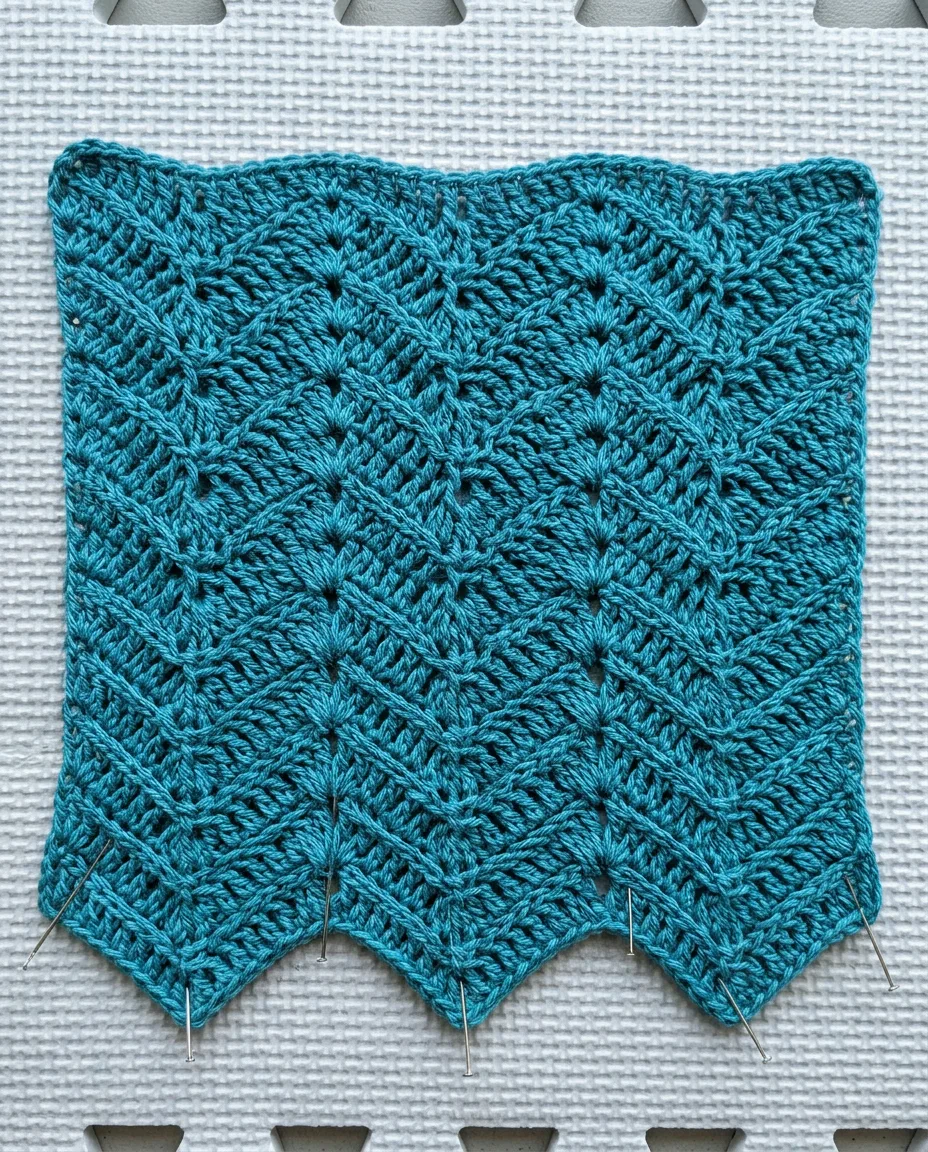
Here’s where the points really get sharp. Wet the finished piece and pin it flat to dry (that’s all blocking is). One pin in every peak, one in every dip along the bottom edge. Then tug each pin outward a touch. The tips stretch into clean Vs. Cotton takes about a day to dry fully, so leave it alone till then. There is a fuller walkthrough in the guide to the crochet picot stitch.
Skip the water for acrylic. Steam it, holding the iron above the fabric. Don’t let it touch, because a pressed acrylic stitch stays flat forever.
 Save
Where the sharp chevron shines
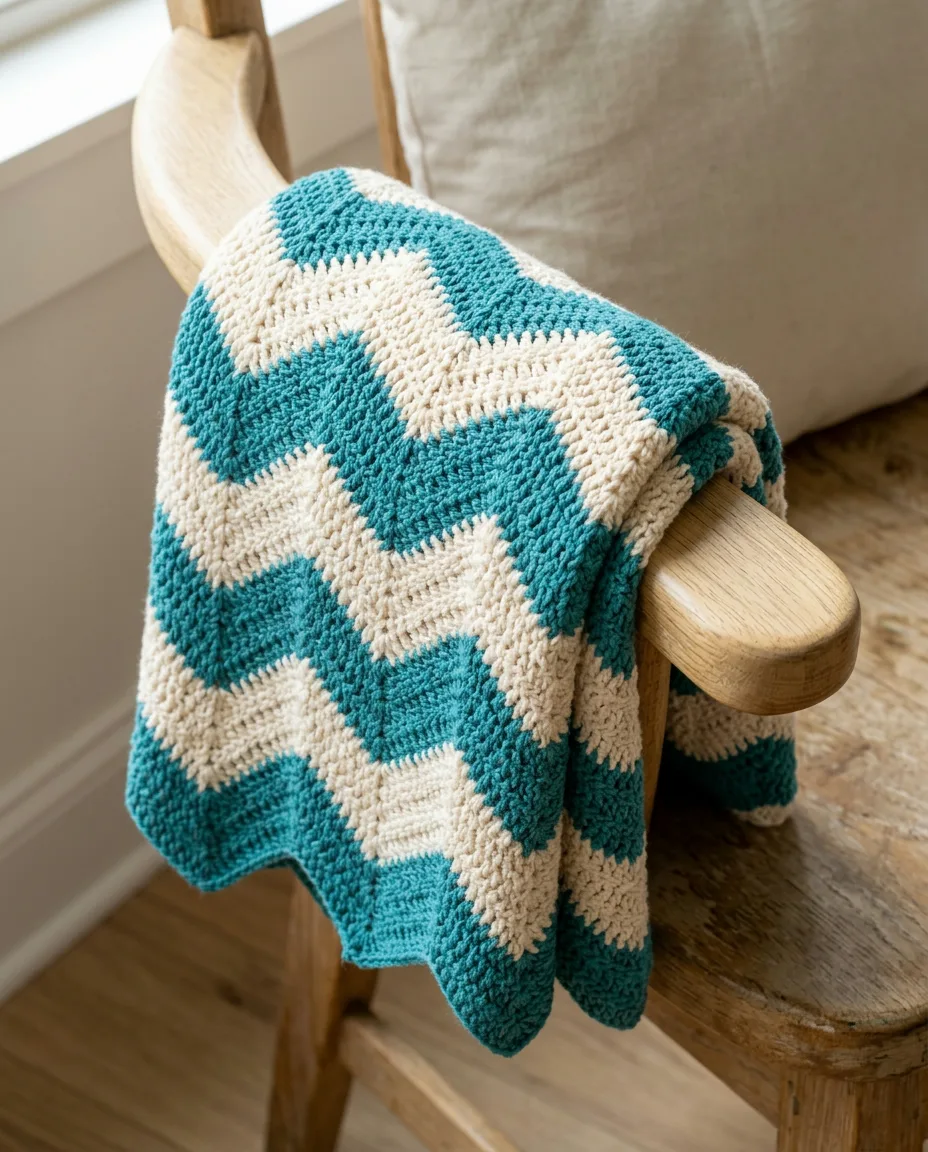
Blankets, mostly. The points along the bottom edge look finished without any border at all. For a baby blanket, chain about 112. That’s 9 full repeats plus the edge.
A scarf is fine too, though the back looks a little different from the front. Pillow covers are better. Only one side ever shows.
 Save
Deeper points and stripes
Steeper points just need longer slopes. Work 6 double crochets on each side of every peak instead of 4. Your chain becomes a multiple of 16 plus 4, so a chain of 36 gives 33 stitches. Taller and narrower points, same rhythm. The bullion stitch guide breaks the whole project into steps.
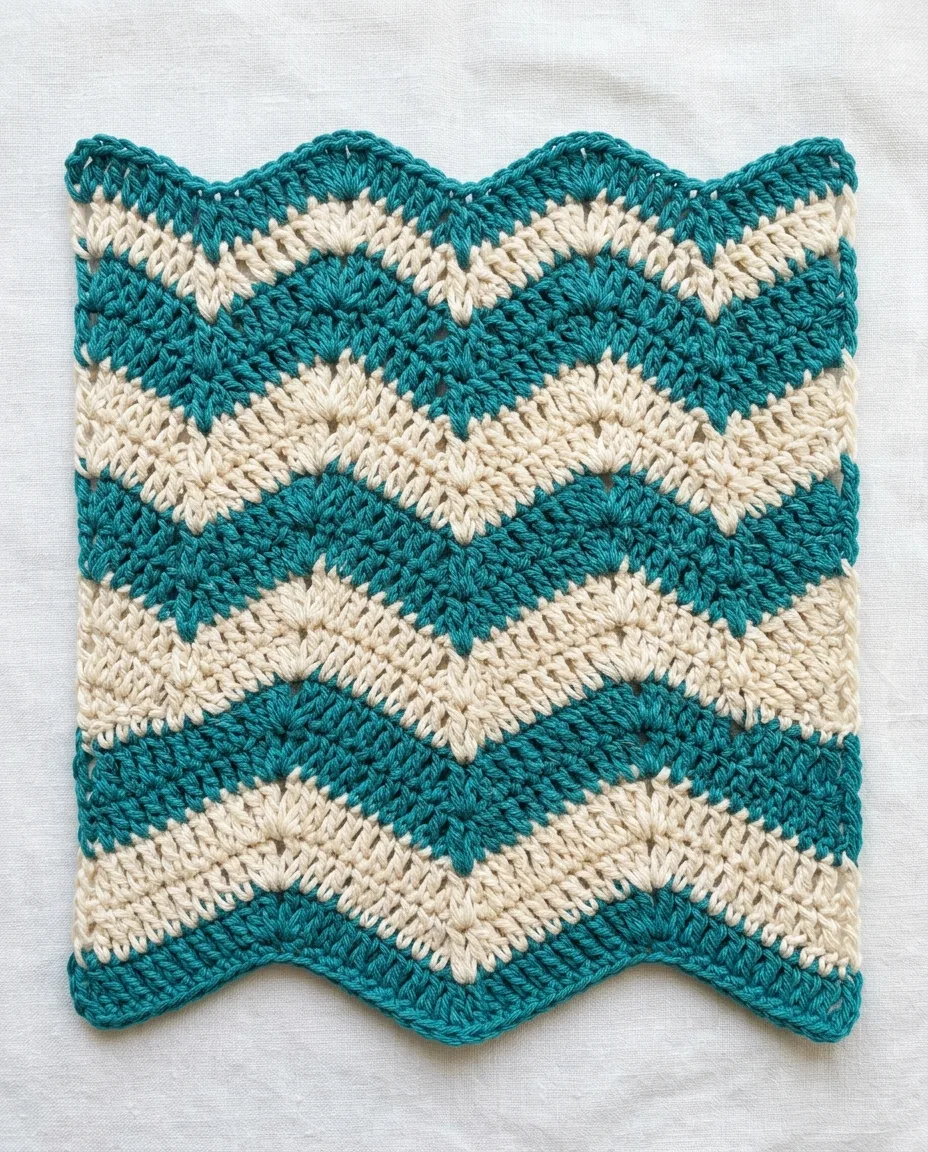
Stripes are where the sharp version pays off. The color line traces every point, so a soft tip would show at once and a crisp one looks drawn with a ruler. Two rows per color keeps both faces matching. Swap colors at the end of a row, using the new yarn for the final wrap of the last stitch.
 Save
From first row to finished swatch
Hold your swatch up to the photos at Row 2 and Row 6. Then again at Row 14. The points only turn properly sharp after blocking, so a bit of roundness straight off the hook isn’t a mistake yet. Count the last row first. If it says 25, don’t rip anything out.