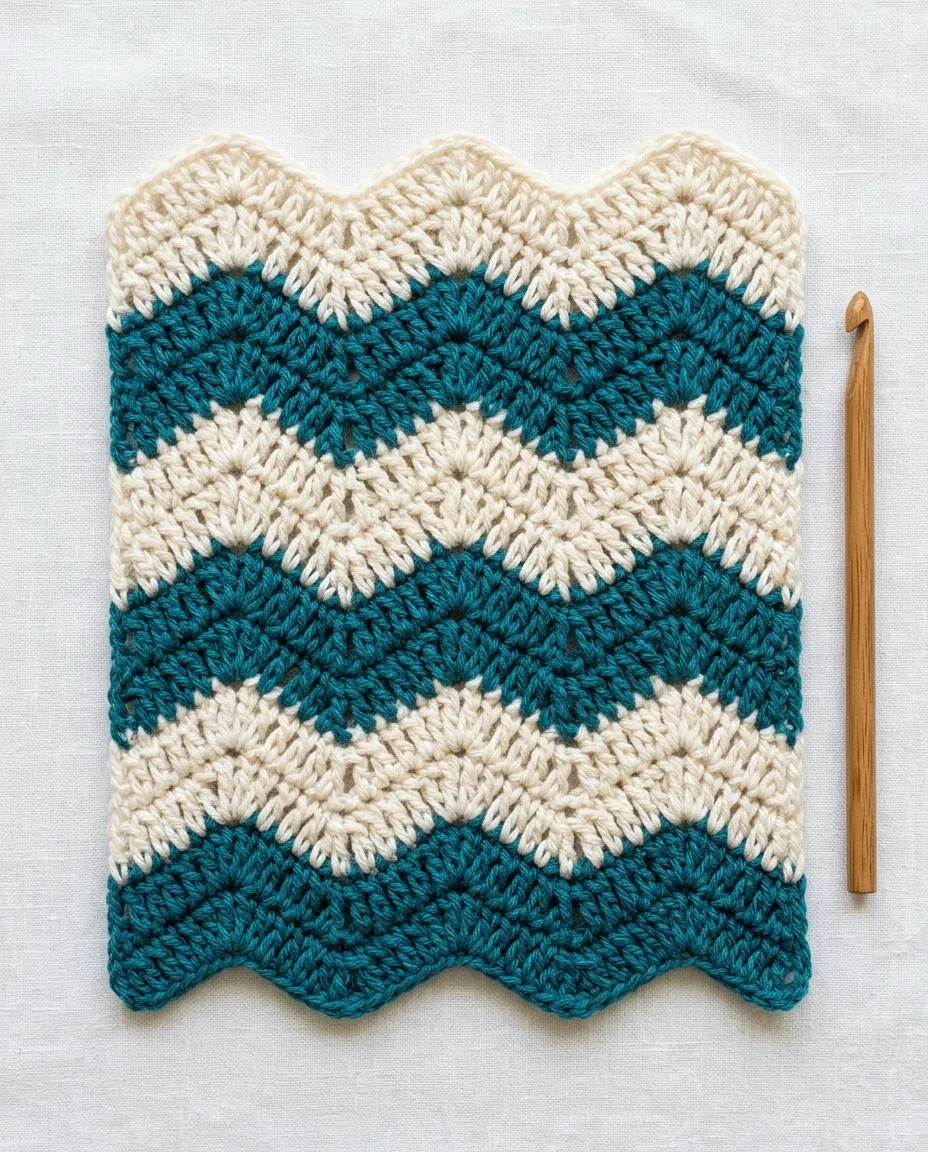
One repeat of this ripple eats 12 stitches. Four climb the slope. Three crowd into one stitch at the peak, four walk back down, and the valley squeezes three into one. It all cancels out, and you end every row with the same 37 stitches you started with. That’s why the blanket won’t flare. Or shrink, which is the other way ripples go wrong.
You build the whole wave from double crochet, the tall stitch where you wrap the yarn twice and work off the loops in pairs. Can you make a straight row of it? Then you can make this. Counting is the hard part. Drop one stitch on a slope and the next peak lands a stitch off, and it looks wrong for good. The crab stitch guide breaks the whole project into steps.
Then there are the edges. Plenty of ripple patterns leave a little step at each side (the blanket ends up looking nibbled). This one starts and finishes every row with half a valley. Both sides go straight up.
Cotton gives you crisp points. Acrylic’s fine too, just rounder at the tips.
Work one wave from peak to valley
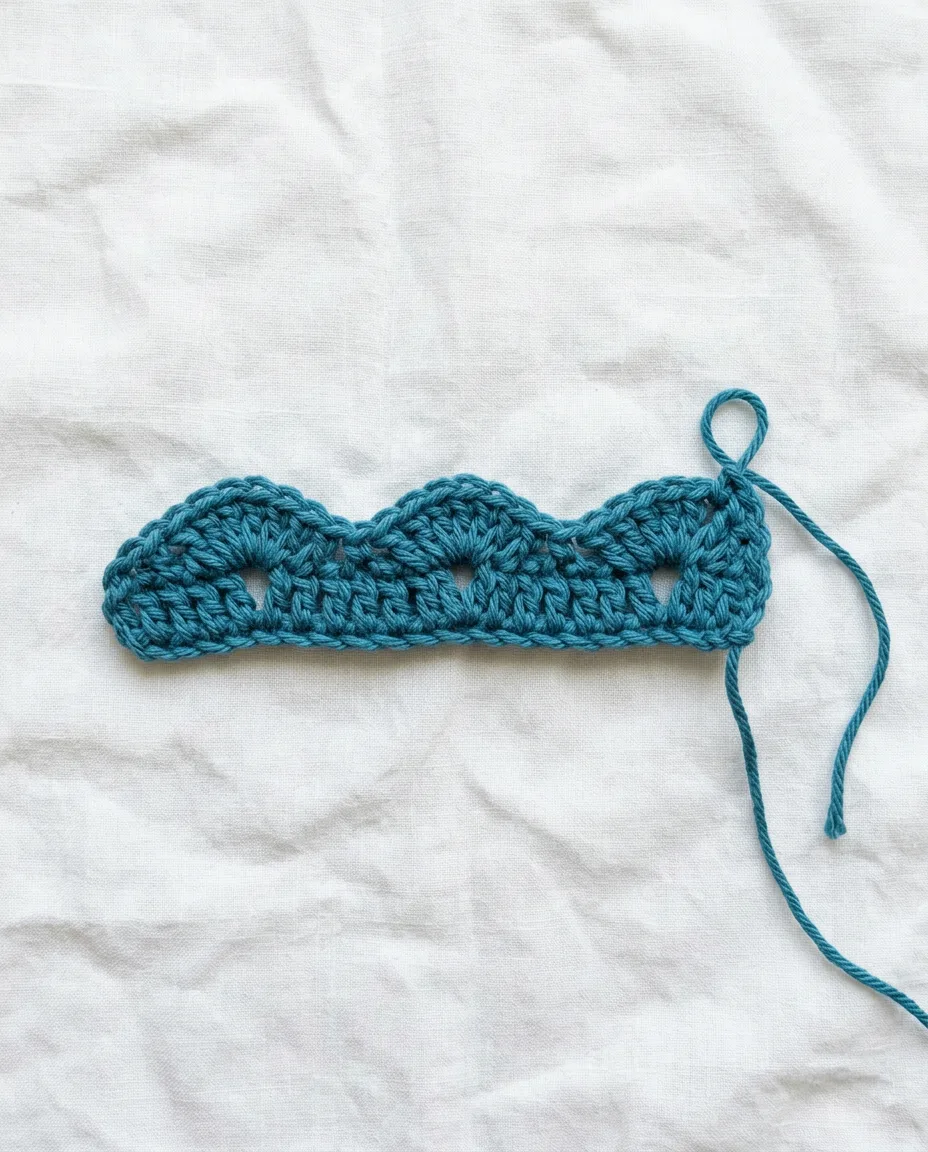
Chain 39 to begin. That’s 12 times 3, plus 3. These steps get you across the first row, and every row after uses the exact same moves.
- Skip 2 chains from the hook. They’re your turning chain, the lift at the start of a row, and they don’t count.
- Wrap the yarn over the hook, back to front. That’s a yarn over. Hook into the next chain and pull up a loop. Three loops on the hook.
- Yarn over. Pull through 2. Two loops left.
- Yarn over again, into the next chain, pull up a loop. Four loops now.
- Yarn over, through 2. You’ll have 3.
- Yarn over and go through all 3. That’s a dc2tog. Half a valley, sitting at the edge.
- Now plain double crochet in each of the next 4 chains. Yarn over, in, pull up a loop. Then through 2 loops, twice.
- Three double crochet, all in the next chain. Your peak.
- Back down. One double crochet in each of the next 4 chains.
- Next 3 chains: start a double crochet in each, but stop with 2 loops left every time. Four loops on the hook at the end.
- Yarn over and pull through all 4. That’s the dc3tog. The valley.
- Steps 7 to 11 again, once. Then steps 7 to 9.
- Last 2 chains get a dc2tog, same as steps 2 to 6.
Stop and count. 37 stitches, three peaks, two full valleys. Got 36? A slope came up short, so check every run of 4 between the points.
 Save
The row pattern, written out
Here’s the same thing in shorthand. Dc is double crochet. And the “tog” stitches just join two or three into one.
- Ch 39. Dc2tog over 3rd and 4th ch from hook, *dc in next 4 ch, 3 dc in next ch, dc in next 4 ch, dc3tog over next 3 ch* x2, dc in next 4 ch, 3 dc in next ch, dc in next 4 ch, dc2tog over last 2 ch 37 sts
- Ch 2 (does not count), turn, dc2tog over first 2 sts, *dc in next 4 sts, 3 dc in next st, dc in next 4 sts, dc3tog over next 3 sts* x2, dc in next 4 sts, 3 dc in next st, dc in next 4 sts, dc2tog over last 2 sts 37 sts
- Repeat Row 2 37 sts
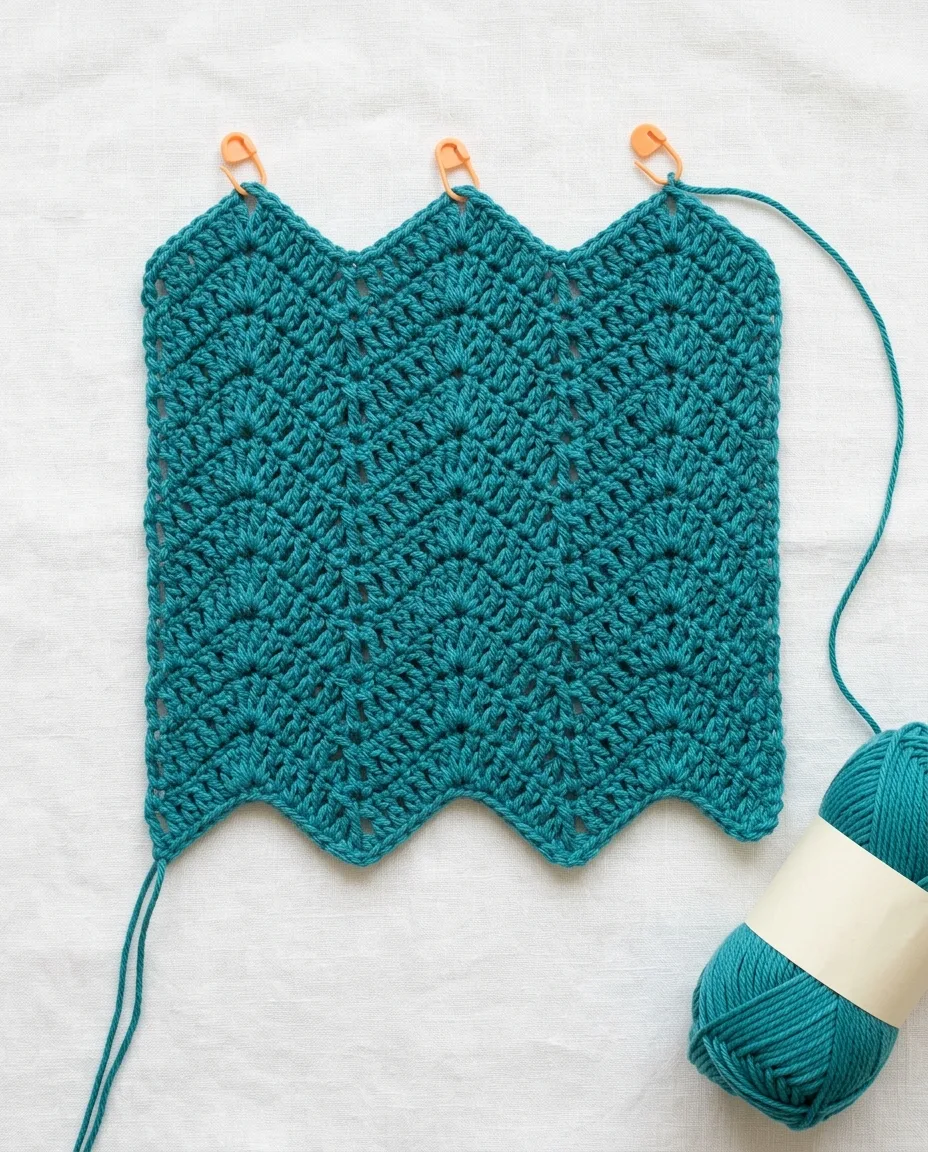
Keep going with Row 2 until the piece is as long as you want. Each peak stacks right on the one below. Aim the 3 dc at the middle stitch of the old peak group, and center the dc3tog over the old one. The guide to straight, even single crochet rows covers the whole method.
By Row 2 the waves are obvious. Clip a marker into the center stitch of the first two peaks. Move them up every row or so and you’ll never hunt for a peak again.
 Save
Why the edges stay straight
Each side starts low. That edge dc2tog is precisely half a dc3tog, and it drags the edge down just like a full valley drags down the middle.
Don’t overlook the turning chain either. Two chains that don’t count hug the work. Three counted as a stitch? They tend to leave a hole and stick up taller than everything else in the row.
Wobbly ripple edges almost always trace back to a skipped first stitch or a forgotten last one. Count. If it’s 37 every row, the edge can’t wander. The picot stitch guide covers it round by round.
Where ripples look their best
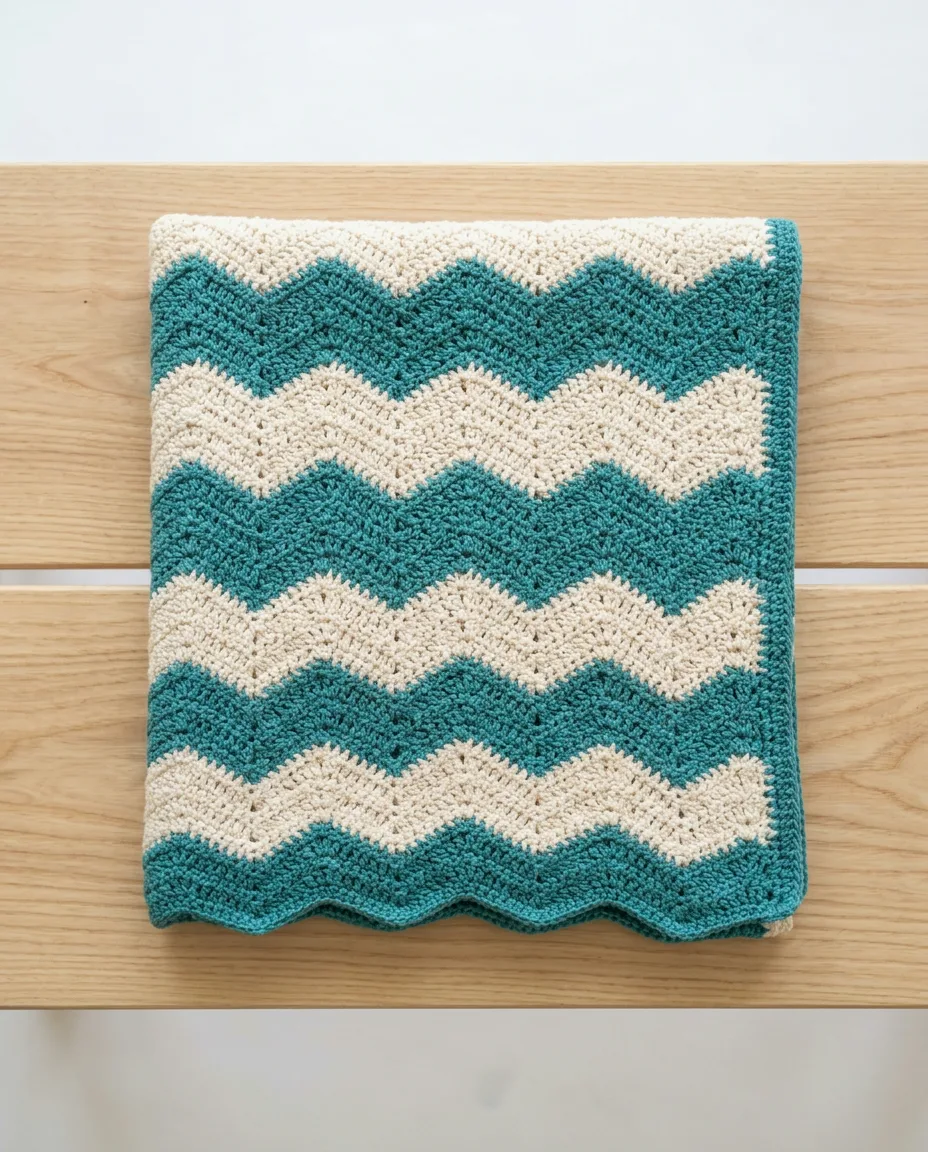
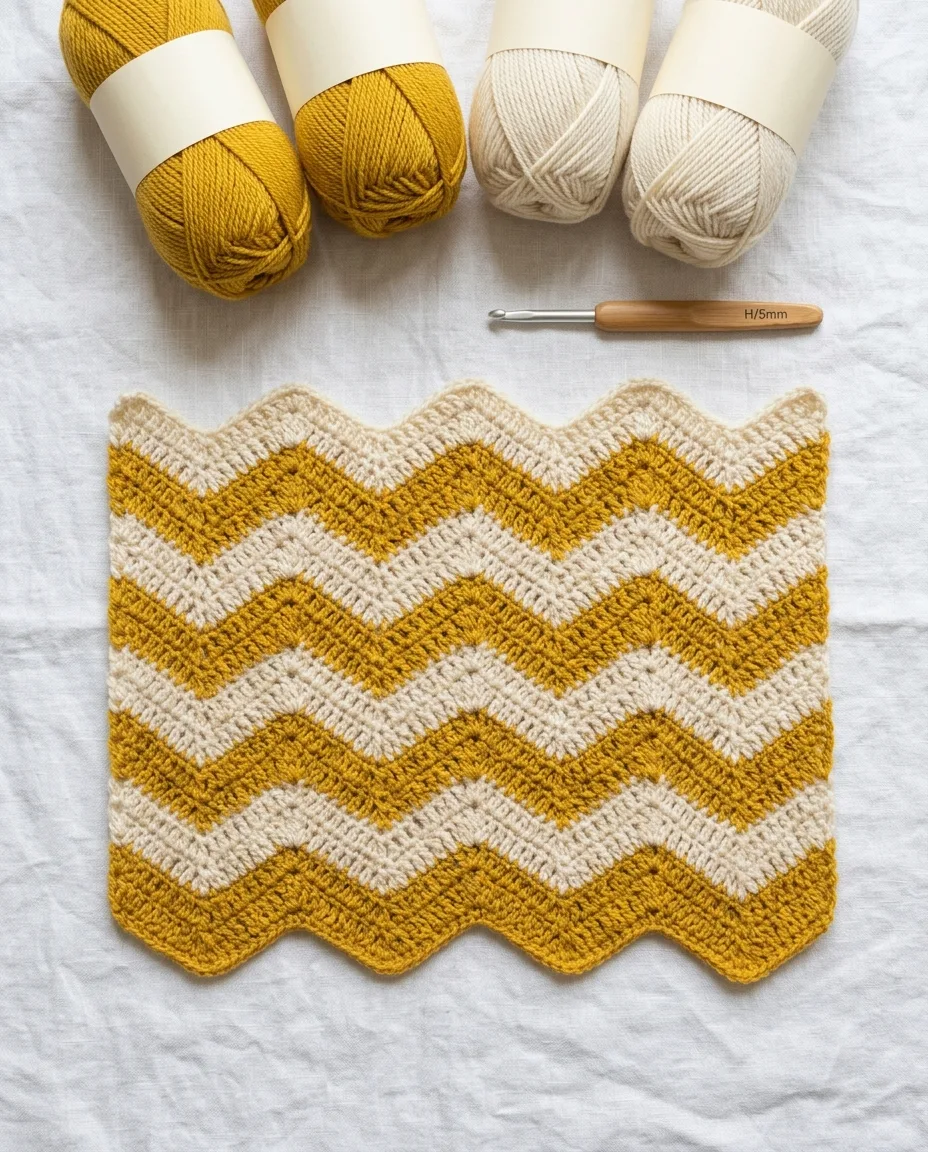
Blankets, obviously. Stripe a baby blanket in two colors and the waves read from across the room, and double crochet grows fast. Chain 87 for 85 stitches and seven peaks.
So turn the waves sideways for a scarf. Chain the full scarf length and work just 6 to 8 rows. Cushion covers are good too. A zigzag sits nicely on a flat square.
Garments are trickier. Valleys pull in, peaks push out, and the fabric never quite lies flat on a body.
 Save
If your waves start to drift
Never ignore a peak that’s wandered. It means the count changed. Count after each of the first 4 rows and you’ll catch nearly all of it.
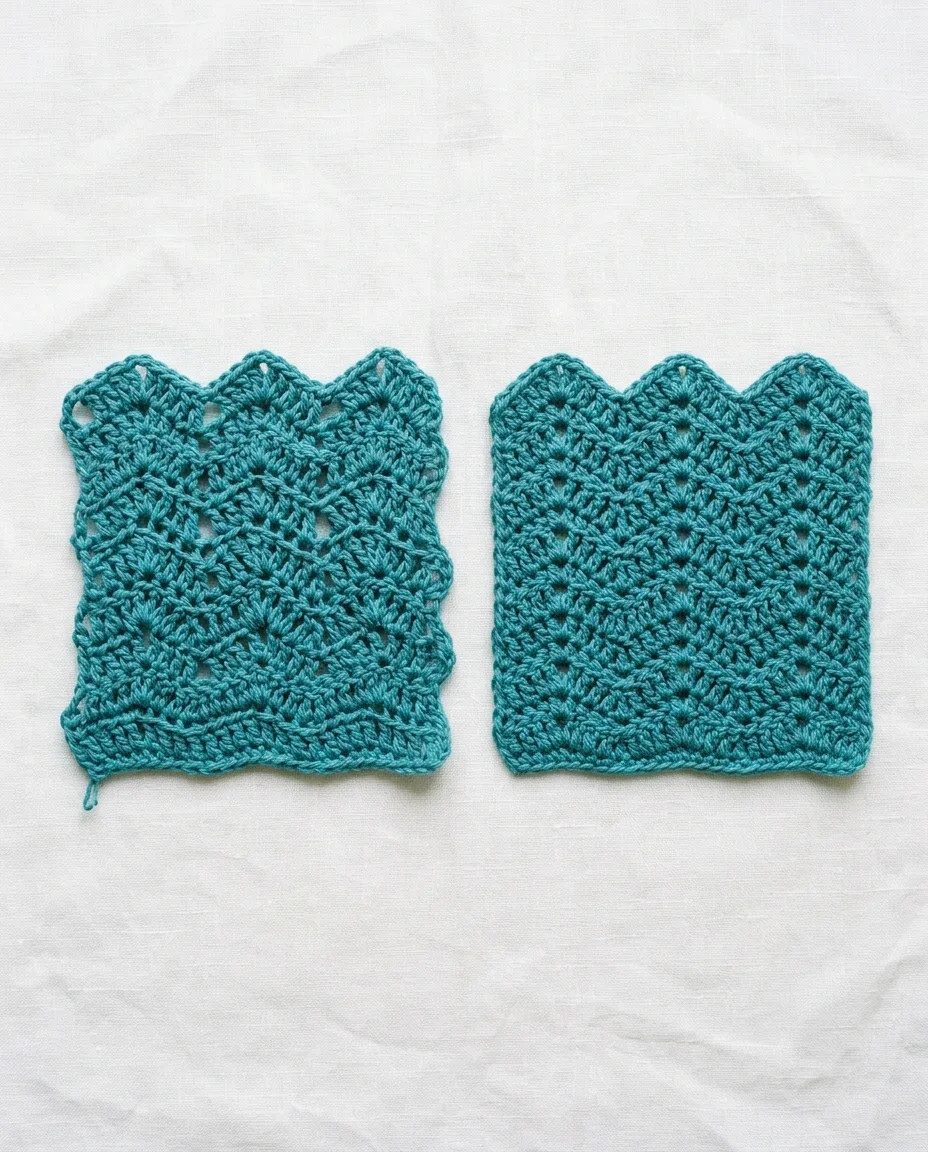
Peaks leaning to one side? Usually the 3 dc went into the stitch beside the center. Find the old peak’s middle stitch first (it has a neighbor on each side sharing the same base) and work into that.
Valleys flattening into steps are a dc3tog that went in one stitch early. Its middle leg belongs in the old dc3tog. Pull back to the valley. Redo it.
Edges curling in come down to tension, how tightly you hold the yarn you’re feeding from the ball. Ease your grip on the dc2tog at each end and the curl relaxes.
 Save
Make the wave deeper or flatter
Slope length decides how tall the wave is. Change the 4 dc on each side and leave everything else alone.
Want deep, pointy waves? Six dc on each slope. The repeat grows to 16, so your chain is a multiple of 16, then 3 extra. Gentle ones get 2 dc per slope instead. An 8-stitch repeat, chained in 8s with the same 3 on top.
Stripes show the shape off. Swap colors every 2 rows, bringing the new yarn in on the final pull-through of the last dc2tog. If the stripes are 2 rows deep, carry the spare color up the side. Anything wider, cut it.
 Save
Finish and block a ripple
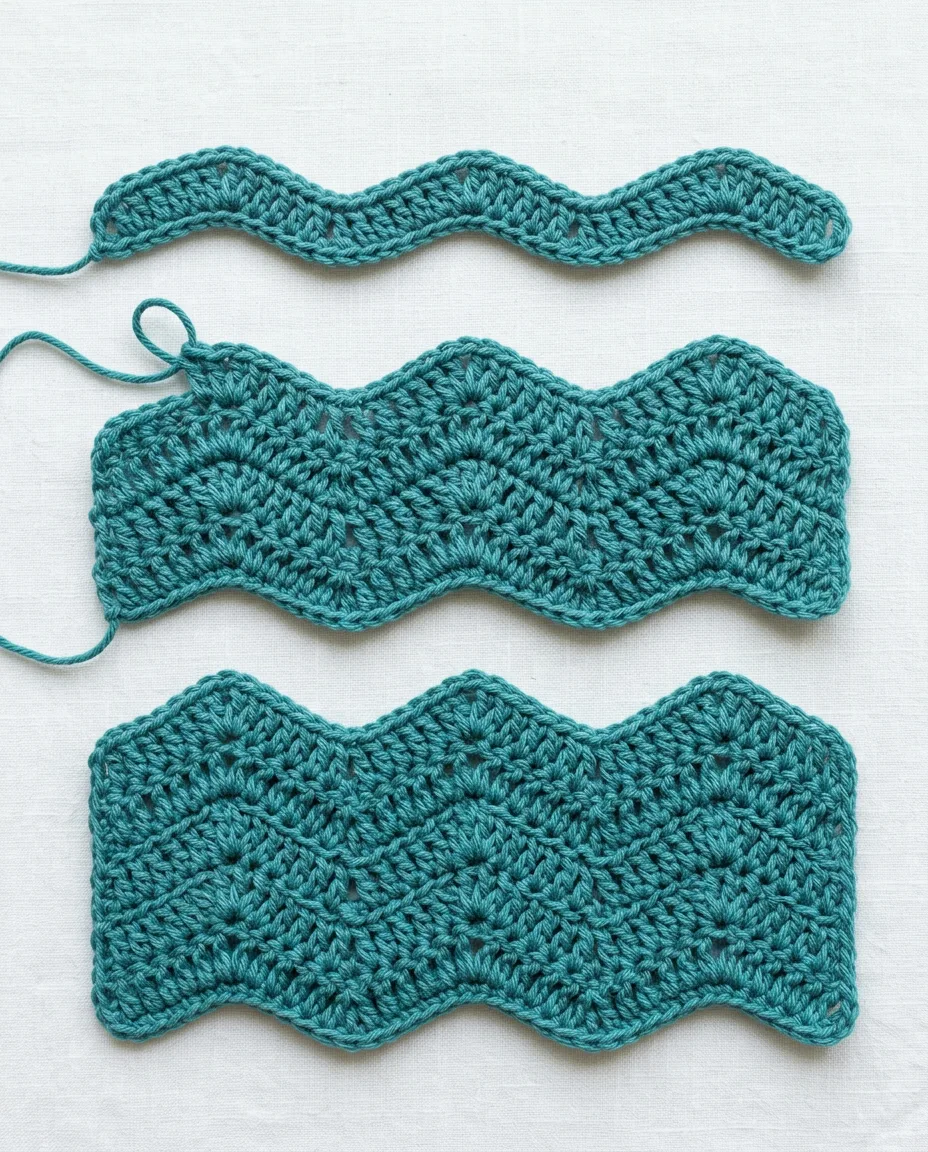
Weave the ends along the slopes. A run of double crochet swallows them nicely.
But the points only go sharp after blocking, where you wet the piece and pin it flat to dry. Pin every peak and every valley to a towel and leave it overnight. Cotton keeps a crisp point. Acrylic relaxes back a bit.
 Save