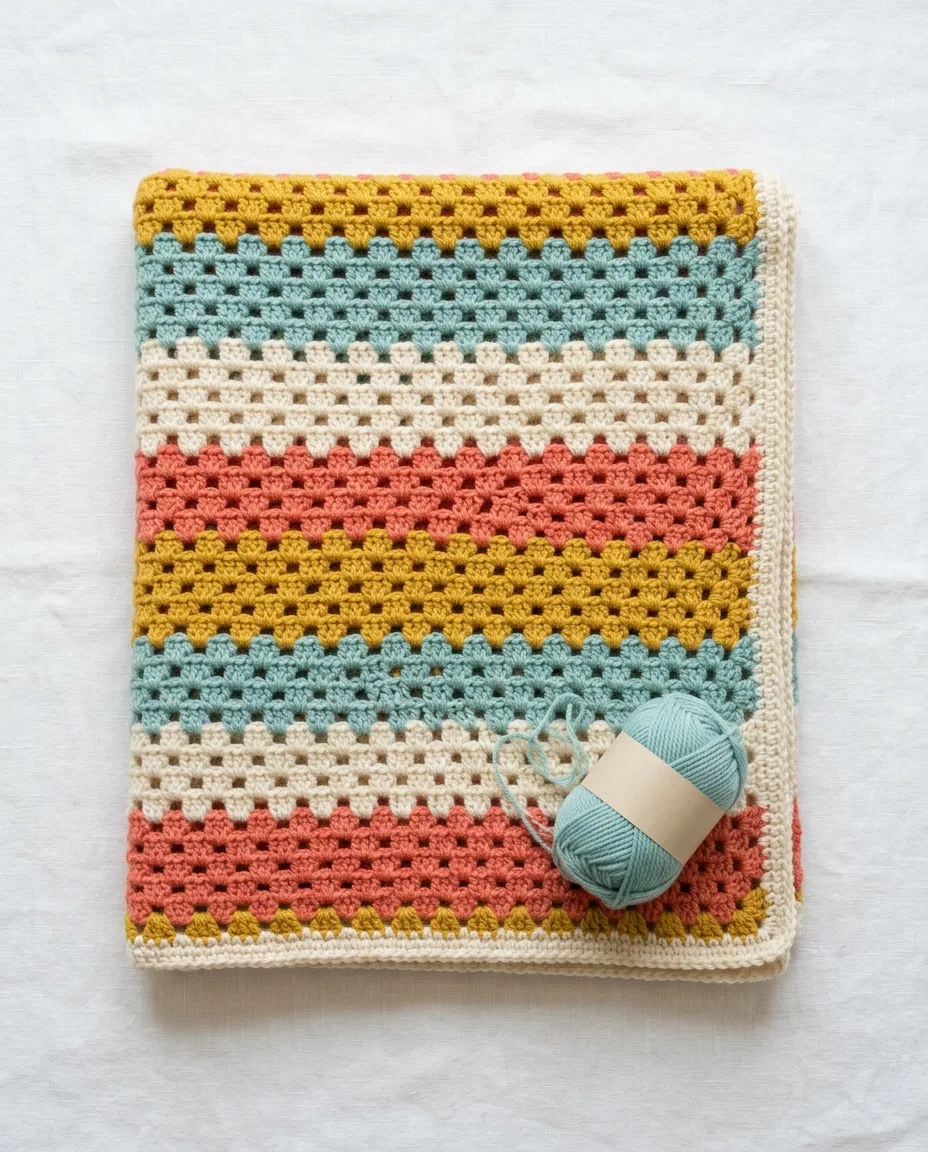
You want the look of a granny square blanket. What you don’t want is forty-eight little squares to sew together at the end. Granny stitch worked in rows solves that. Each granny stitch is a cluster of three double crochets worked into the same gap, with the hook pushed under the stitches of the row below. Those clusters sit in neat staggered lines, and the whole blanket grows as one piece. No seams. No pile of yarn ends from every square, either, which is honestly the bigger win.
This pattern uses US crochet terms. A double crochet (dc) starts with a yarn over, meaning you wrap the yarn over the hook from back to front. Push the hook into the stitch. Wrap again and draw up a loop, so three loops sit on the hook. Yarn over and pull through two. Then yarn over once more and pull through the last two. A granny cluster is nothing more than three of those worked into the same spot.
Worsted weight is the medium-thick yarn sold for most blankets. It shows the gaps between clusters clearly. Don’t skip the swatch. It teaches you the two alternating rows, and it tells you how wide each cluster comes out in your hands, which no pattern can know. There is a fuller walkthrough in the guide to waffle stitch crochet.
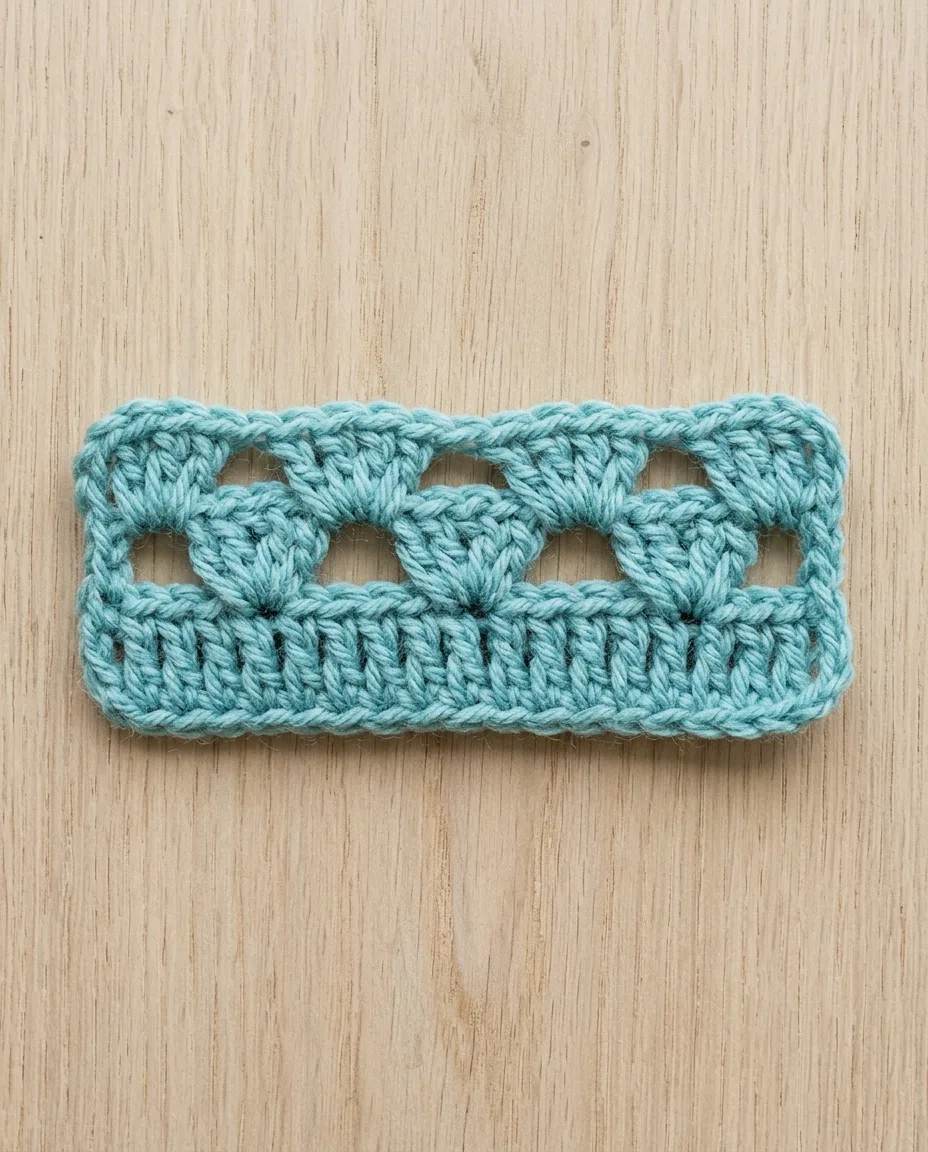
Work the first four rows
There are two kinds of row here. One has a single double crochet at each edge with full clusters in between. The other starts and ends with a half cluster of two stitches. Swapping back and forth between them is what keeps the edges straight.
- Chain 18. Keep it loose. If your chains usually come out tight, use a hook one size bigger for this part.
- Yarn over and push the hook into the 4th chain from the hook. Finish a double crochet there. The three chains you skipped count as the first stitch.
- Now double crochet in each chain to the end of the row. That gives you 16 stitches.
- Chain 3 and turn. Those 3 chains are the turning chain, and they count as the edge double crochet.
- Skip 2 stitches. Work 3 double crochets into the next stitch, and that’s your first cluster.
- Keep repeating the skip-2-then-cluster step across until only 3 stitches remain. Skip 2 of them and put 1 double crochet in the top of the turning chain.
- Chain 3 and turn. Put 1 double crochet into the first space, which is the gap between the edge stitch and the first cluster.
- In each space between two clusters, work a cluster of 3 double crochets. The hook goes into the gap itself, under the stitches. Never into the top of a stitch.
- Finish the row with 1 double crochet in the last space and 1 more in the top of the turning chain.
- Chain 3 and turn. Put a cluster into every space across, then end with 1 double crochet in the top of the turning chain.
From here you just repeat the last two rows for as long as you want the piece. These counts are for the 18-chain swatch.
- dc in 4th ch from hook and in each ch across 16 sts
- ch 3, (skip 2 sts, 3 dc in next st) x4, skip 2 sts, dc in top of turning ch 14 sts
- ch 3, dc in first space, 3 dc in each of next 3 spaces, dc in last space, dc in top of turning ch 13 sts
- ch 3, 3 dc in each of next 4 spaces, dc in top of turning ch 14 sts
 Save
Count clusters at the end of every row. It’s tedious, and it’s worth it. Row 2 and Row 4 each hold four full clusters. Row 3 has three full ones plus a half cluster at each side. See five on a full-cluster row? A stitch went into the wrong gap.
 Save
A blanket is just a wider swatch
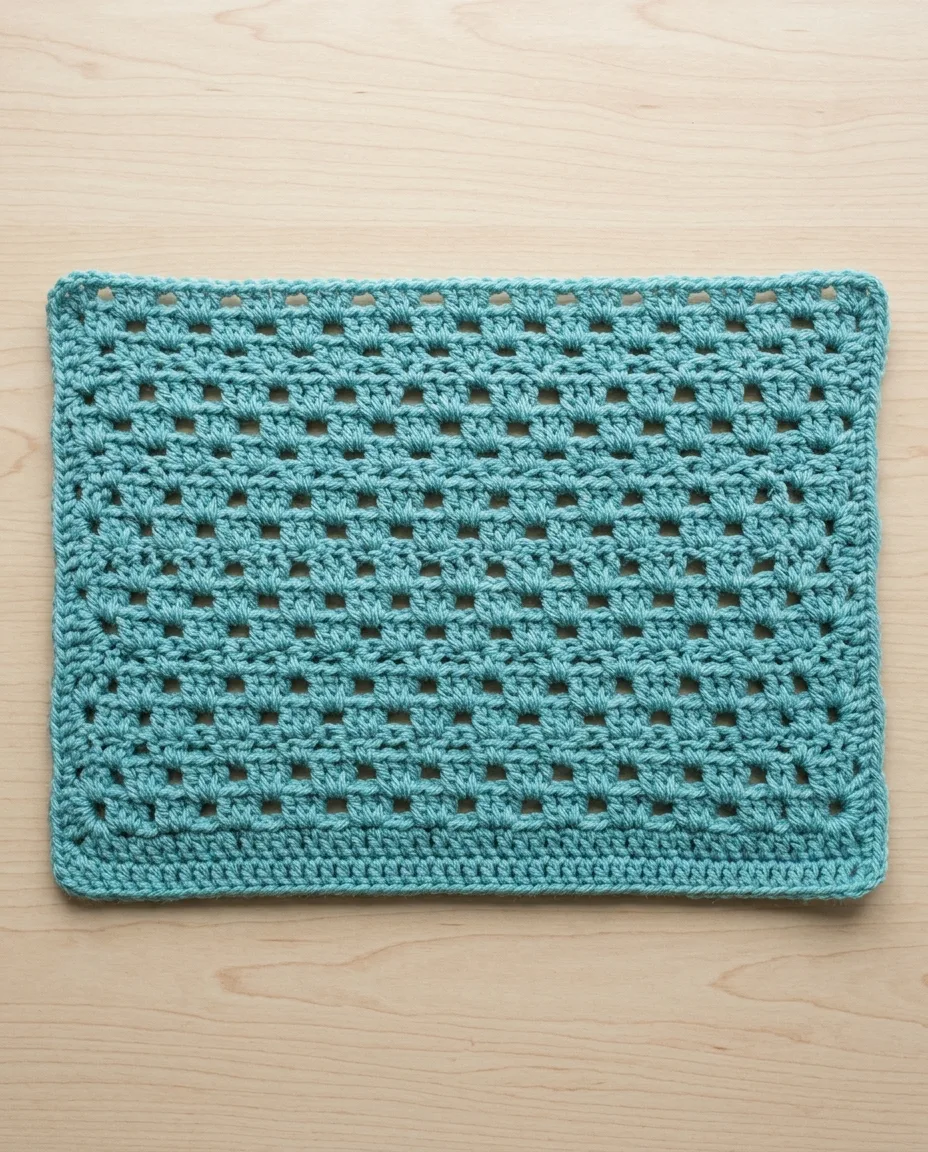
After Row 6, measure the swatch. Lay it flat and don’t stretch it. With worsted yarn on a 5 mm hook, each cluster usually comes out close to 1 inch (2.5 cm) wide, and every two rows add roughly 1 inch of height. Yours will differ a little. That’s the whole point of swatching first.
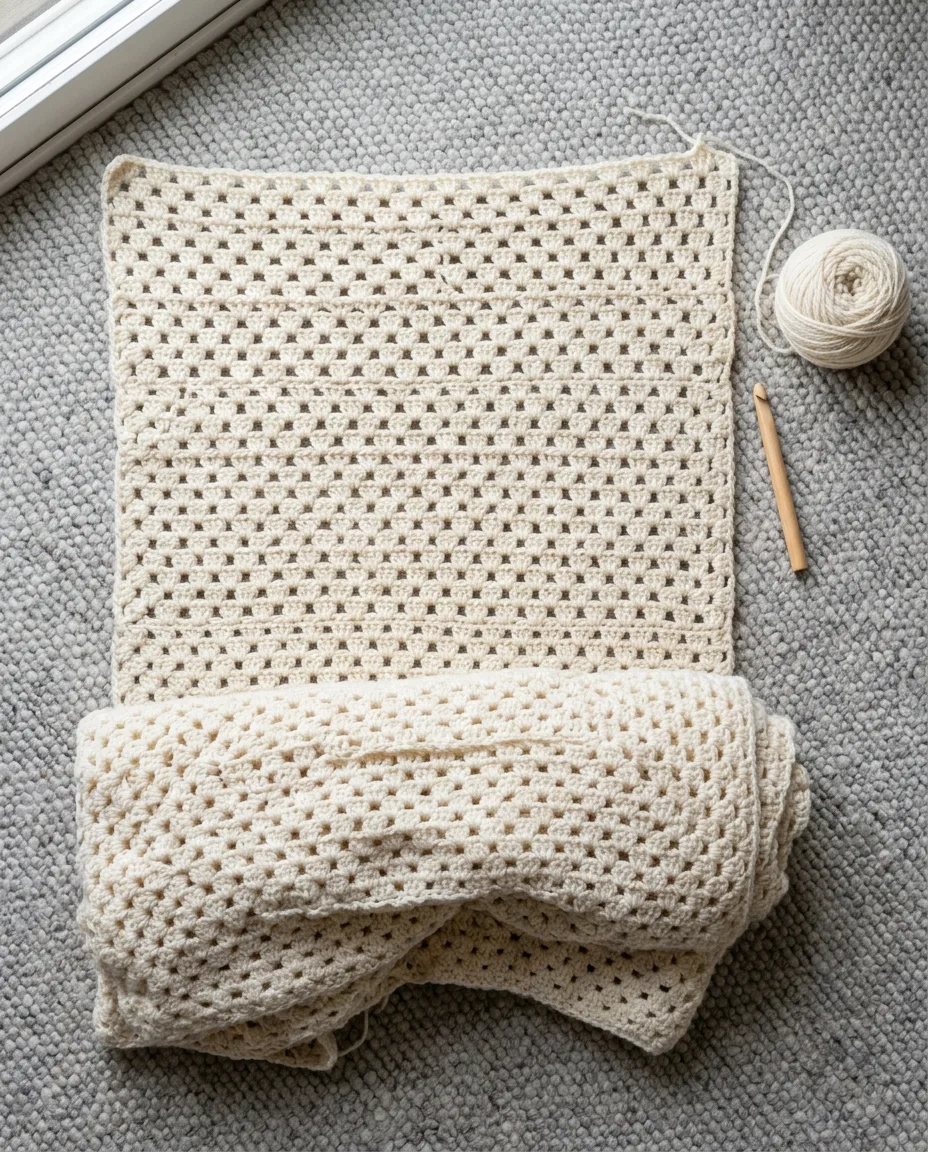
So the starting chain is always a multiple of 3. Decide how many full clusters you want across. Add 2, then multiply by 3. The swatch proves the rule: 4 clusters plus 2 is 6, and 6 times 3 is the chain of 18. For a baby blanket about 30 inches (76 cm) wide you need about 30 clusters, so chain 96. A throw near 50 inches (127 cm) wide takes about 50 clusters and a chain of 156. Long chains twist easily. Before Row 1, lay yours flat and make sure it isn’t spiraling around itself.
156 chains give you a row of about fifty clusters, and a row that wide takes a while. Clip a stitch marker (a small plastic clip that hooks into a stitch) onto the first cluster. After a break you’ll find your place right away.
 Save
Carry the yarn up the side for stripes
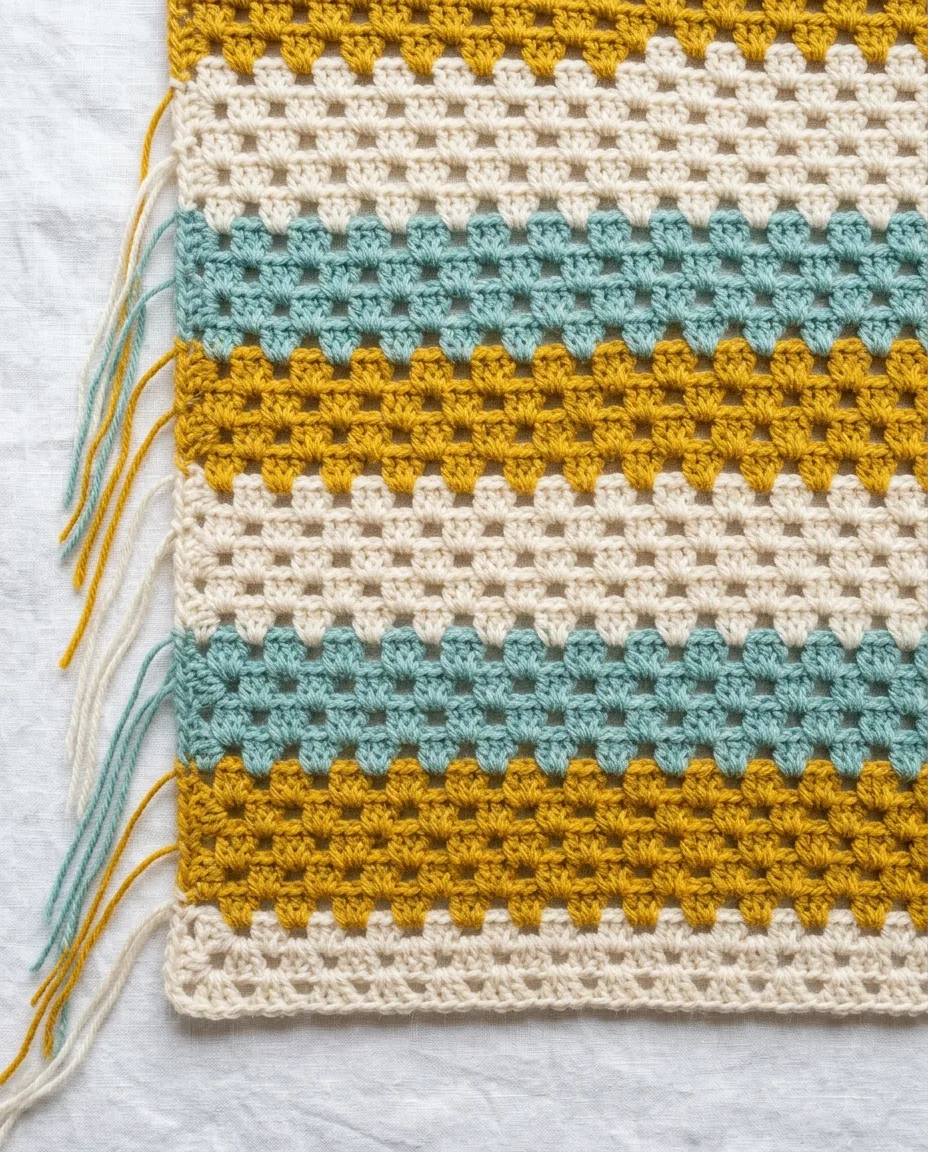
Stripes are where this stitch really earns its place. Change color every two rows and the old color lands back on the same edge. So there’s no need to cut it. Drop it and pick up the new color. Carry the unused strand loosely up the side until you need it again.
Stop before the final step of the last stitch in the row. That’s when you change color. Yarn over with the new color and pull it through the last two loops, and the chain 3 at the start of the next row comes out in the new shade already. Keep the carried strand slack. Tug it tight and the edge puckers into a curve.
But more colors change the rule. With three or more, cut each one at the end of its stripe, because carrying several strands builds a thick, lumpy edge. Weave every tail into the clusters of its own color so it stays hidden.
 Save
Straight edges come from the half cluster
When a granny-in-rows blanket leans or narrows, it’s almost always one thing. Someone skipped the half cluster on the short rows. Leave out that single double crochet in the first space and Row 3 loses a stitch at each edge. Every few rows the blanket shrinks by a whole cluster. The guide to shell stitch crochet covers the whole method.
No count check, no straight sides. Mistake number two is working clusters into the tops of stitches. That closes up the gaps, and the fabric stops looking like granny stitch at all. After Row 2, every cluster goes into a space.
Tension, meaning how tightly you hold the yarn, matters less here than in solid stitches. The open gaps hide small differences. A tight hand does make the clusters cup upward, though. If your swatch curls, go up half a millimeter.
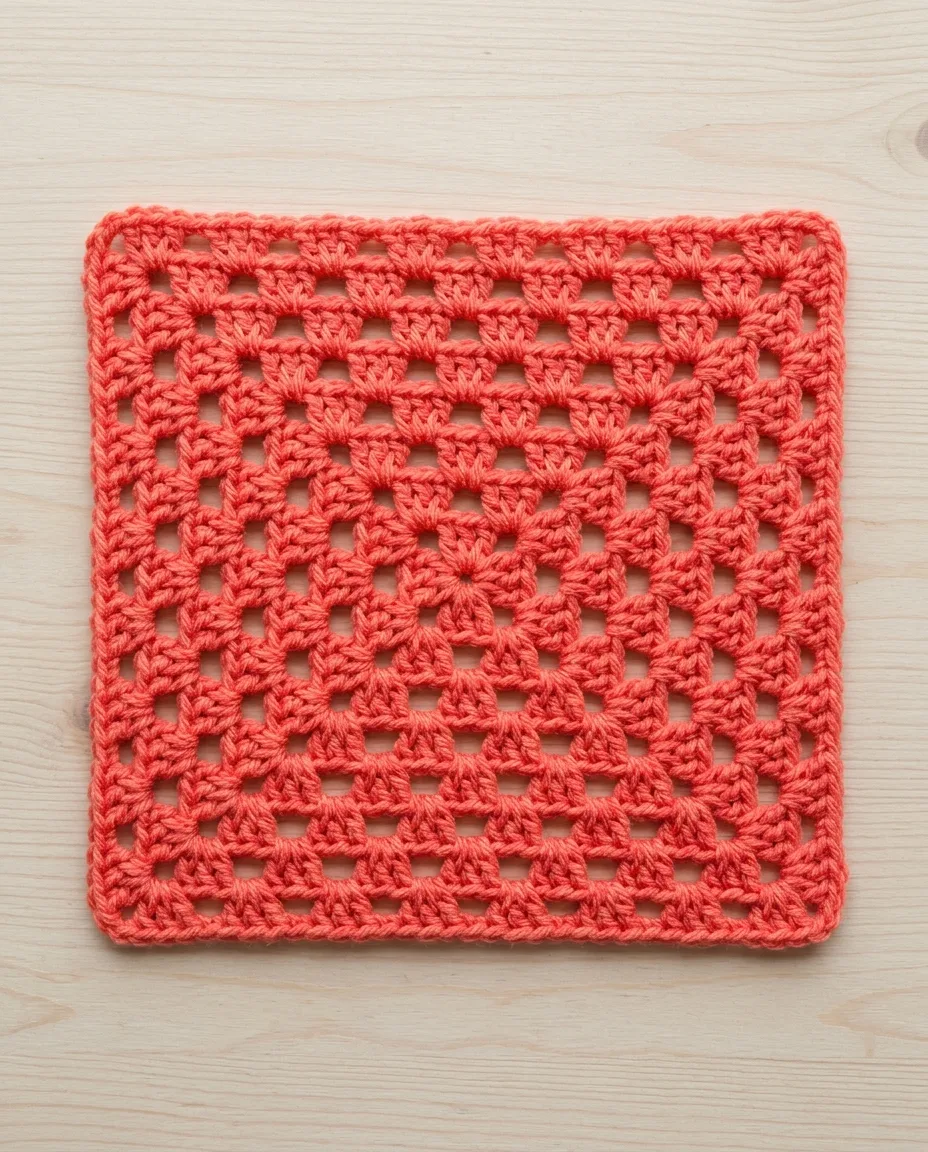 Save
Finish with a single crochet border
Granny rows leave the side edges a little ragged. Each edge is the post of a double crochet or a turning chain, and those don’t line up neatly. A border fixes it. Single crochet (sc) is the shortest stitch. Push the hook through and catch the yarn to draw up a loop. Wrap the yarn once and pull it through both loops on the hook. The herringbone half double guide breaks the whole project into steps.
Go all the way around the blanket in single crochet. Top and bottom get 1 stitch in each stitch. On the sides, put 2 single crochets around the post of each edge stitch. Corners take 3 single crochets in the same spot so they turn flat. Two or three rounds like this make a firm frame.
Prefer something softer? Add one more round of granny clusters into the gaps of the border, and it reads as part of the pattern. Still finish with the plain single crochet round outside it. That last round is what stops the edge stretching in the wash.
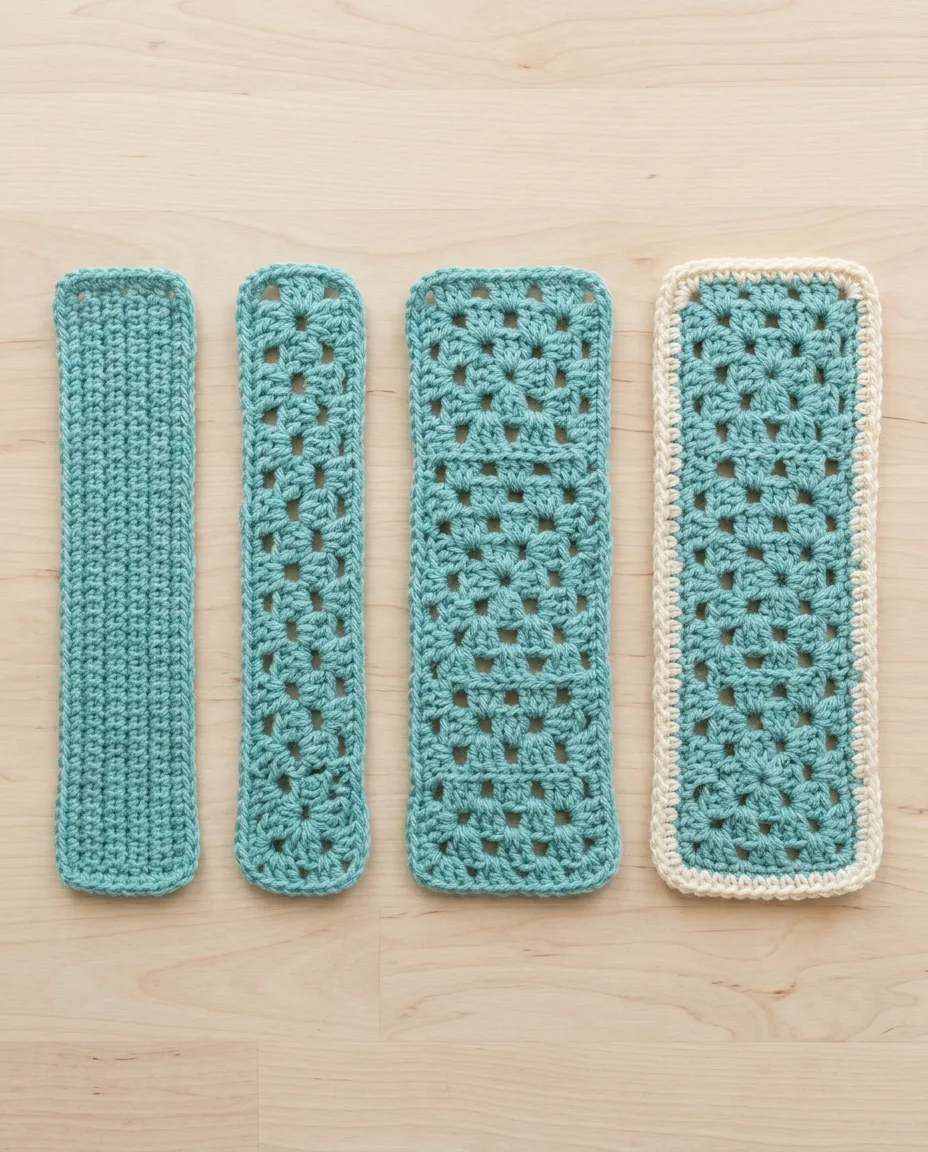 Save