New crocheters usually hear the same thing: sort out your tension, then try textured stitches. For the cluster stitch, that’s backwards. A cluster pulls three half-finished double crochets into one shared top. A loose loop and a tight loop end up in the same knot. And the bumps break up the surface, so the eye stops judging each stitch on its own. Rows that look ragged in plain single crochet suddenly look like you meant them.
All you need is a stitch you probably know already, the double crochet. Plus some patience for row one. The terms below are US crochet terms. At 16 stitches wide, the swatch is small enough to finish in an evening, yet big enough that you can watch the texture settle.
Worsted weight is a medium thickness, the kind that fills most of a store shelf. Don’t underestimate the light color. Dark yarn swallows the bumps. Variegated yarn does the same, and then your cluster stitch just looks like lumpy double crochet.
Work one cluster
Double crochet (dc) is the tall stitch. You wrap the yarn once, go into a stitch, then pull through two loops at a time until only one is left. A cluster begins three of those in a single stitch and halts each one partway. Quick reminder: a yarn over is wrapping the yarn over the hook from back to front. Each step below is one movement of the hook.
- Yarn over. Push the hook into the stitch from front to back.
- Yarn over again and pull up a loop. You should count 3 loops.
- Yarn over, then pull through 2 of them. Two loops stay put, and the first leg is finished.
- Yarn over and head back into that same stitch.
- Yarn over and pull up a loop. Wrap once more and pull through 2. Now there are three loops on the hook.
- Yarn over and go into the same stitch a third time. Pull up a loop, then pull through 2 again. Four loops sit on the hook now.
- Yarn over and draw through all 4 loops in one go.
- Chain 1. That locks the top shut.
Trouble with tension shows up first on that final pull through four loops. Snug loops make the hook stick. Tilt the hook head down a touch and pull with a small rocking motion. Still stuck? Then the loops got too tight on the way up. Lift every new loop to the full height of the hook shaft before you carry on.
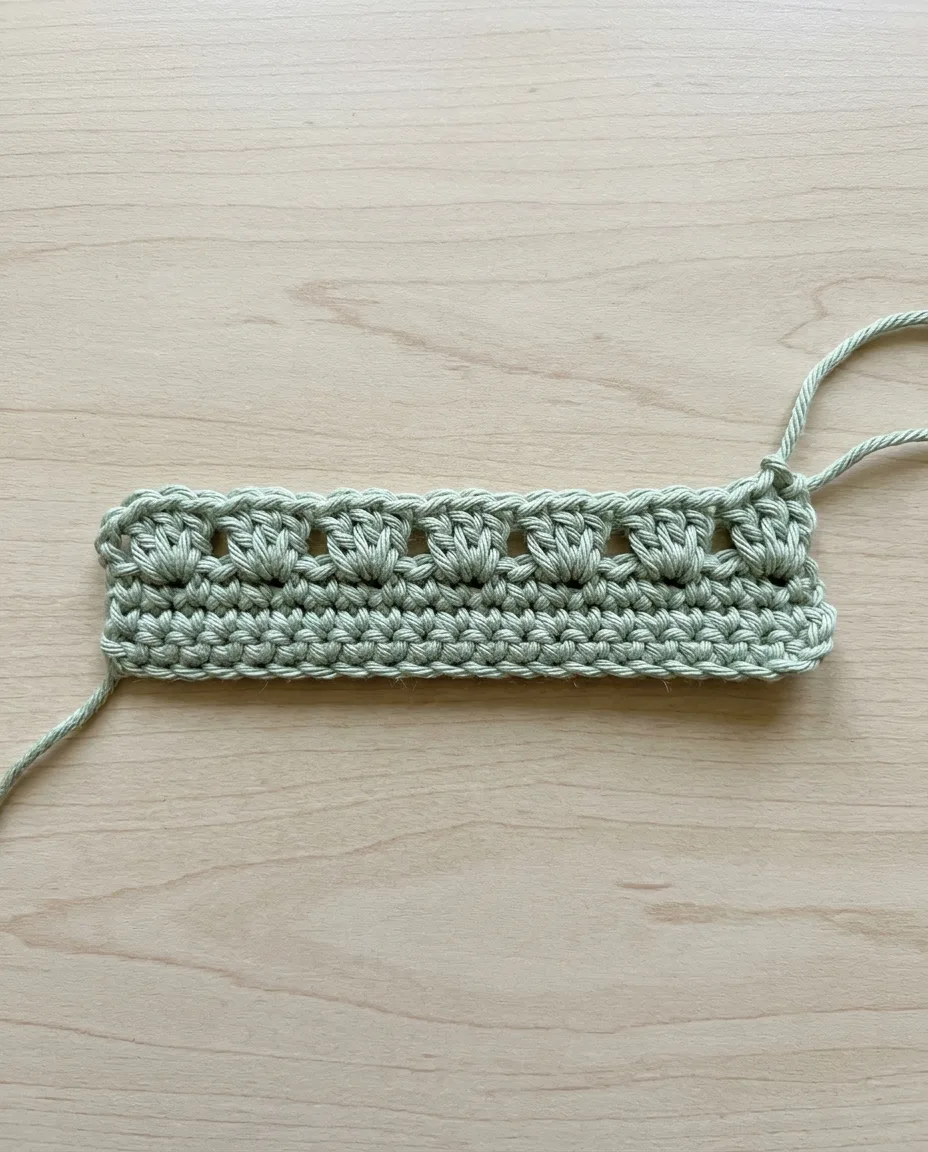 Save
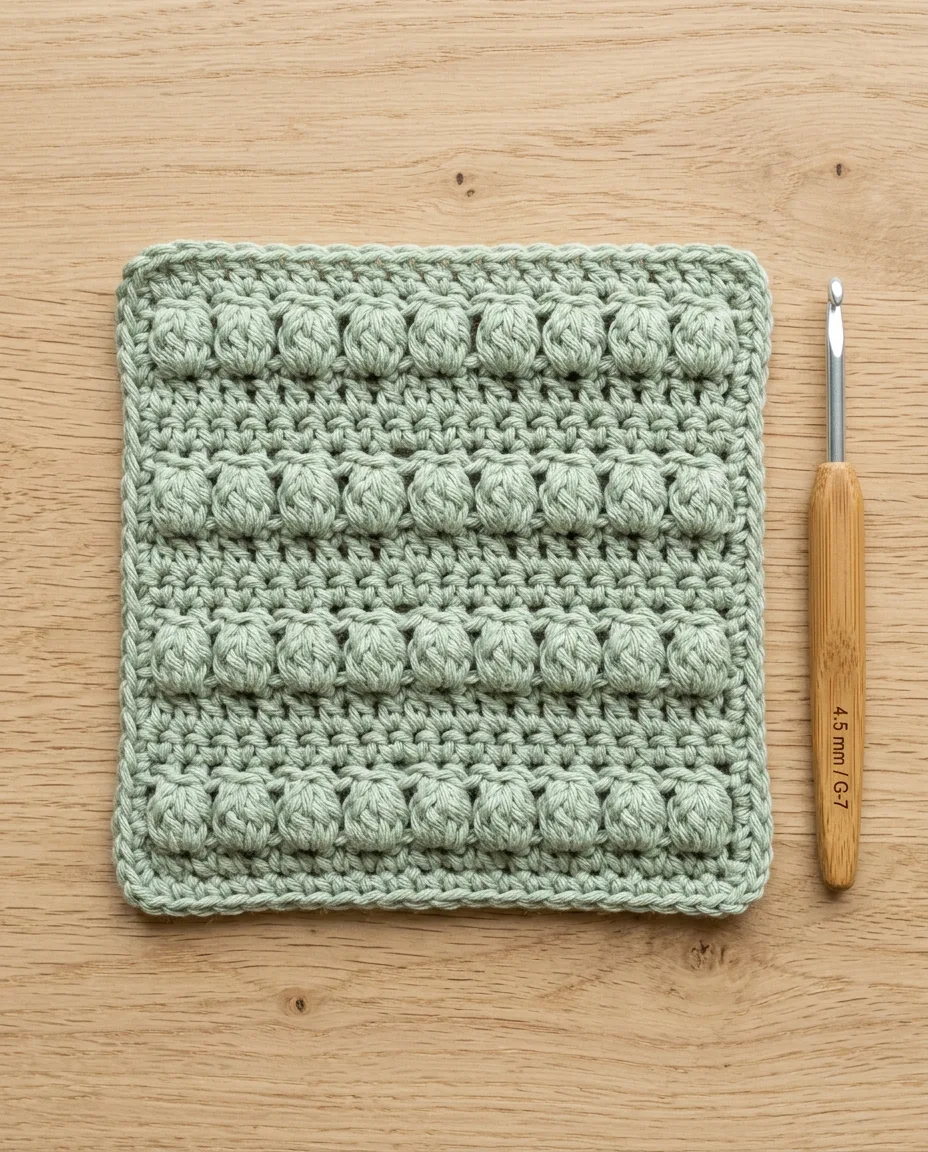
The swatch, row by row
Cluster rows take turns with single crochet rows. Single crochet (sc) is the short one. Go into the stitch and draw up a loop. Wrap again and draw through both loops. That flat row in between gives each cluster row a level base to sit on. Leave it out and the bumps pile up, and the swatch curls.
- sc in 2nd ch from hook and in each ch across, turn 16 sts
- ch 3 (counts as dc), (skip next st, cl in next st, ch 1) x7, dc in last st, turn 7 clusters
- ch 1, sc in first dc, sc in each cl and each ch-1 space across, sc in top of the ch-3, turn 16 sts
- Repeat Rows 2 and 3 until the swatch is about 4 inches, 10 cm, tall, ending on a Row 3.
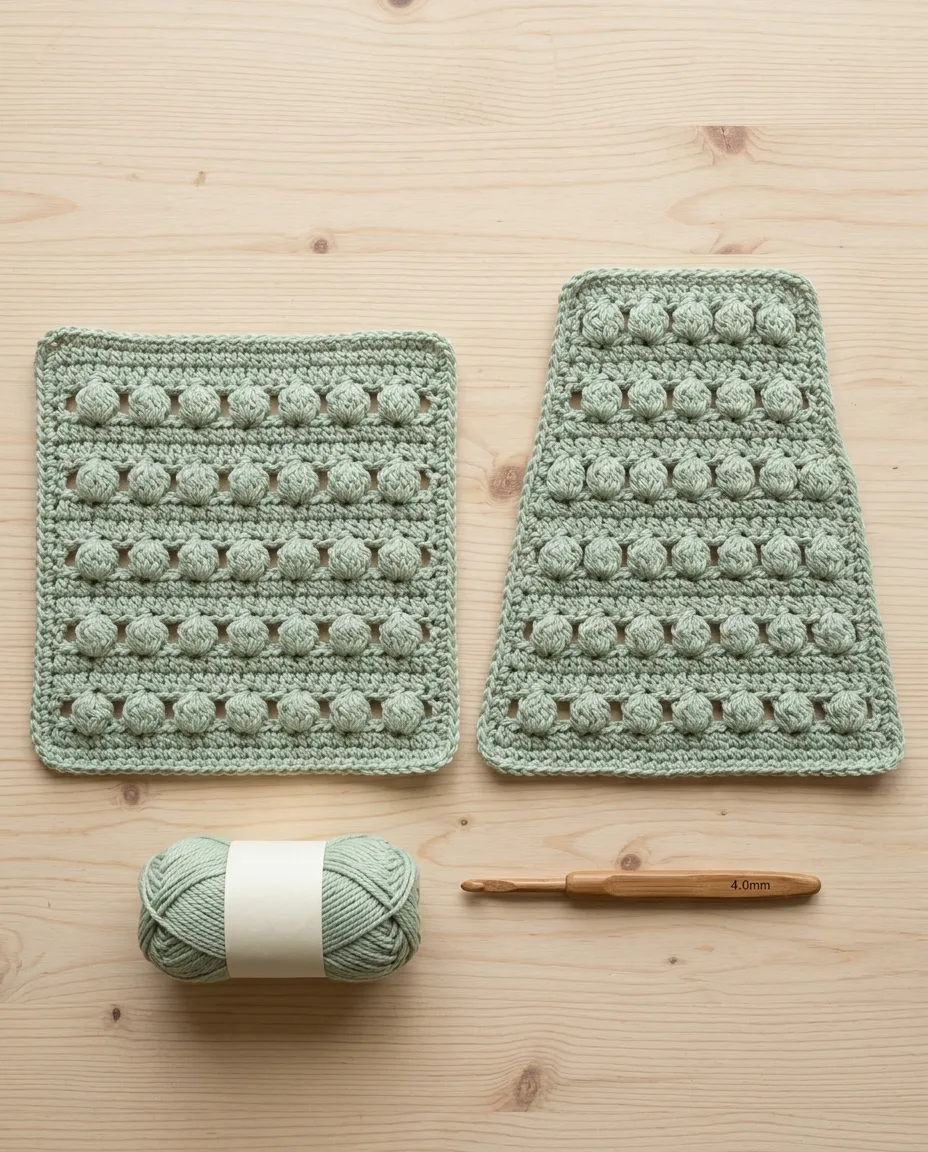
Count Row 3. Every single time. A chain space is the little gap under a chain stitch, and your hook goes into the gap itself. The 3 chains that open Row 2 are the turning chain, standing in for the first double crochet. One single crochet goes into each cluster and each chain space, which makes 14. Add the two edge stitches and you’re at 16. Miss one, and the next cluster row loses a whole repeat. That drift is exactly what makes a swatch lean to one side.
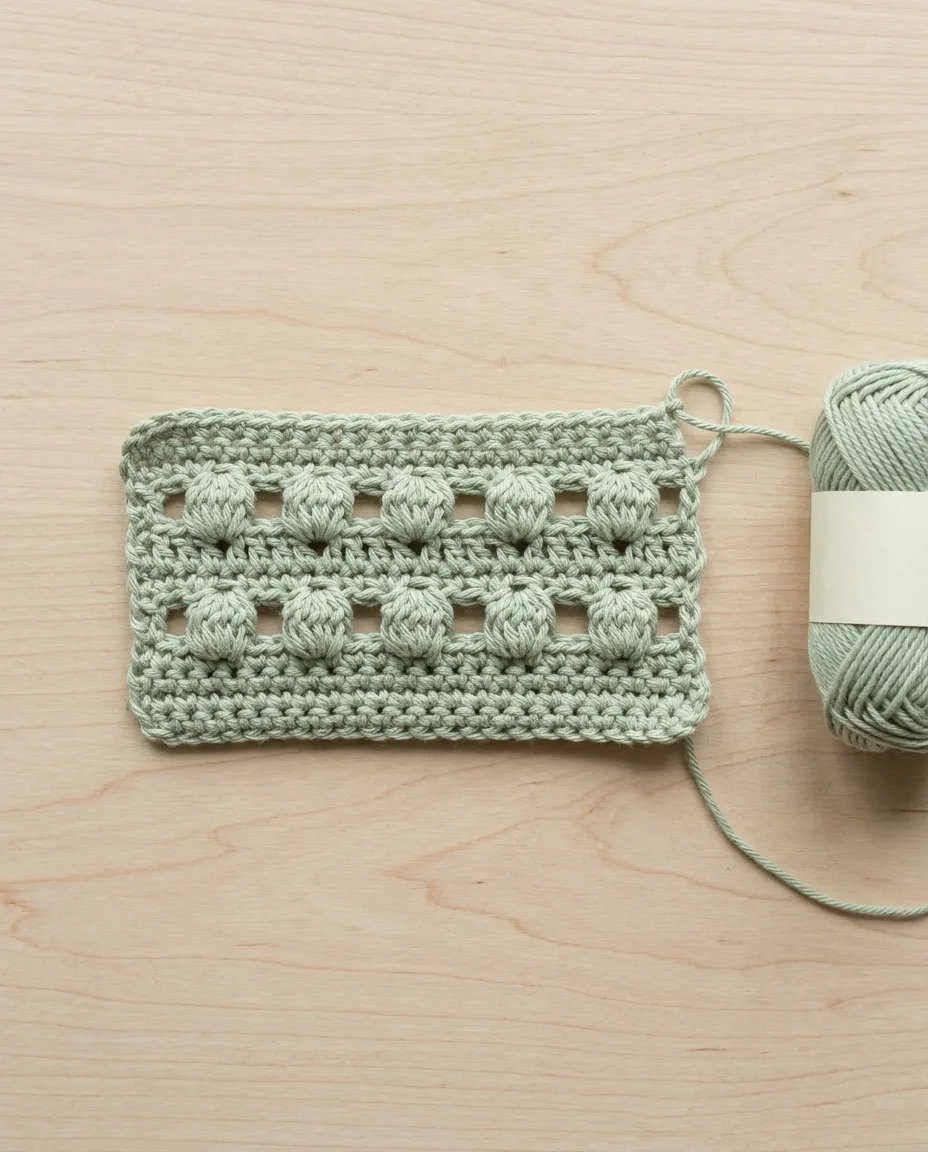 Save
Ten rows in, one missed turning chain has turned a square into a trapezoid. It counts as a stitch. Beginners skip working into it on Row 3 all the time.
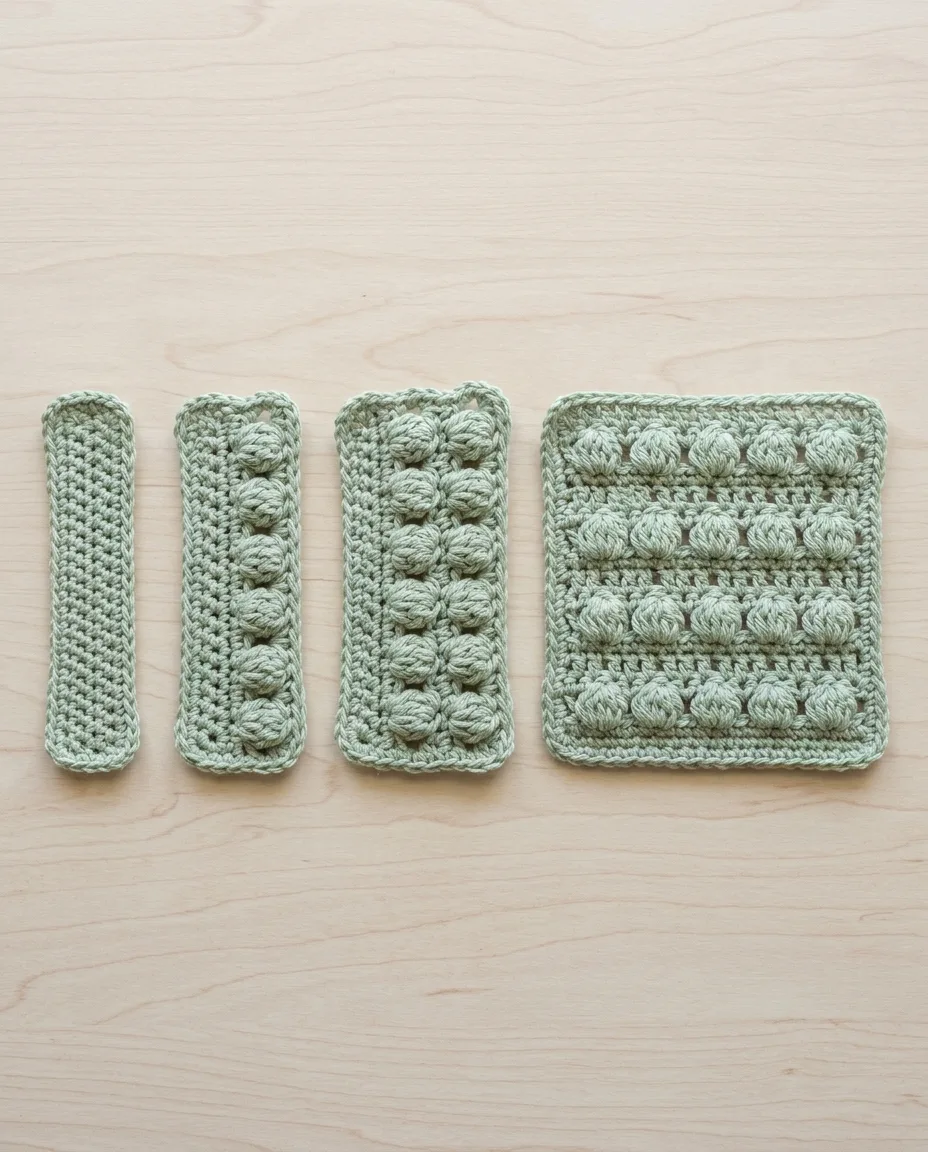 Save
Why the bumps hide uneven loops
Picture a plain double crochet swatch by someone still learning. Some stitches stand tall. Others squat. On smooth fabric you can see every one of them. Clusters behave differently, because three legs share a single closing loop. A long leg and a short leg finish at the same height, and the difference gets split between them.
No cluster comes out perfectly round. Good. The surface is meant to be irregular, so a stitch sitting slightly proud of its neighbors just reads as texture. Your eye follows the pattern of bumps and gaps, and the size of any one loop stops registering.
But this only goes so far. If your tension starts very tight and drifts loose by the end of a session, you’ll still get rows of different heights. Clusters are good at hiding wobble from stitch to stitch, much less good at hiding drift from row to row. When your hand starts to cramp, take a short break. Then compare the row height with the one below before going on.
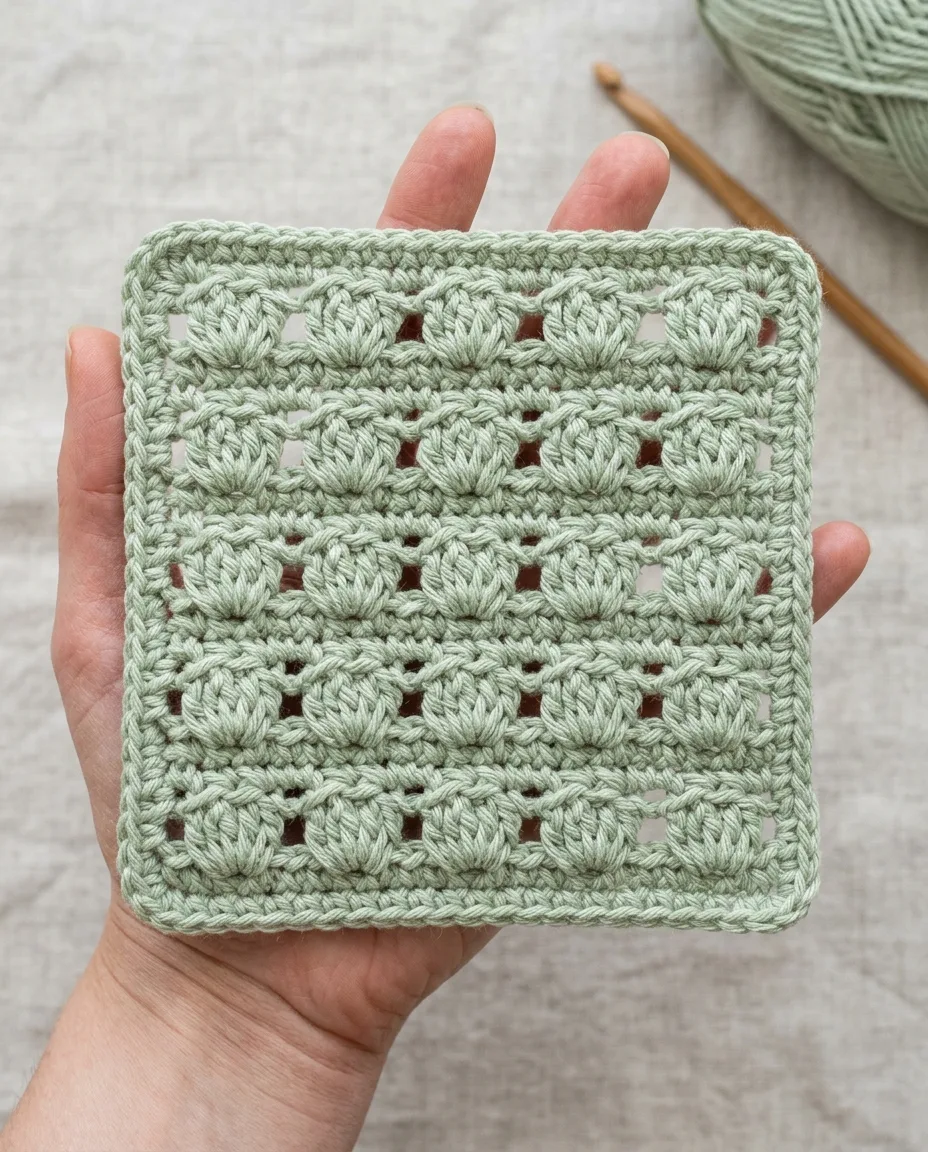 Save
Where clusters go wrong
The number one complaint is gaps you could poke a finger through. Usually the chain 1 between clusters was worked too loosely. Sometimes it’s a skipped pair of stitches where the pattern skips only one, which is easy when the clusters cover up what’s underneath. Snug that chain against its cluster before moving on. Glance back at the row below too. Exactly one stitch should sit under each gap. Even gaps with uneven loops still look tidy, while uneven gaps look messy no matter how good your loops are.
Next up, flat and smeared clusters. They happen when each of the three legs goes into a different stitch, so the legs fan out and the top spreads wide. All three belong in one stitch. Keep your eye on the hole you’re working into and return the hook to that same hole each time.
Wavy edges point to the turning chain. Pull a chain of 3 too tight and the edge comes out shorter than the middle. Loosen it. Or, if your double crochets run short, swap in a chain of 2. Measure a few rows against each other before deciding which suits your hand.
Counting by eye trips nearly everyone. A finished cluster looks like one fat stitch, and the chain 1 beside it all but vanishes. So touch each cluster as you count it, then each gap, and say the numbers out loud. It feels silly. It works.
 Save
Where it shines and where it doesn’t
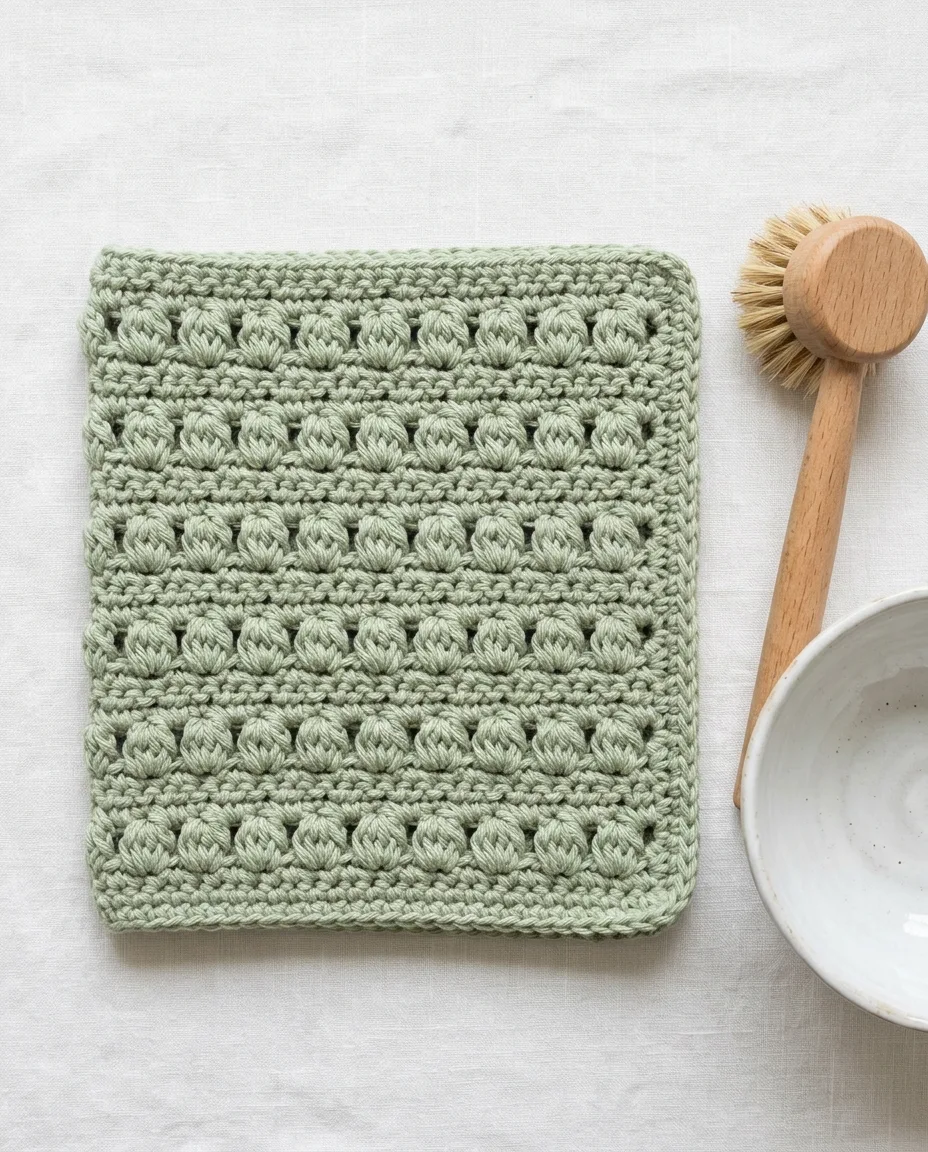
Start with dishcloths. Cluster fabric is stiff, which is just what a scrubbing cloth wants. The bumps do the scrubbing, and cotton keeps their shape wash after wash. Baby blankets and winter hats are good matches as well, since the fabric is thick and warm. The catch is yarn. A cluster blanket uses about a third more than the same size in plain double crochet. Buy the extra ball before you start. Running out halfway is no fun.
 Save
Anything that needs to drape? Leave this stitch out of it. Fine crochet thread is a poor match too, because each bump is too tiny to hide anything at all.
Try a two-leg cluster first
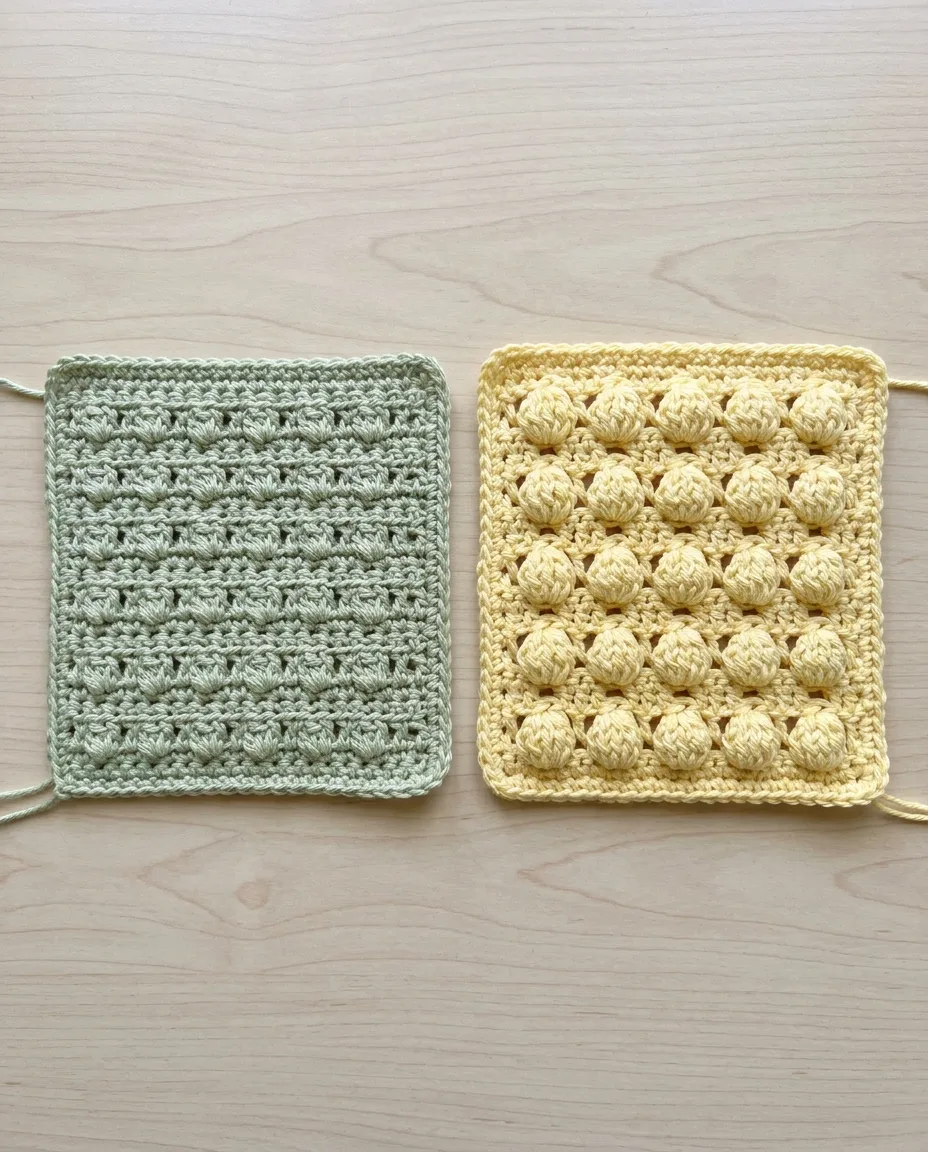
Fighting the four-loop pull? Shrink the cluster. Work steps 1 to 3, then repeat steps 4 and 5 just once, leaving 3 loops on the hook. Yarn over and pull through all 3. That’s a two-leg cluster. Flatter bumps, lighter fabric, and it still evens out loose loops. When the pull through 3 feels easy, go back to three legs.
Going bigger works on the same logic. Five legs in one stitch give a bold, rounded bump, with a final pull through 6 loops. Separate them with 2 chains instead of 1 and skip 2 stitches between each, or the fabric will ripple.
 Save