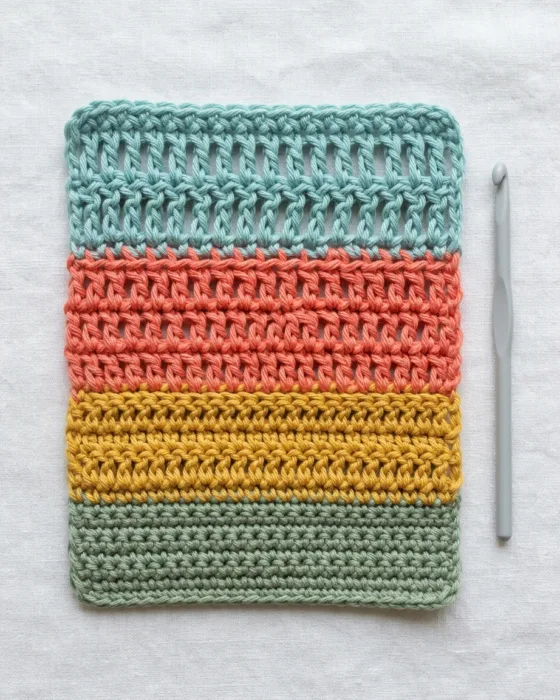
Wrap the yarn around your hook twice before going into the stitch. That’s it. That double wrap is the entire difference between a treble crochet and the shorter stitches, because every wrap adds height. A finished treble stands roughly as tall as four chains stacked up, so rows climb fast. How fast? A scarf needing 60 rows of single crochet reaches the same length in about 20 rows of treble. (Single crochet is the short one. You insert the hook, pull up a loop, then wrap the yarn and draw it through both loops at once.)
Terms here are US. UK patterns call this same stitch a double treble, and that mix-up catches plenty of people who buy patterns online. In US patterns it’s shortened to tr.
You’ll see two words in every step. A yarn over means wrapping the yarn over the hook from back to front. A loop is any strand sitting around the hook’s shaft. Trebles get worked by pulling through those loops two at a time, so keep count as you go. Lose count and you’ll know soon enough. The stitches come out at different heights, and that’s behind most early mistakes.
Not much is needed for a practice swatch, which is just a small test square you make before a real project. Grab worsted weight, a medium-thick yarn that most labels pair with a 5 mm hook. Cotton is the better pick for learning. It shows every stitch clearly, so you can actually see what went wrong.
Work one treble crochet, loop by loop
Start with a chain of 17. To chain, pull a loop of yarn through the loop already on your hook, and keep doing that. Your first treble goes into the fifth chain from the hook. Why skip four? They stand in for the first stitch of the row.
- Yarn over twice. Two wraps now sit on the hook next to the loop that was already there.
- Insert the hook into the fifth chain from the hook, front to back.
- Yarn over and pull a loop back through the chain. Count them: 4 loops on the hook.
- Yarn over, then pull through the first 2 loops. 3 loops remain.
- Yarn over again and go through the next 2. Now 2 loops remain.
- One last yarn over, through the final 2 loops. A single loop is left, and the treble is finished.
- Carry on across the chain with a treble in each one. Every single treble starts with two yarn overs.
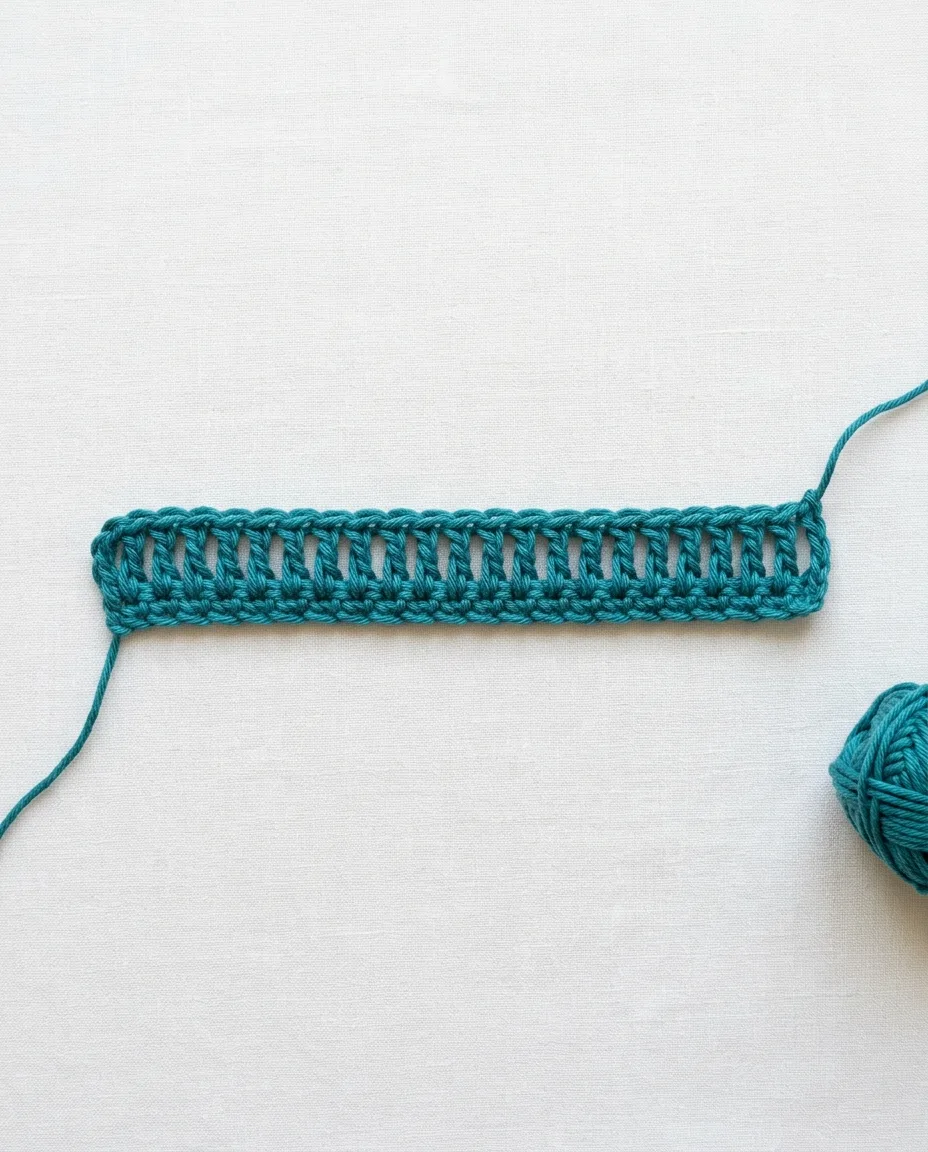
Count once the first row is done. The target is 13 trebles plus the 4 skipped chains, which together count as one stitch. So 14. Got 13? You probably forgot the skipped chains. Got 15? One chain picked up two stitches by accident. While inserting the hook, press the two wraps against it with your index finger, since they love to slide off the tip. And a wrap that slips loose makes the whole stitch sag.
 Save
Four chains start every new row
At the end of each row, turn the work so the back faces you. Chain 4. This turning chain is about as tall as a treble and counts as the first stitch of the new row. That means you skip the stitch right at its base, since the chain is already sitting on top of it. Then a treble into each stitch across.
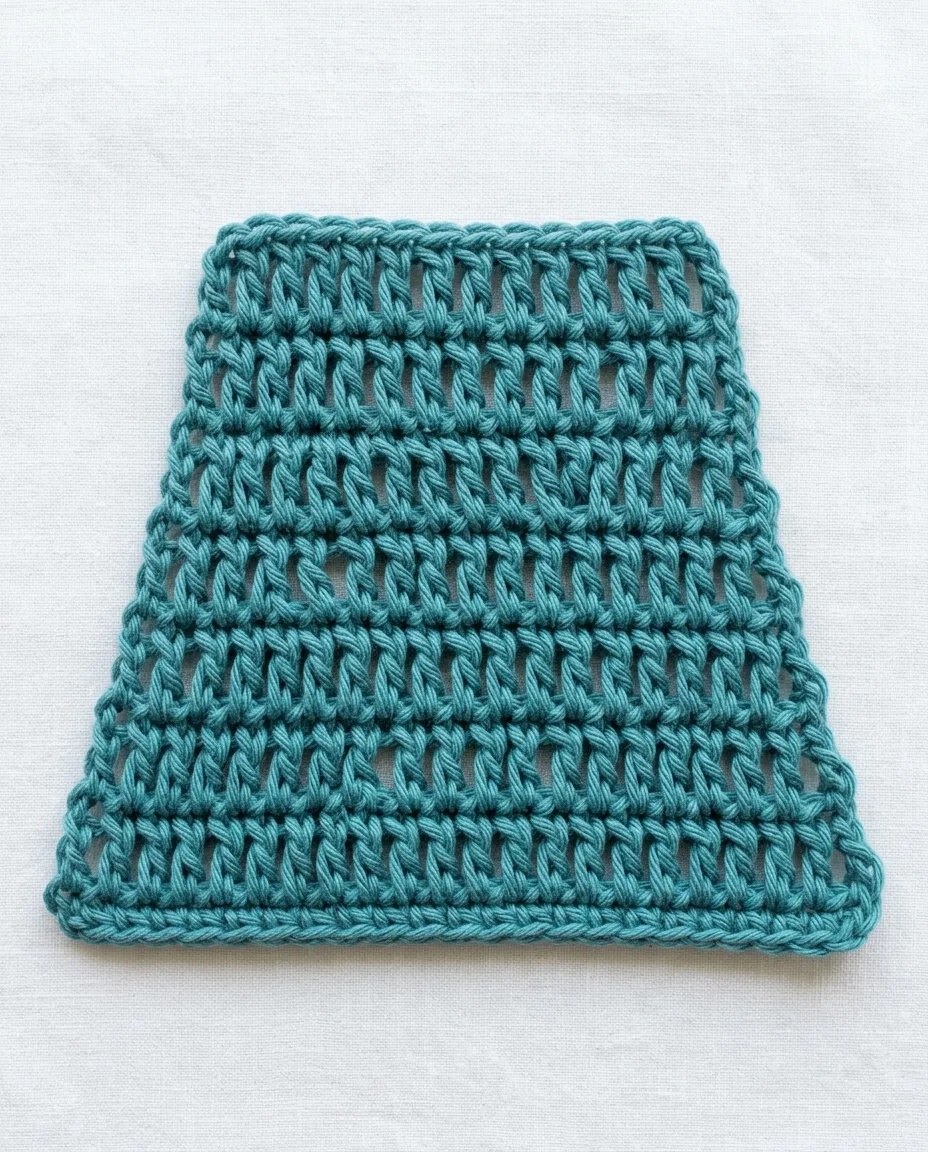
No stitch gets missed more often than the last one. It goes into the top chain of the previous row’s turning chain, and it’s easy to overlook. Miss it once and the row is a stitch short. Miss it every row and your square slowly narrows into a wedge.
- Ch 17, tr in 5th ch from hook and in each ch across 14 sts
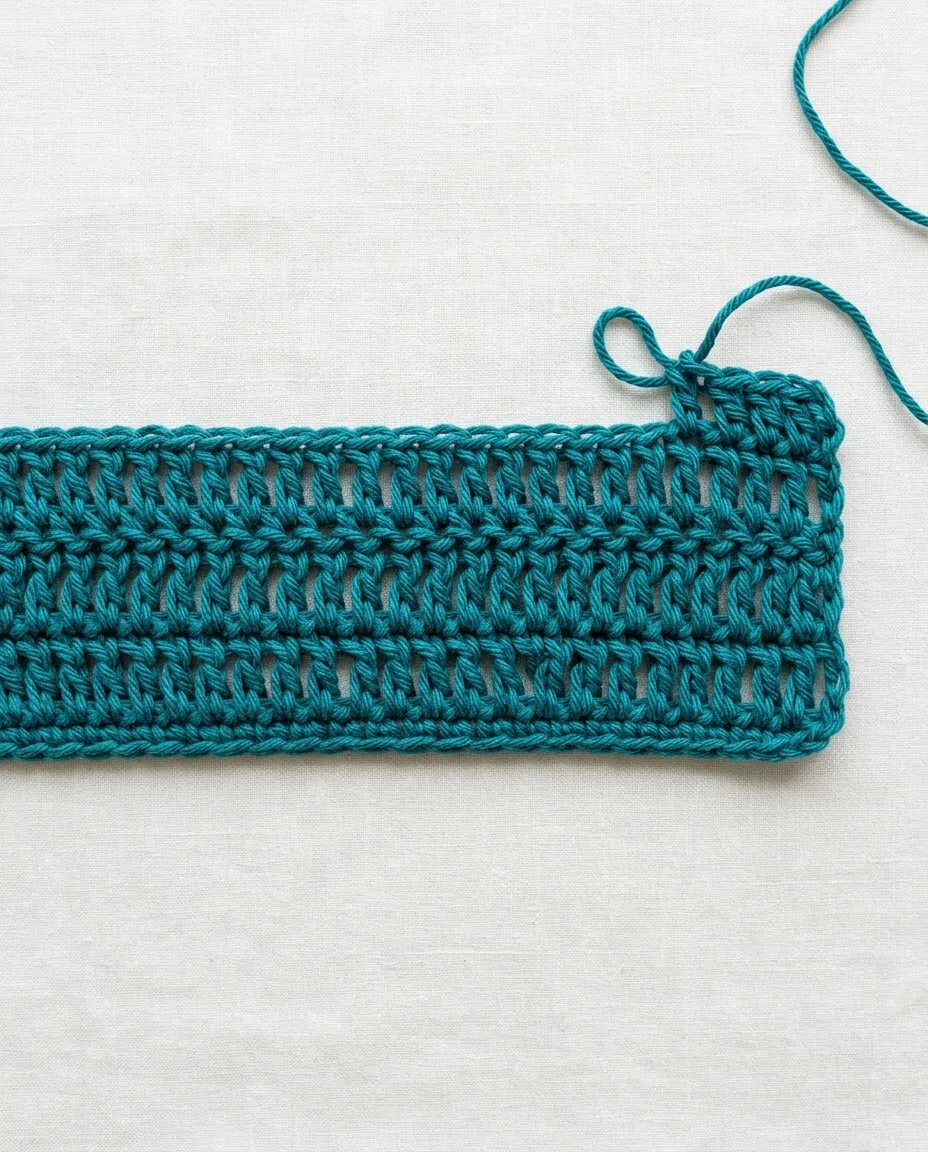
- Ch 4 (counts as tr), turn, skip first st, tr in each st across, tr in top of turning ch 14 sts
- Repeat Row 2 three more times 14 sts
 Save
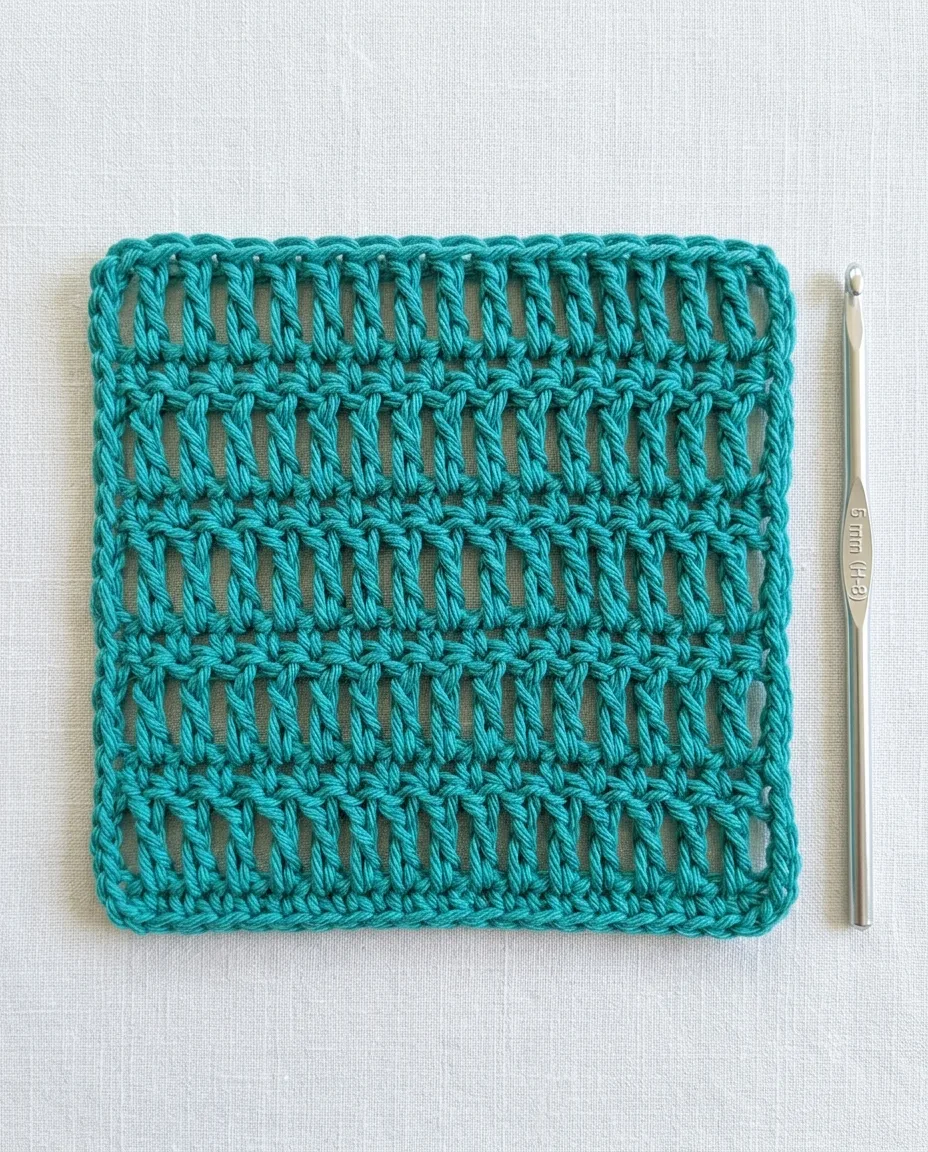
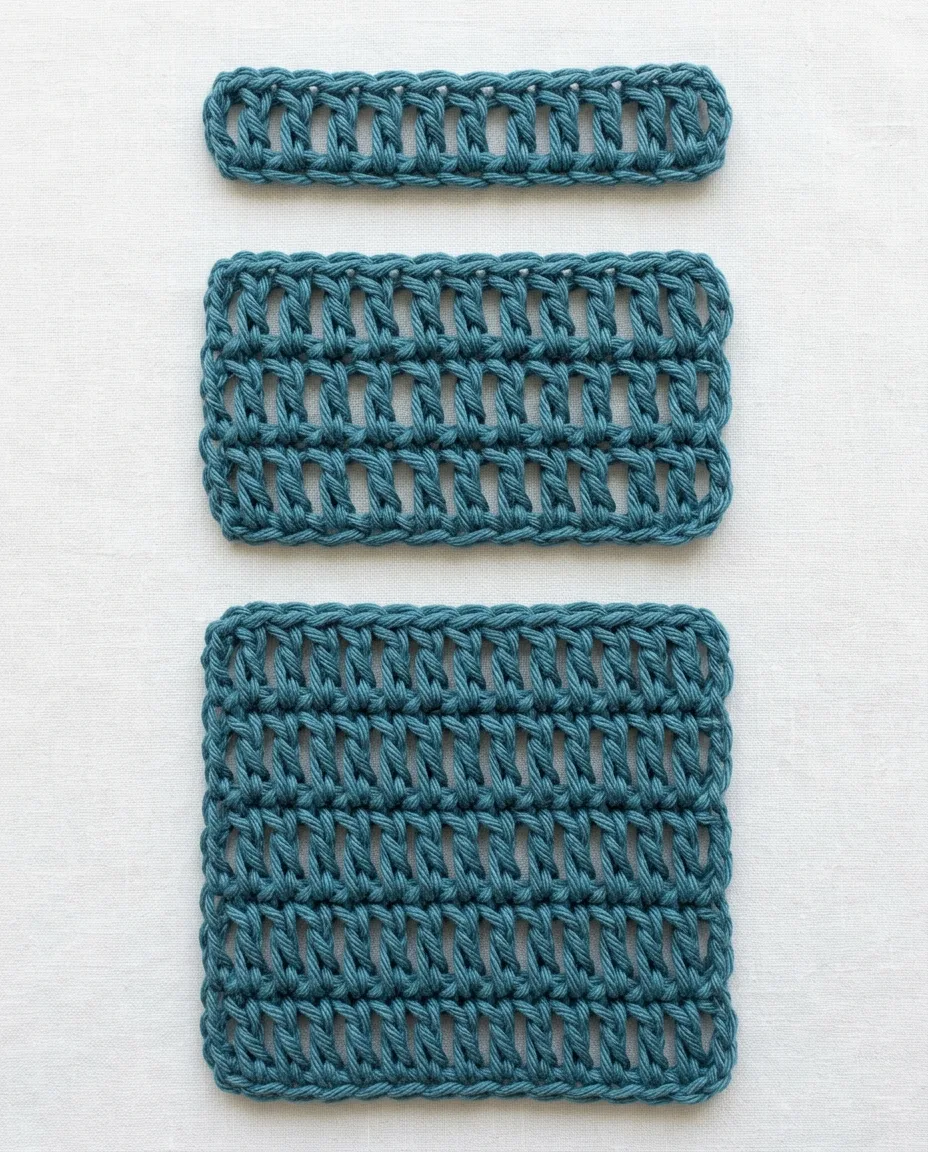
Five rows of worsted cotton give you something close to a square, about 5 inches, 13 cm, across. Use it to measure gauge. Gauge is how many stitches and rows fit in a set width, and it tells you whether your hook matches a pattern. Aim for roughly 12 stitches and 4 rows to 4 inches, 10 cm. Your tension will shift both numbers. That’s how tightly you hold the yarn as it feeds onto the hook. Tight hands pack in more stitches per inch. If your swatch comes out small, go up half a millimeter.
Drapey fabric, open gaps
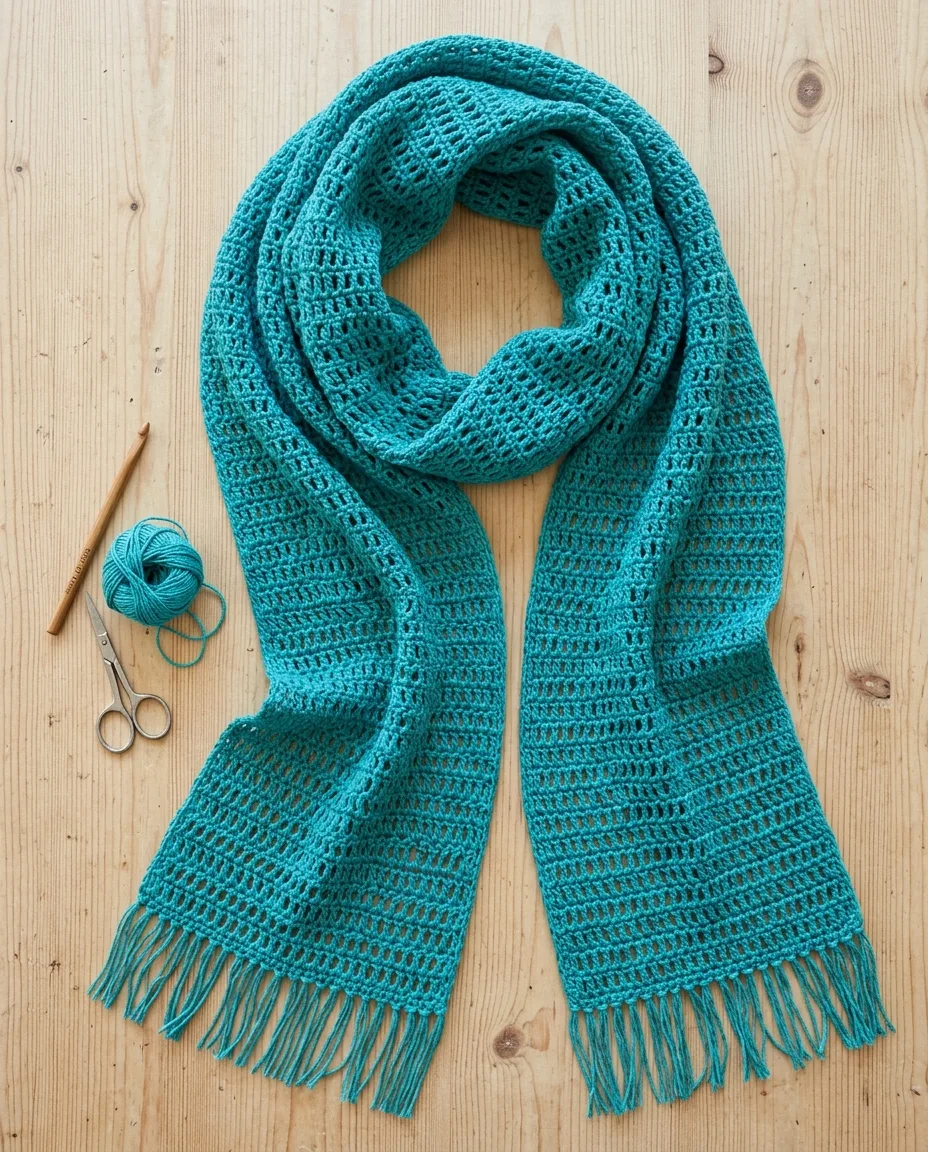
Tall stitches mean fewer horizontal bars per inch of fabric. Each stitch has a post, the long upright part, and treble posts are long. With fewer bars holding things together, the fabric hangs loose. Lift it and it swings.
Small gaps open up between the posts as well. For a summer piece, that openness is exactly the drape you’re after.
So use it there. A summer shawl, a loose scarf. A cotton market bag in treble rows will stretch around a melon and then fold flat into a pocket. Lap blankets are another good fit, because a few hundred trebles cover a surprising amount of ground. Yes, each stitch takes longer than a short one. You need far fewer of them, though, and the math ends up in your favor.
 Save
But skip it for stuffed toys. Fiberfill, the soft polyester stuffing inside most toys, pokes right through those gaps. Potholders are a bad match too. Heat comes straight through the same holes. Go with a short, dense stitch for both.
Where treble rows go wrong, and the fix for each
Loose loops are the first problem most people hit. Those two wraps feel slippery at the start, so new crocheters tend to pull them long to stop them falling off. The result is a row where every stitch is a different height. Keep each pull short and even. The loop should sit snug on the thickest part of the hook.
 Save
Then there are slanted edges. If the swatch narrows toward the top, some rows are missing their last stitch, the one into the turning chain. If it widens, there’s an extra stitch at the start, worked into the base of the turning chain. Count to 14 at the end of every row until you do it without thinking. It takes ten seconds and saves a lot of ripping.
The turning chain itself can look thin next to everything else. Four chains are one skinny strand. The trebles beside them are thick. Plenty of crocheters chain 3 instead of 4 to tighten that edge, and it still counts as a stitch. Honestly, there’s no single right answer here. Try both on your swatch and keep whichever edge looks closer to its neighbors.
Leaning stitches are rarer. They come from accidentally pulling through three loops at once, which squashes one side of the post. Glance at your hook before each pull. Exactly 2 loops should sit ahead of the yarn over you’re pulling through, every time.
Try the double treble when you want even more height
Add one more wrap and you’ve got the double treble, written dtr. Wrap the yarn three times before inserting the hook. Draw up a loop through the stitch. Five loops are now on the hook. From there it’s wrap and pull through 2 loops, four times running, until a single loop is left. The turning chain goes up to 5.
Double trebles are lacier, and harder to keep even. They also take longer. Save them for one tall row in a shawl border, or a row you plan to thread a ribbon through. For whole pieces, plain treble holds its shape better, which is why most patterns stick with it.
 Save
Before any real project, make the 17-chain swatch. Five rows take around 20 minutes. Skipping it feels faster, right up until a gauge problem means ripping out a whole shawl.