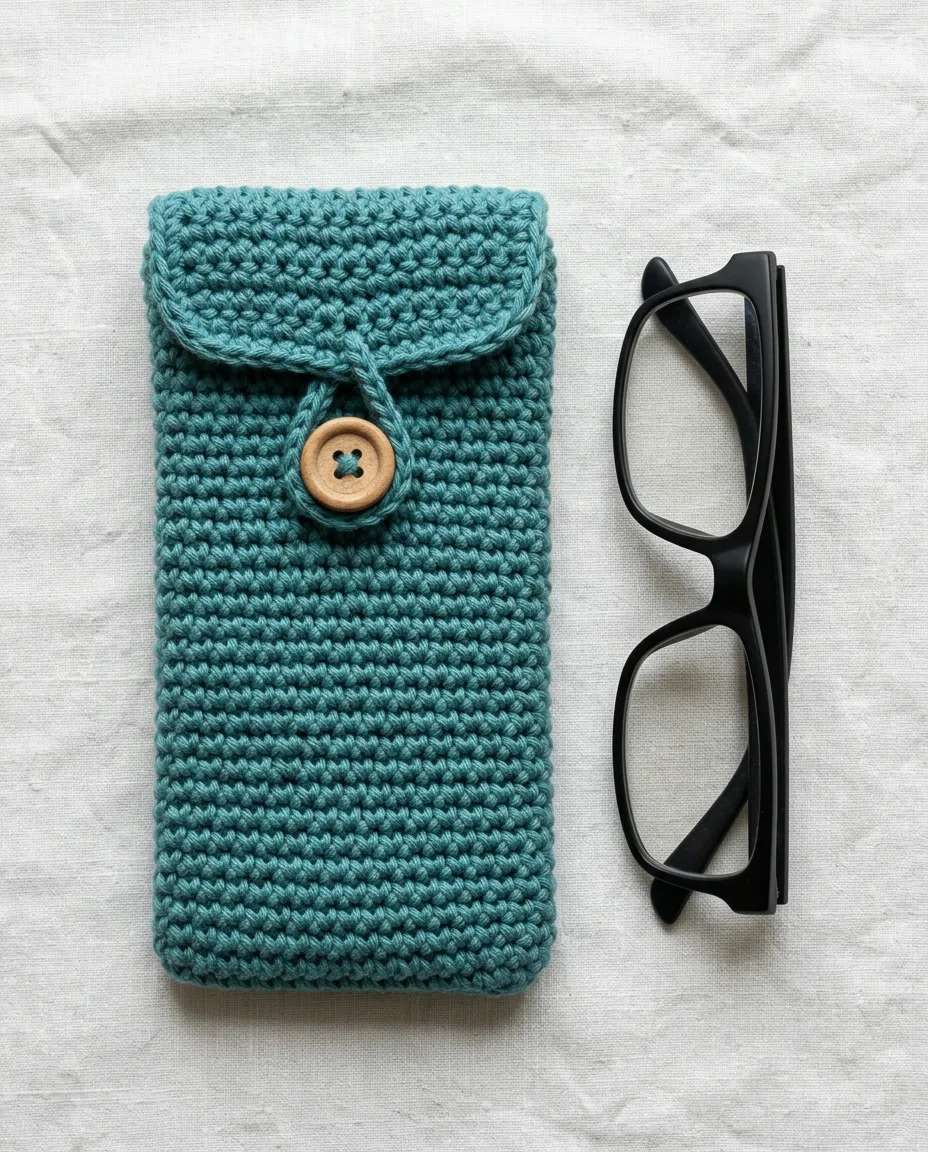
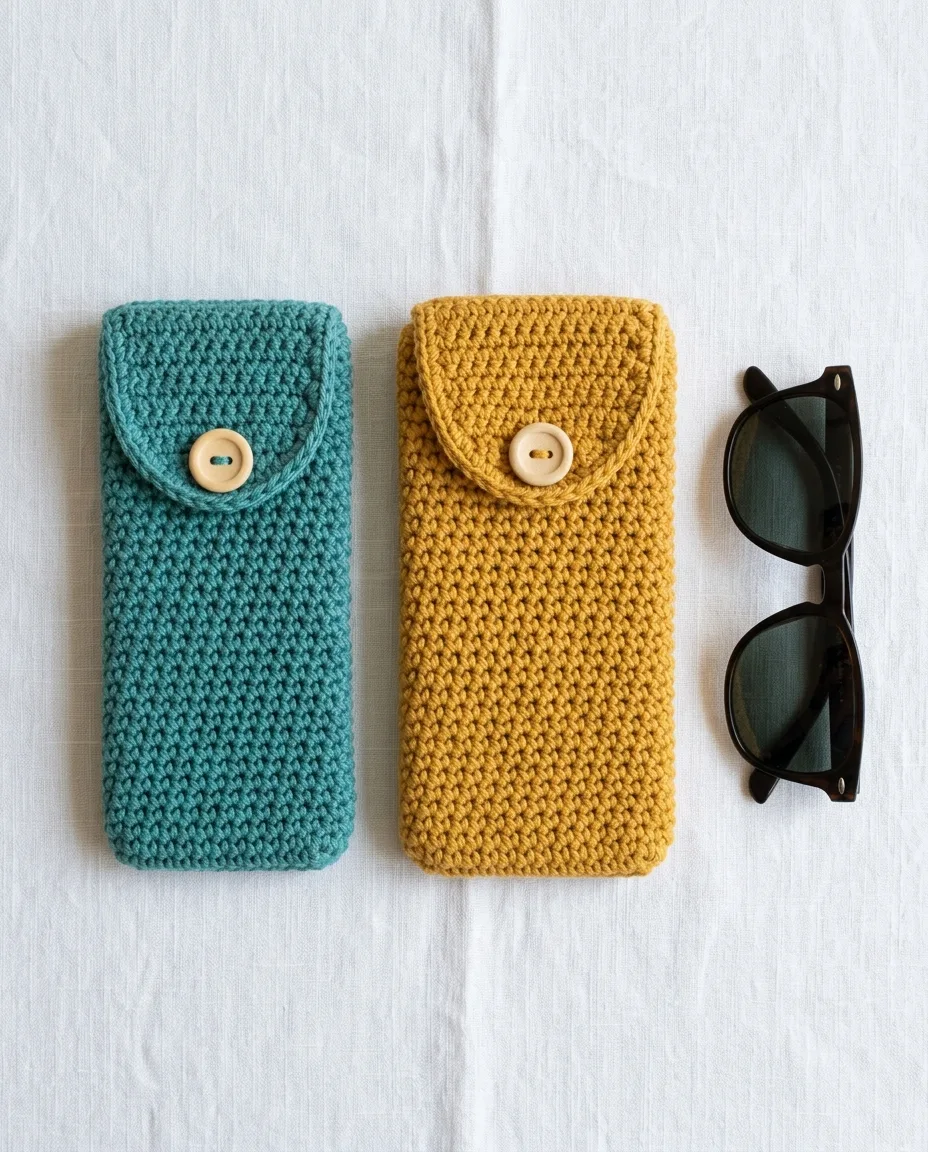
Eighteen stitches to 4 inches. That one number decides whether this case keeps your lenses clean or lets a set of keys poke straight through. Hit it, and you get a snug teal pouch about 3.5 inches wide and 7 inches tall (9 by 18 cm). A flap buttons over the top. It’s all single crochet in a spiral. If you can chain and work a single crochet, you can make this in an afternoon.
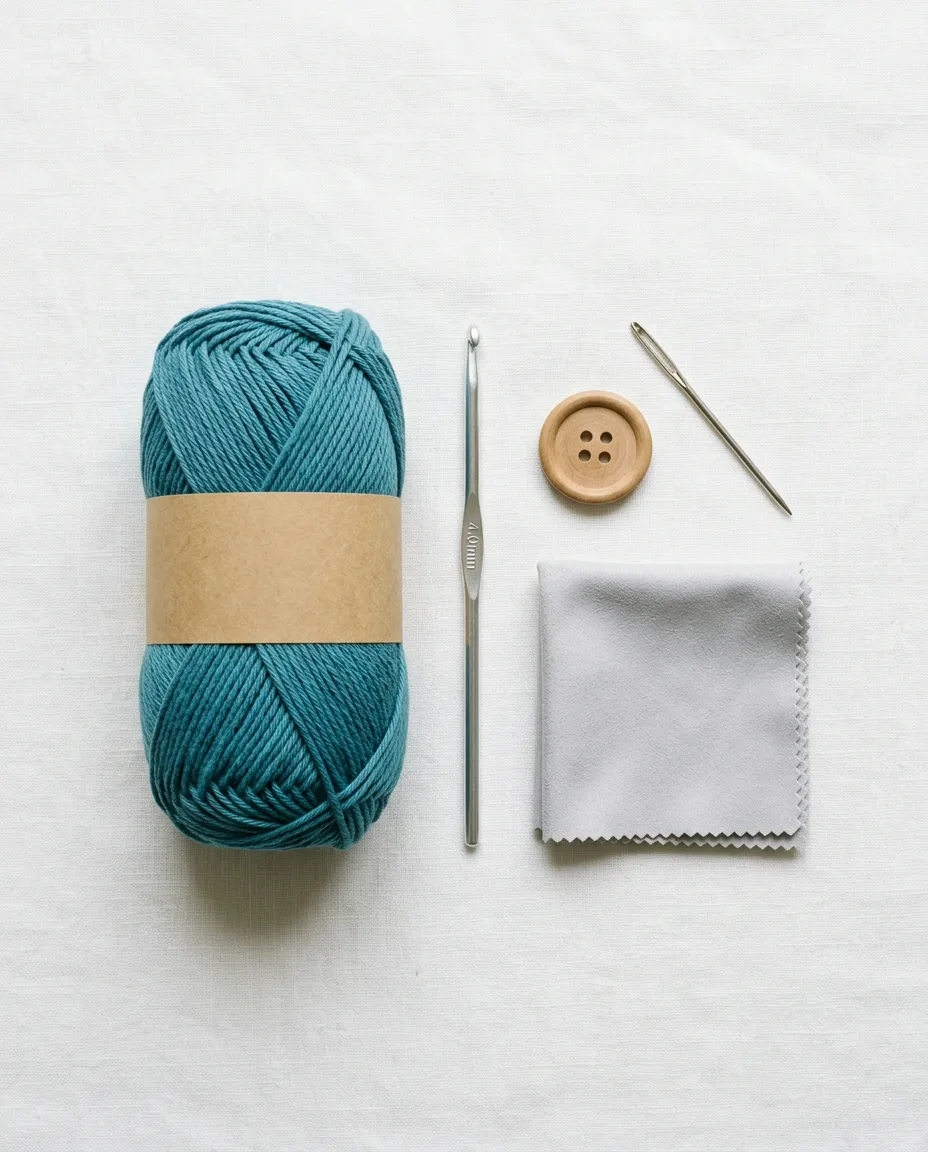
The pattern uses US crochet terms. Cotton is the yarn to pick here. It doesn’t shed fluff onto glass the way some wool and acrylic does.
The whole case, step by step
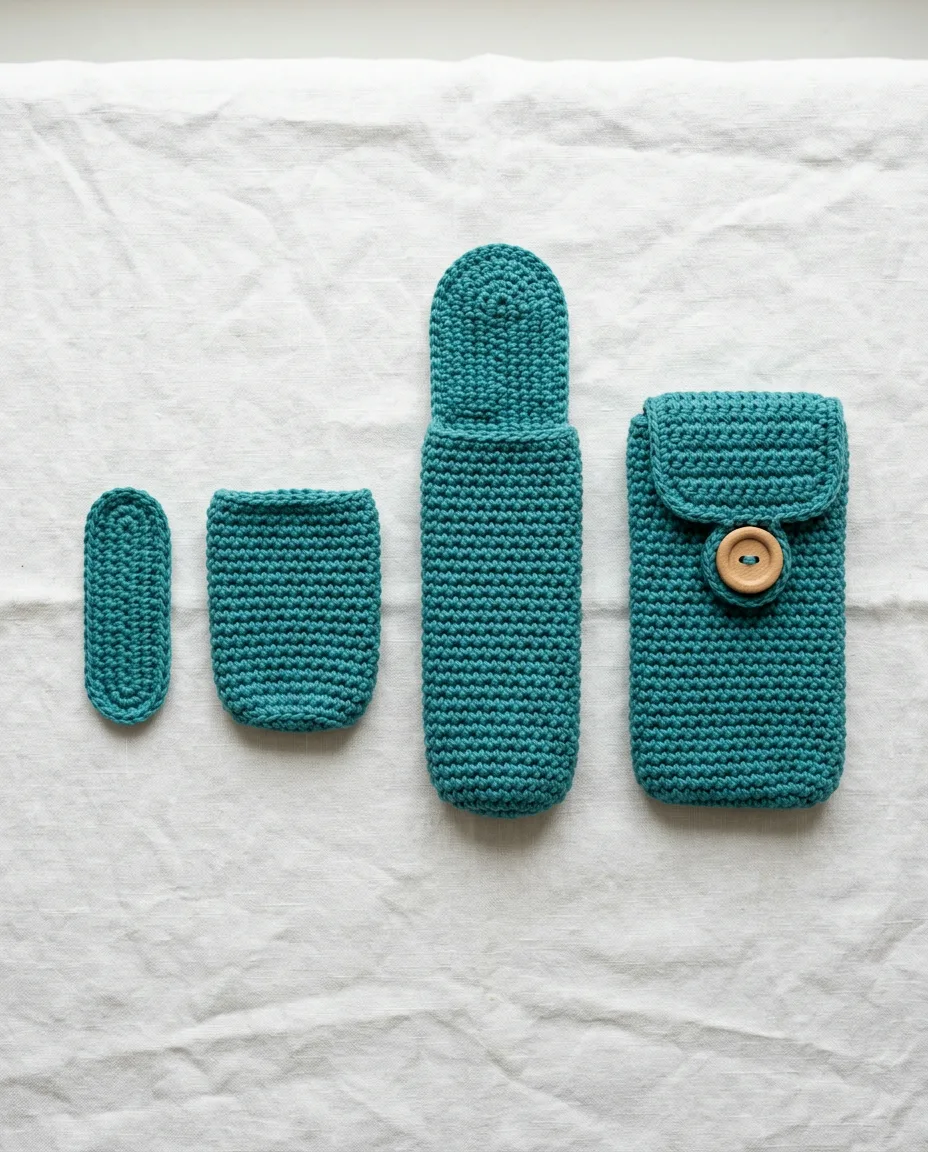
Here’s the route before the details. Every piece grows from one chain, so there’s nothing to sew together at the end except a button and the lining.
 Save
- Make a small test square first. Eighteen stitches should measure 4 inches.
- Chain 16 for the base. Count the chains twice.
- Work the first round along both sides of that chain. You’ll have 32 stitches.
- Keep going around in single crochet. Stop when the tube is 7 inches tall.
- Now the flap. It’s worked back and forth over one side only.
- Sew on the button. Check it against the loop before the last knot.
- Slip in the lining. A few stitches along the top hold it.
Tight stitches keep lenses safe
Most glasses cases fail at the stitches, and the yarn gets the blame. A loose single crochet leaves little holes. Grit gets in. So does the corner of a phone, and that’s how lenses pick up fine scratches inside a case that looks fine from the outside.
So the hook here is small for the yarn. A worsted weight cotton band usually asks for 4.5 or 5 mm, and this case drops to 3.5 mm on purpose. The fabric comes out firm and close, almost like canvas. Your hands will notice. It’s slower going and a little stiff, and that’s the trade.
Before the base, check your gauge, which just means how many stitches and rounds fit into a set measurement. Chain 19 and work 20 rows of single crochet. Single crochet goes like this. Push the hook into the next stitch. Wrap the yarn over the hook from back to front (crocheters call that wrap a yarn over) and pull a loop through. Two loops sit on the hook. Wrap once more and pull through both. That’s one stitch.
Measure the middle of the square. Eighteen stitches should span 4 inches (10 cm), and 20 rows should be 4 inches tall. More than 18? Your case will come out narrow, so go up half a millimeter. Fewer, and go down to 3.25 mm.
Base and body rounds
Chain 16. Then the first round wraps around that chain like a sleeve. You work down one side, turn the corner at the end, and come back along the bottom loops of the same chain. Don’t join at the end of each round. The case grows in a spiral, so put the stitch marker in the first stitch of every round and move it up as you go.
- sc in 2nd ch from hook, sc in next 13 ch, 3 sc in last ch, working along the other side of the ch, sc in next 13 ch, 2 sc in last ch 32 sts
- sc in each st around 32 sts
Counting matters most in Round 1. Thirty-two stitches, with 3 at the far end and 2 back where you started. Got 31? One chain was probably skipped along the second side. Pull it back and redo it. Fixing it later isn’t possible.
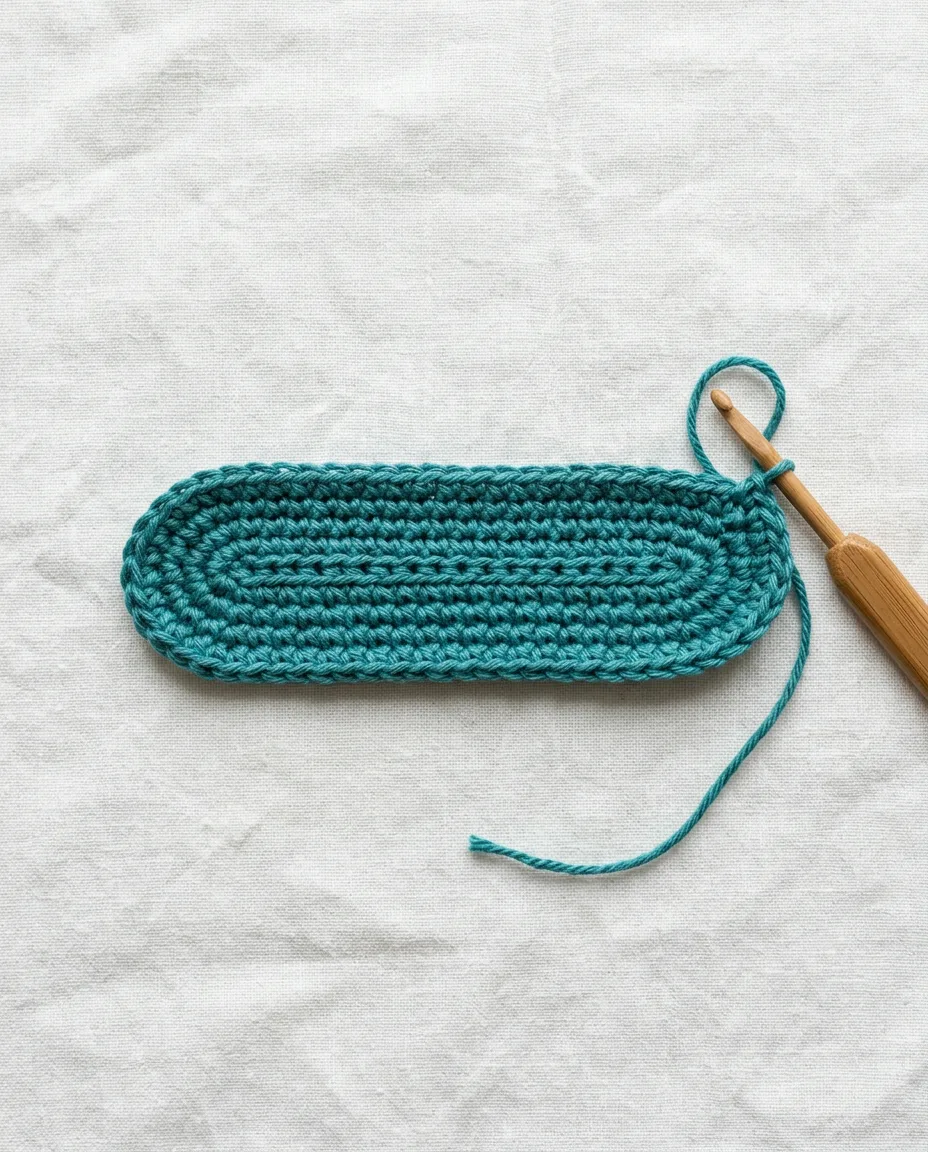 Save
From here it’s Round 2 over and over. Keep working single crochet in each stitch, 32 every round, until the tube measures 7 inches (18 cm) from the base. At the gauge above that’s about 35 rounds in all. Somewhere around the middle the piece stops looking like a strip and starts lying flat as a pouch.
And keep checking it against the glasses you plan to carry. Folded frames up to about 6.5 inches long and 2.75 inches wide slide in with room for the lining. If yours are bigger, jump to the sunglasses section before going further.
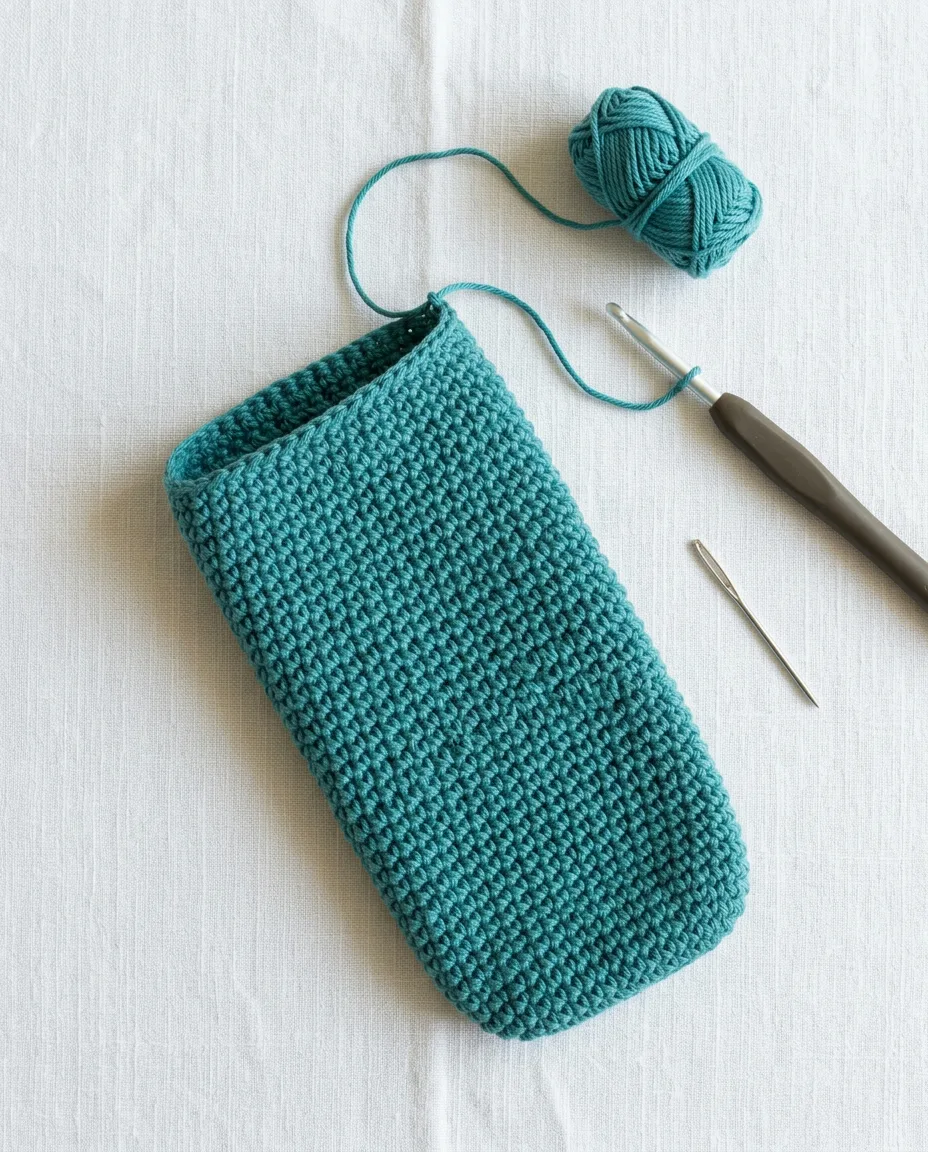 Save
Add a flap with a button loop
Flatten the tube so the base chain runs straight across the bottom. Work single crochet until you reach one folded side edge. The flap starts there and covers the 16 stitches of the back panel.
Rows 5 to 8 use a decrease, a way of turning two stitches into one. Push the hook into the next stitch, wrap the yarn and pull up a loop. Do the same in the stitch after it. Three loops now. Wrap once more and pull through all three. The flap narrows by a stitch at each end, and the tip rounds off.
- ch 1, sc in next 16 sts, turn 16 sts
- ch 1, sc in each st across, turn 16 sts
- ch 1, sc in each st across, turn 16 sts
- ch 1, sc in each st across, turn 16 sts
- ch 1, dec, sc in next 12 sts, dec, turn 14 sts
- ch 1, dec, sc in next 10 sts, dec, turn 12 sts
- ch 1, dec, sc in next 8 sts, dec, turn 10 sts
- ch 1, dec, sc in next 6 sts, dec, turn 8 sts
- ch 1, sc in next 3 sts, ch 8, skip 2 sts, sc in last 3 sts
Fasten off. Weave the ends into the inside of the case, where nobody sees them.
Fold the flap down over the front. Push the button up through the loop and mark the spot with a pin. It usually lands about 1.25 inches below the top edge, centered. Sew it on with doubled yarn through the front panel only. Catch the back panel by mistake and the case is sewn shut, which happens more often than anyone admits.
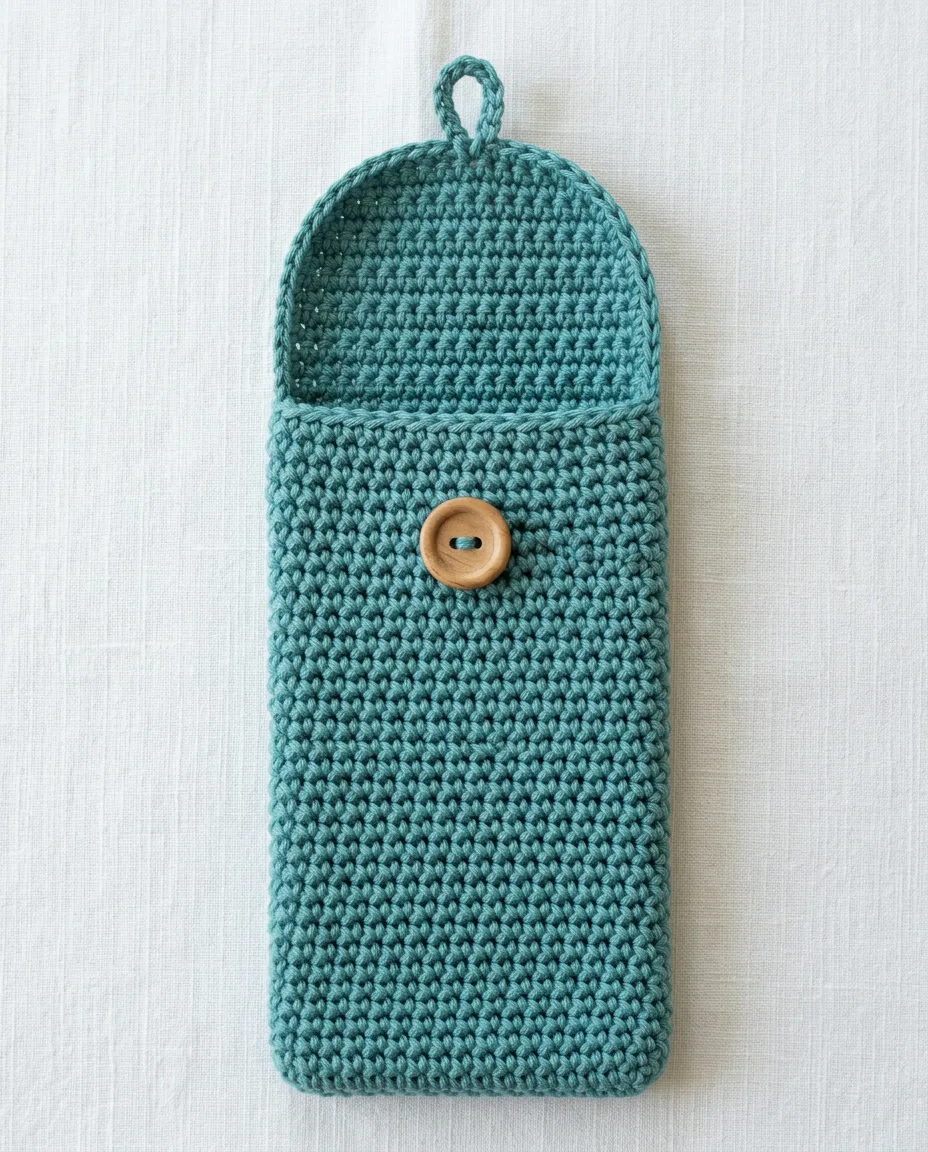 Save
No 3/4 inch button in the drawer? A smaller one works if the loop shrinks to 6 chains. Too loose and the flap pops open in a bag.
A lens cloth makes the best lining
Lining is optional. It’s still the part that does the most for the lenses. Tight cotton is gentle, but a microfiber cloth is softer and it wipes the glass every time the frames slide in or out.
Cut the cloth to 7.5 by 7 inches (19 by 18 cm). Fold it in half the long way, so it’s 3.75 inches wide. Sew the bottom and the open side with a quarter-inch seam. That gives a pocket just a hair smaller than the case. Push it in with the seams facing the crochet. Then turn the top edge of the cloth under and sew it to the last round with small stitches.
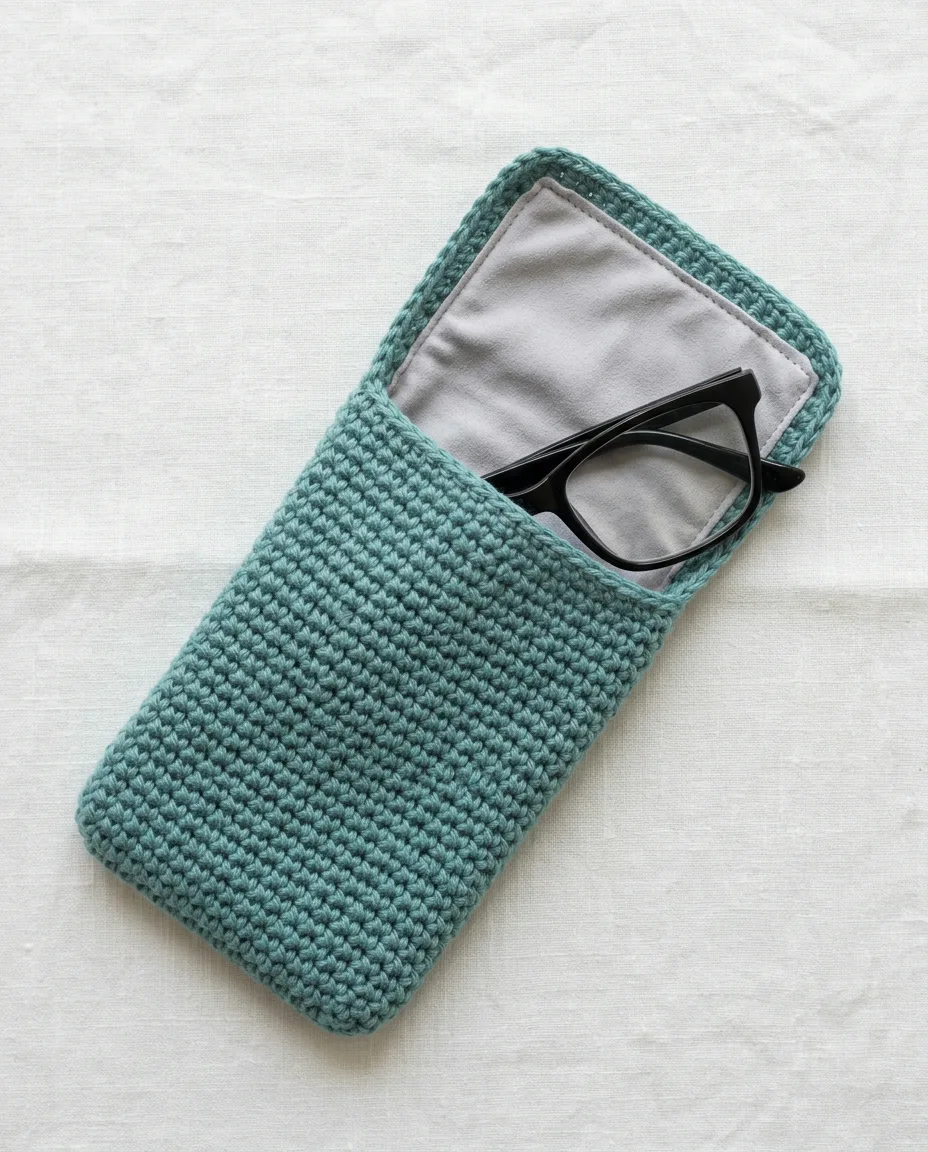 Save
Don’t use felt from a craft store. It pills fast and leaves bits on the lenses. Thin cotton fabric is a fair second choice if no lens cloth is around.
Bigger frames need a wider case
Sunglasses with wide lenses won’t fit the standard size. The fix happens in the first chain. Chain 18 and work Round 1 the same way, with 15 single crochets down each side. That gives 36 stitches and a case about 4 inches (10 cm) wide.
Work it to 7.5 inches tall. The flap grows to match. Work 18 stitches across for four rows, then four decrease rows down to 10. The loop row gets 4 stitches on each side of the 8-chain loop. Plan on roughly 120 yards for this size.
 Save
Going narrower works too. Reading glasses that fold small fit a case started on 14 chains, which gives 28 stitches around.
If the case fits badly
Too tight is the usual problem. If the glasses jam halfway in, the gauge drifted as the rounds piled up, which is common once a project feels routine. Measure the width again at the top. If it’s under 3.5 inches, the honest fix is to pull back and work the upper half with a 3.75 mm hook.
Too loose shows up differently. The glasses slide around and the sides gape. Lining helps here, since it takes up a little room. A very baggy case needs restarting on 14 chains.
The flap can curl up at the tip. That’s cotton, mostly. Wet it, pin it flat over a folded towel and leave it overnight. It dries straight and stays that way.
 Save
One piece, start to finish, with the only sewing at the very end. Cotton holds up to the wash on a gentle cycle. Take the lining out first.