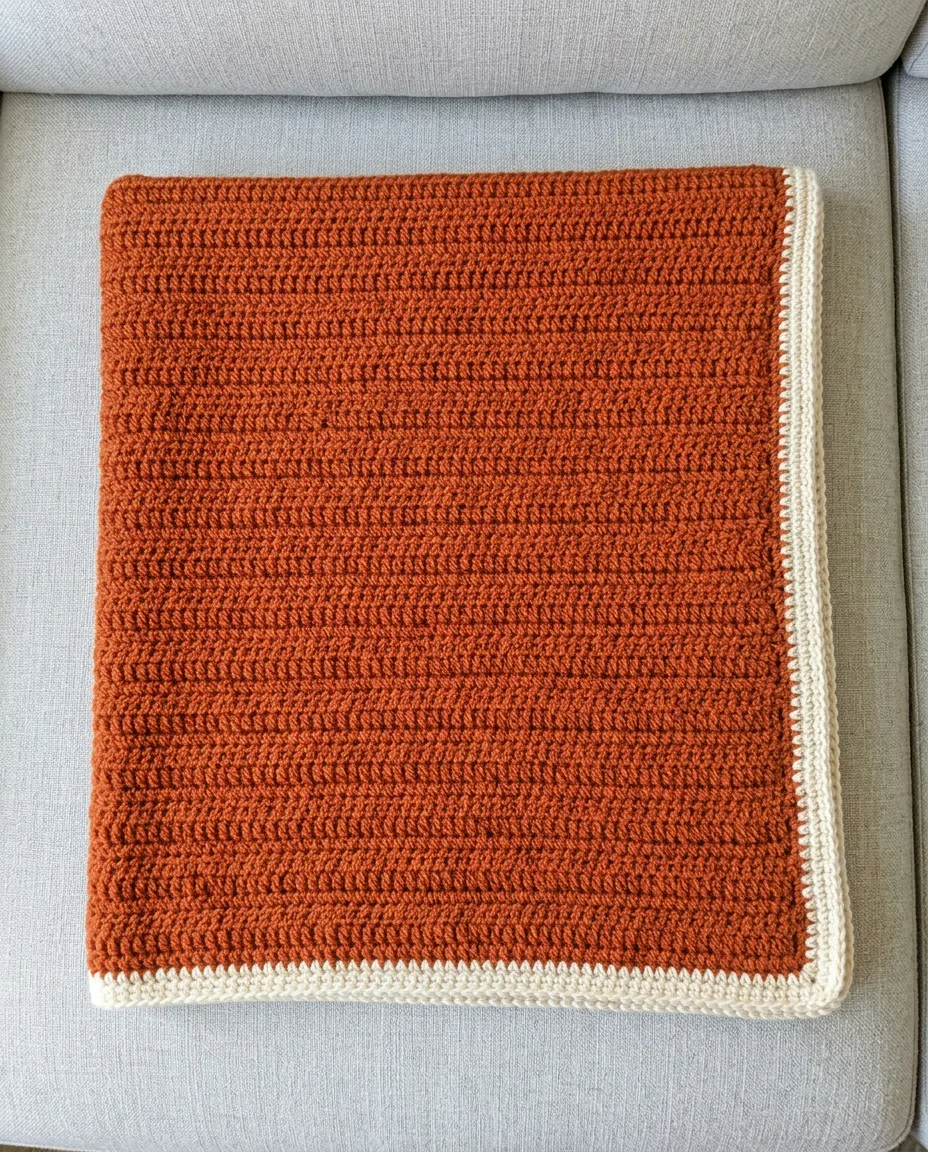
You want a throw sized to your own couch, and most blanket patterns are written for somebody else’s. This one works the other way round. You make one small square, measure it, and the numbers for any size come out of that square. Big? Yes. A 50 by 60 inch throw takes weeks of evenings. But nothing in it is hard once the first row is done.
Every row is half double crochet, worked back and forth in plain rows. No pattern repeat has to fit, so a throw can be 108 stitches wide or 151 and look the same. The yarn is worsted weight, which is the medium thickness most acrylic on a craft store shelf comes in. All the terms here are US crochet terms.
Start with a swatch the size of your hand
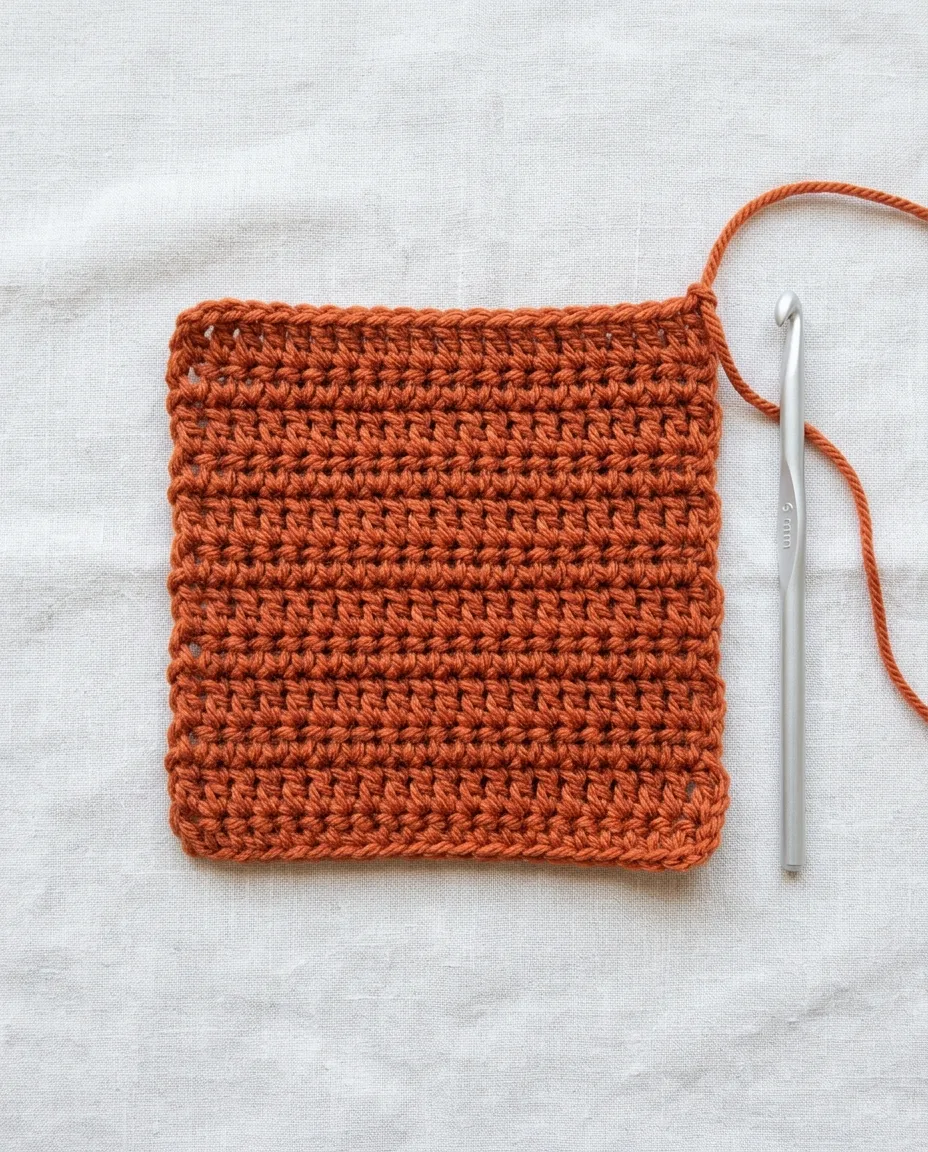
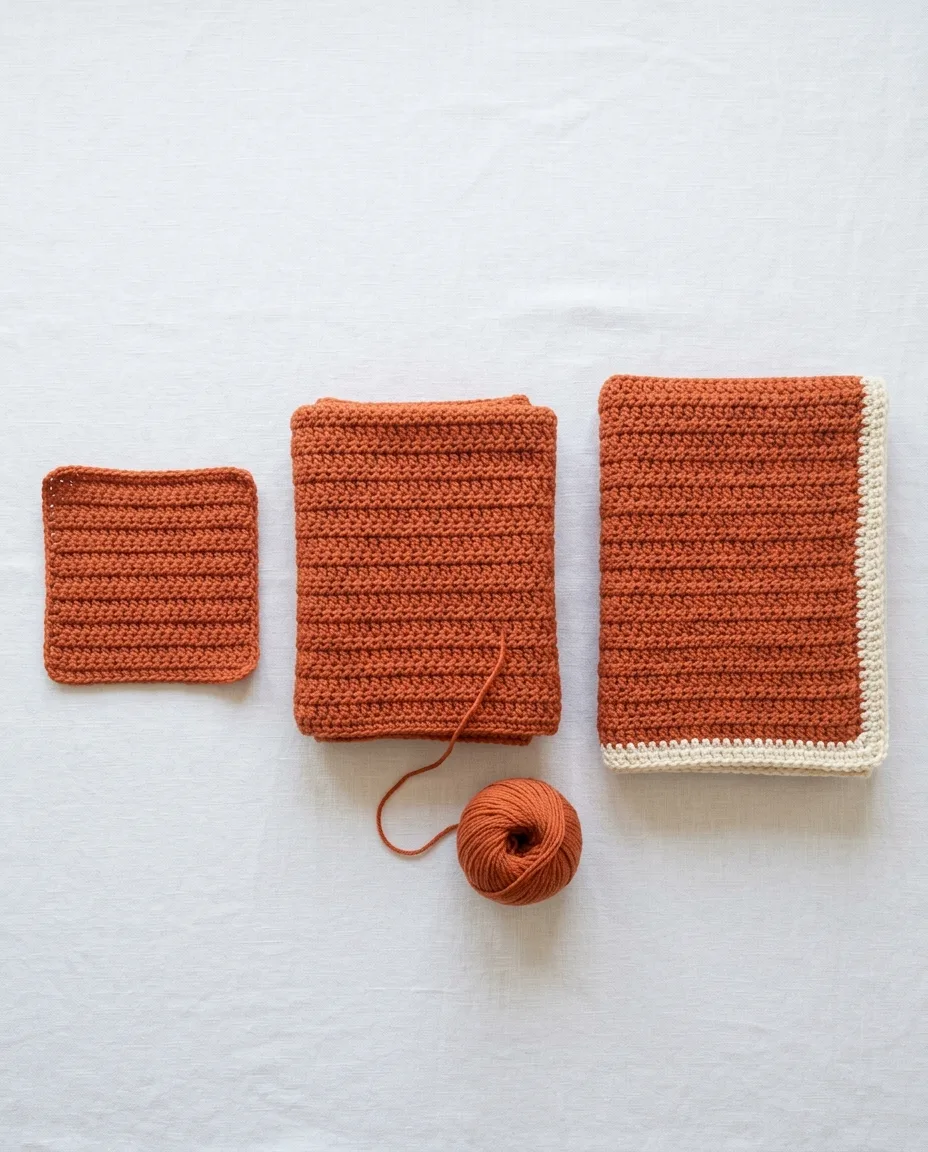
Everything that follows hangs on a swatch, a small test square. Skip it and the throw can come out a foot narrower than planned. Your gauge is how many stitches and rows fit into 4 inches, and two people with the same hook rarely match. The swatch tells you yours.
- Chain 17 with the 6 mm hook. Keep the chains loose.
- Wrap the yarn over the hook from back to front. That’s a yarn over.
- Push the hook into the third chain from the hook.
- Yarn over again and pull a loop back through the chain. Three loops on the hook now.
- Yarn over once more. Pull it through all three loops.
- That’s one half double crochet. Work one into every chain to the end. Fifteen stitches.
- Chain 2 and turn the piece over. Those 2 chains don’t count as a stitch.
- Work a half double crochet under both top loops of each stitch below. Keep going until it’s about square.
- Wash it the way you’ll wash the throw. Dry it flat.
Measure the dry swatch flat on a table. Count the stitches across 4 inches, then the rows down 4 inches. This pattern is written around 12 stitches and 9 rows. Got 13 stitches? Your stitches run small, so go up to the 6.5 mm hook or use your own count in the next section. Got 11? Drop half a millimeter.
 Save
Work out the size you want
Sit on the couch first. Drape a bath towel over your knees to see what length feels right. A common couch throw is 50 by 60 inches, long enough to tuck your feet under.
| Size | Finished size | Starting chain | Stitches per row | Rows |
|---|---|---|---|---|
| Lap throw | 36 x 48 in (91 x 122 cm) | 110 | 108 | 108 |
| Couch throw | 50 x 60 in (127 x 152 cm) | 152 | 150 | 135 |
| Large throw | 60 x 72 in (152 x 183 cm) | 182 | 180 | 162 |
Those numbers assume 12 stitches and 9 rows in 4 inches. For a size not on the table, multiply the width in inches by 3 for the stitches. Multiply the length by 2.25 for the rows. Then add 2 to the stitch count for the chain. Did your swatch give a different number? Use your own stitches per inch in place of the 3.
Don’t count the border in any of this. It adds about three quarters of an inch on every side, and nobody minds a throw that grew an inch and a half.
Yarn is the other number, and the scale beats any guess. Weigh the swatch on a kitchen scale. A 5 inch square covers 25 square inches, and the 50 by 60 throw covers 3,000. That’s 120 swatches’ worth of weight. Add a tenth on top for the joins and the odd row you rip out.
Crochet the body in plain rows
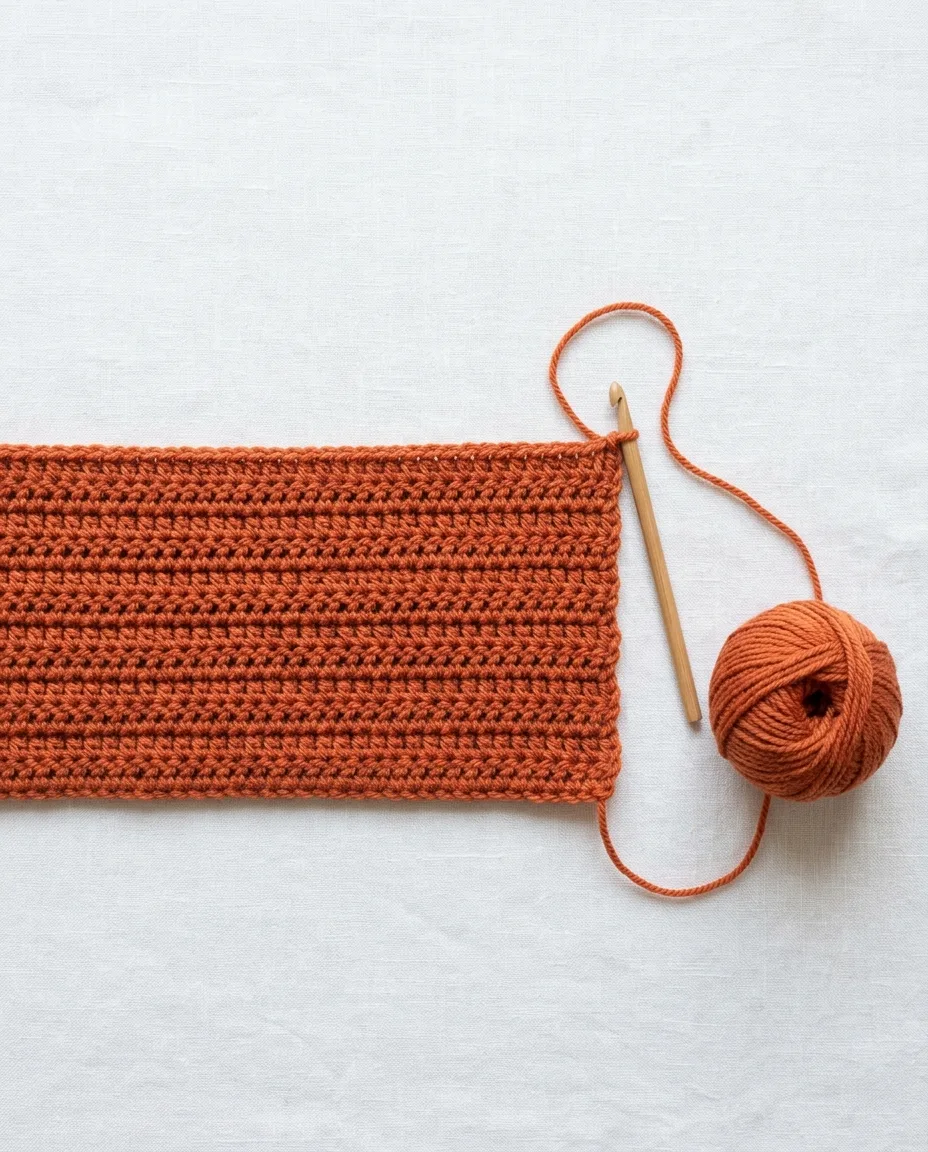
Here’s the 50 by 60 inch throw. For another size, swap in the chain and row counts from the table.
- With the 6.5 mm hook, ch 152; switch to the 6 mm hook, hdc in 3rd ch from hook and in each ch across 150 sts
- Ch 2 (does not count as a st), turn, hdc in each st across 150 sts
- Rep Row 2 until the piece measures 60 in from the chain, about 135 rows in all 150 sts
152 chains make Row 1 the slow one. A chain of 152 twists if you let it, so keep the bumps on the back facing the same way. Lost count? Clip a stitch marker into every 25th chain. Six markers and two spare chains, and you’ll know it’s right.
Using a bigger hook for the chain matters more than it looks. Chains worked on the same hook as the rows come out tight. Then the bottom edge pulls in like a drawstring while everything above it flares.
 Save
Count Row 2 once, all the way across. You should get 150. One short usually means the last stitch got skipped. It hides beside the turning chain, which is the 2 chains you made to start the row. Find the top of the last half double crochet below and work into it.
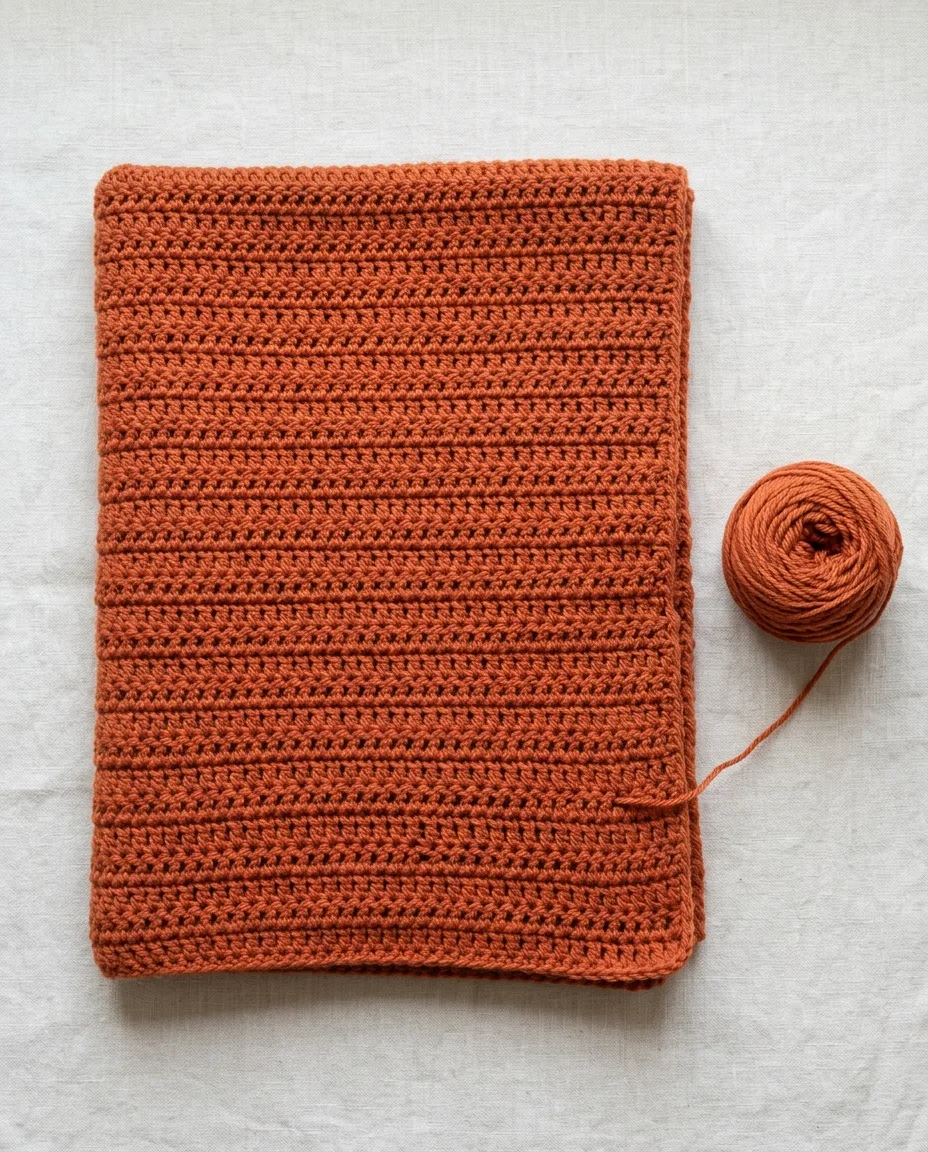
After that it’s rows. Lots of them. Put a marker in the first stitch of every tenth row, and you can count without unfolding the whole thing. Measure the length every 20 rows or so on a flat surface. A heavy blanket stretches when it hangs off your lap, and a hanging measurement reads long.
And you’ll join a lot of new balls. Join as a row finishes whenever you can, with a 6 inch tail on each yarn. The border hides those ends later.
 Save
Add a border that squares the edges
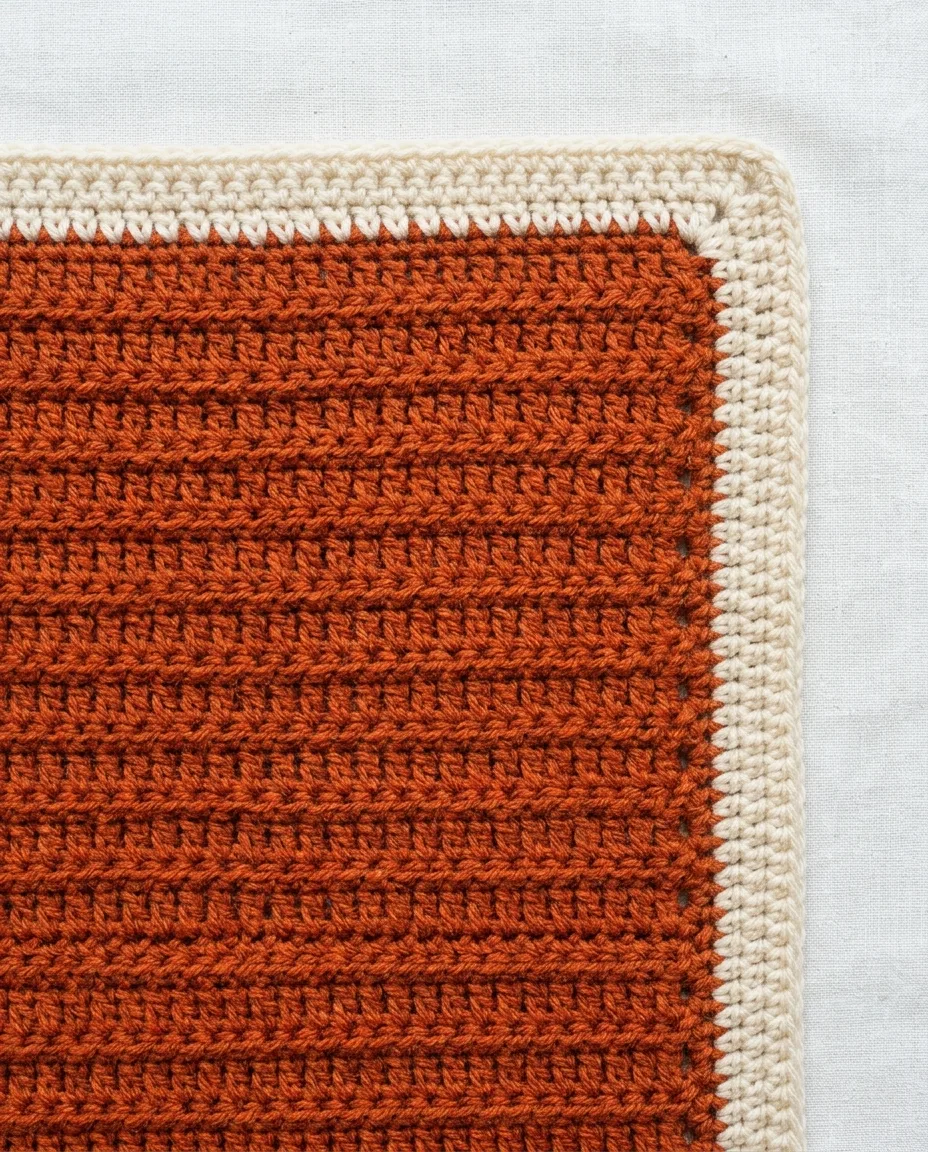
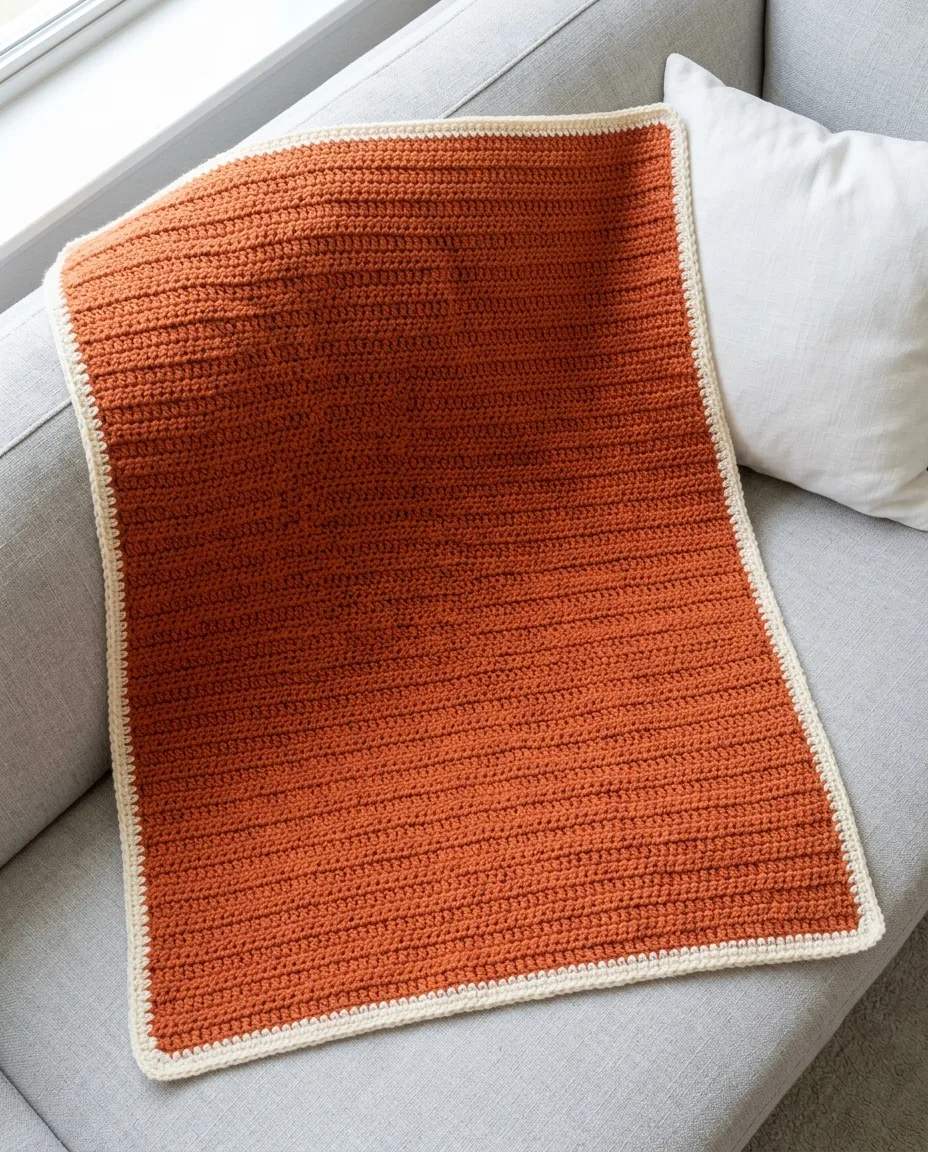
No edge stays perfectly straight over 135 rows. Turning chains are looser than stitches, so the sides wobble a little. Three rounds of single crochet pull it back into line. For each single crochet, push the hook in and pull up a loop, then yarn over and pull through both loops on the hook. Cream makes a clean frame. Same terracotta works too, if you’d rather the edge disappear.
Long sides are the tricky part. There are no stitches there, just row ends. Work 4 single crochets for every 3 rows, with the hook under the outer post of the end stitch. On the 50 by 60 throw that comes to 180 along each side. The lap throw takes 144 and the large one takes 216.
- Join cream with a sl st in the first st of the last row, ch 1, 3 sc in same st, sc in next 148 sts, 3 sc in last st, 180 sc evenly along the side, 3 sc in corner, sc in next 148 sts, 3 sc in corner, 180 sc evenly along the side, sl st to first sc 668 sts
- Ch 1, sc in each st around, working 3 sc in the center sc of each corner, sl st to first sc 676 sts
- Ch 1, sc in each st around, working 3 sc in the center sc of each corner, sl st to first sc 684 sts
Lay it flat after Border 1. A side that ruffles has too many stitches along it. Pull back a stretch and work 3 for every 3 rows in a few spots. A side that pulls in and cups needs more. Fix it now, because every later round copies whatever Border 1 did.
 Save
Fasten off. Weave every end in for about 2 inches, then turn and go back over half an inch. Acrylic ends work loose in the wash otherwise.
If the throw starts to slant or ripple
Slanting sides mean the stitch count is drifting. Count a row. A row of 151 got an extra stitch worked into the turning chain. A row of 149 skipped the last stitch. Pull the rows back to where the count went wrong. Annoying, sure. But a fix row with a hidden extra stitch leaves a bump you’ll see on the couch every day.
Rippling across the bottom is a chain problem. If you chained on the 6 mm hook, the bottom edge is tighter than the rows above it. Blocking, which means wetting the throw and pinning it flat to dry, eases it a little but won’t fully fix it. On the next throw, chain with the bigger hook.
Width shrinking over the length? Tension tightens as you get comfortable. Check the gauge against the swatch every 30 rows. Up to 13 stitches in 4 inches means a looser grip, or the 6.5 mm hook for the rest of the throw.
Change the colors or the yarn
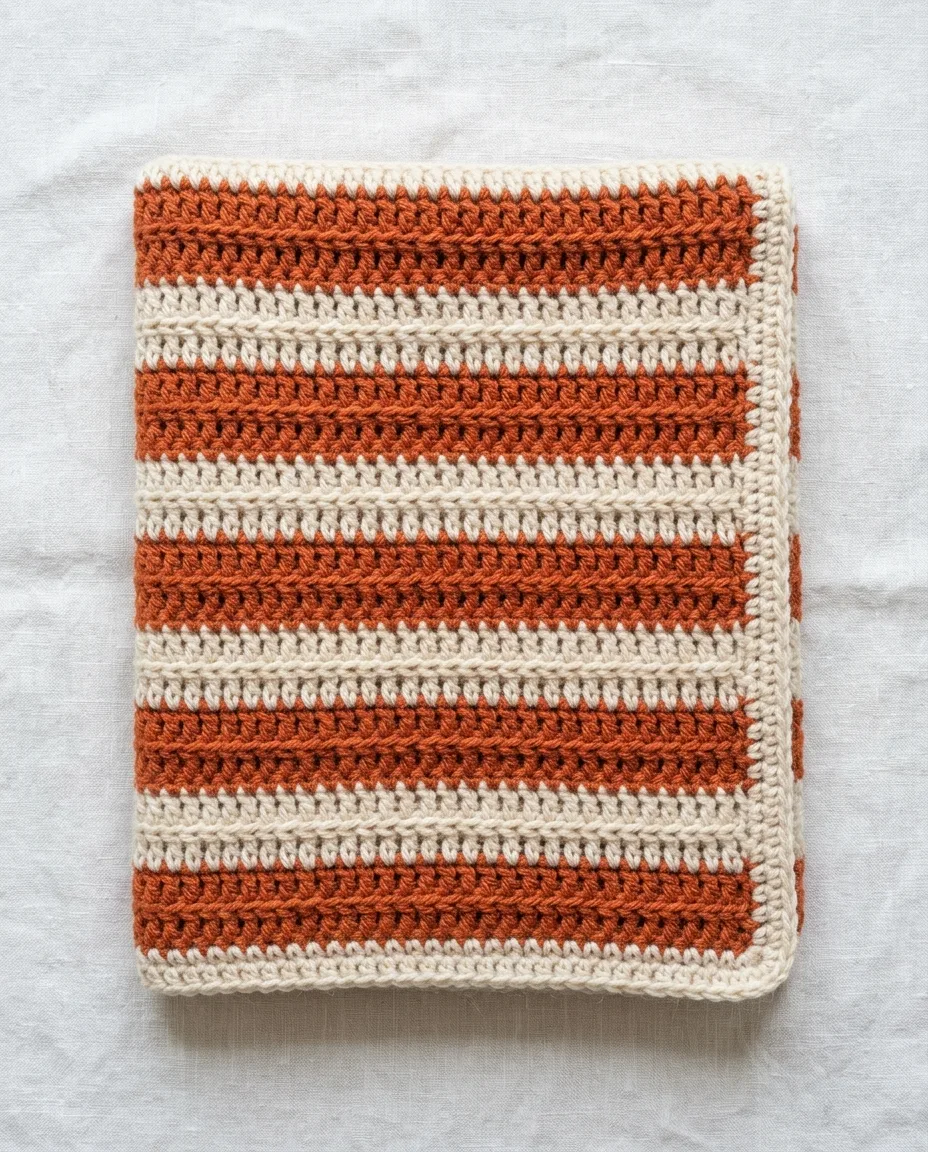
Stripes take the least planning. Pick a stripe height in rows, say 8, and swap colors only where a row ends. With half double crochet the swap happens mid-stitch. Work the last stitch of the row until three loops sit on the hook. Now pull the new color through all three. Clean line, no blip of the old color on the new row.
Stripes of 4 rows or fewer let you carry the unused color up the side. Anything taller, cut it and leave a tail. Carried yarn makes a slightly thick edge, which the border covers anyway.
 Save
Not every change keeps the numbers. Bulky yarn on a 9 mm hook gives roughly 8 stitches in 4 inches, so make a new swatch and redo the table. Don’t guess at it.
Texture needs no new stitch. Want ridges? Work every third row into the back loop only, which means the hook goes under just the top strand farther from you. A raised line forms on the front. The count stays at 150, and nothing in the table changes.
Washing and storing it
 Save
Acrylic shrugs off the washing machine on a gentle cycle. Dry it flat or on low heat. Cotton blends get heavy when wet, so let the drum drain fully before lifting the throw out. Never hang a wet throw over a rail. The weight stretches it lengthwise for good.
Fold it in thirds to store it, and keep it out of strong sun. Warm dyes like terracotta fade faster on a sunny couch than most people expect, so a corner away from the window helps.
 Save